BF Original
The Window Across the Court
Your new apartment has no air, so you stand at the open window in the dark for the breeze - and that is when you notice the lit window straight across the courtyard, and the person in it who moves like they think they are alone. Soon you are not sure who is watching whom. A game of watching and being watched plays out across the dark well between two buildings, button by button, palm to cold glass, each of you protected by the distance and undone by it - until one of you crosses the court and presses a buzzer instead of a hand. A charged, playful, consenting story about the thrill of being seen, where the wanting has nowhere to go but up.
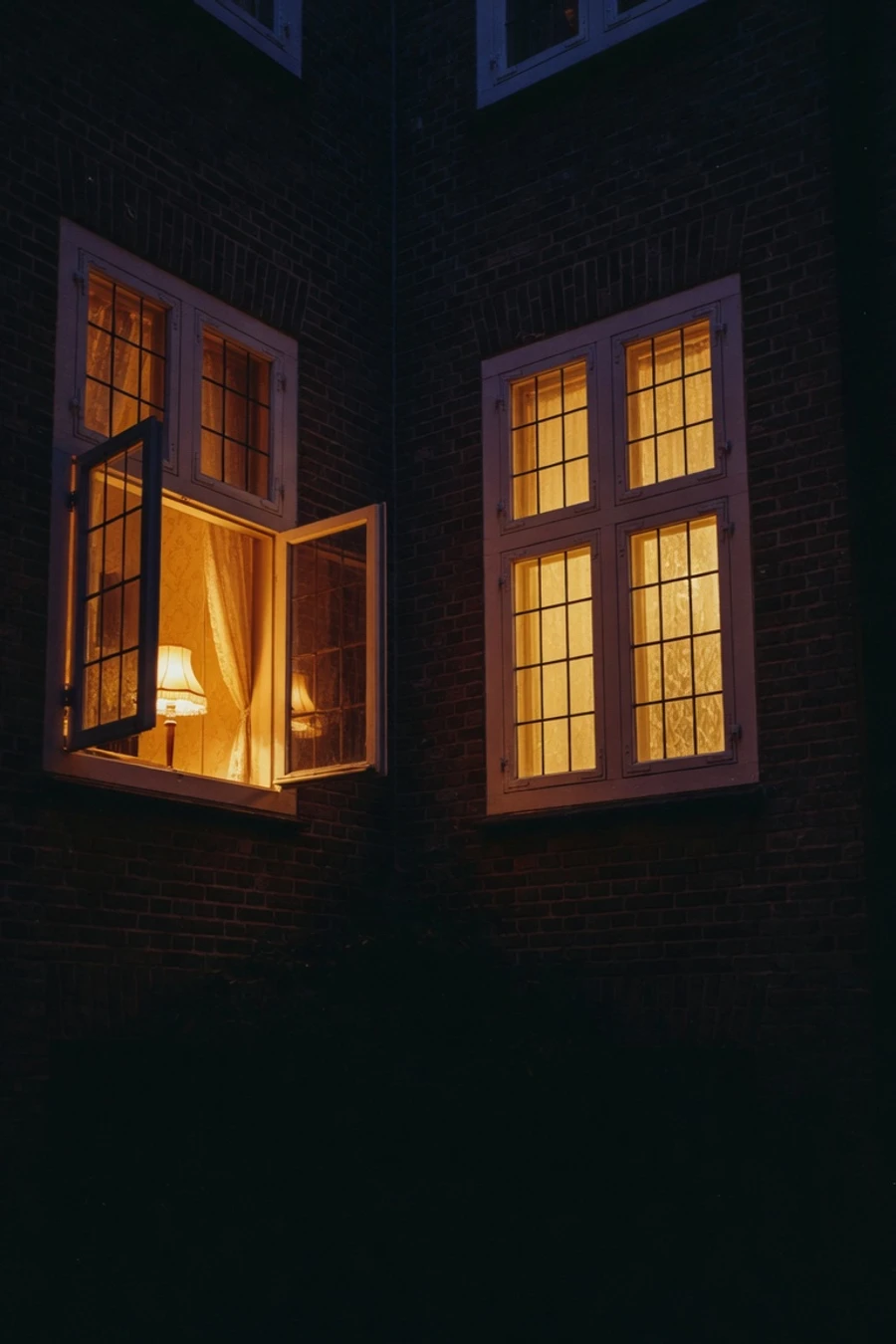
Chapter 1: The Lit Window
You move into the apartment on the fourth floor in the last week of August, when the city is still holding the day's heat in its bricks long after dark, and the first thing you learn about the place is that it has no air. The windows face an interior courtyard, a deep brick shaft six floors high, and to get any breath of moving air at all you have to throw the casement wide and stand in front of it in the dark with the lights off, because with the lights on you can see nothing but your own pale reflection floating over the well.
So you stand there in the dark, the first night, in a thin shirt and nothing else, and you let the cooler air find the backs of your knees, and that is when you notice that the window directly across the court is lit.
It is not a near window. The court is wide. But it is straight across from yours, the geometry exact, like two eyes in a face, and behind the glass a lamp is on, warm and low, and there is a person in the room. You cannot see much - a shape, a movement, the suggestion of someone undressing at the end of a long day, the casual unselfconscious motions of a person who believes themselves entirely alone. An arm raised to pull a shirt over the head. The line of a back. The lamp clicks off before you have decided whether you are the kind of person who watches.
You stand at your own dark window a while longer, your heart going faster than the heat can account for, and you tell yourself you were only getting air.
Chapter 2: The Rules of the Court
It becomes a thing you do not name.
Most nights the window across the court is lit and most nights, around the same hour, you find yourself at your own casement in the dark with the lights off, ostensibly for the air. You have learned a little. The person across the way lives alone, keeps late hours, moves through the room with the loose ease of someone who has never once considered that the deep brick well between the buildings is not a wall but a lens. You have learned that they read in a chair by the lamp. That they sleep with the window open, like you, for the air. That when they undress they do it slowly, without hurry, the way you do a thing you have done ten thousand times and stopped thinking about.
You are very careful, those first weeks, to keep your own lights off. You are the watcher. The dark is your cover. There is a whole charged architecture of one-sidedness to it, a safety, and you are aware of exactly how thin the safety is and you do not examine why the thinness is the part you like.
And then one night you forget, or you do not forget, you will argue both sides of it to yourself for days afterward, and you cross your own dark room toward the window and you reach up to undo the top button of your shirt before you have reached the safety of the unlit air, while the lamp behind you is still on, while you are still, for a moment, lit.
Across the court, the figure in the warm window goes still.
Not the still of someone who has not noticed. The other still. The still of someone who has looked up and understood, all at once, the geometry of the two windows and the fact that the dark across the way has had eyes in it for weeks, and that the eyes belong to the person now standing in their own lamplight with a hand at the top button of a shirt.
You should turn the light off. You should step back into the dark and let it close over the moment like water.
You leave the light on. You undo the button.
Chapter 3: Lit On Purpose
After that, everything changes, and nothing is said, because the whole point is that nothing is said.
The next night your lamp is on, and you stand at the window where they can see you, and you wait. For a long time the window across the court stays dark, and you feel the foolishness of it crawl up your neck, and you have nearly decided you imagined the whole charged understanding when the warm lamp clicks on, across the well, and the figure crosses to their own casement and stands in it, lit, facing you, the way you are facing them. An offer answered. A dare met. Two lit windows in a dark shaft, and the wide safe distance of the court between, and neither of you so much as lifts a hand to wave, because a wave would make it small, would make it neighbors, and this is not neighbors.
You undo a button. Across the court, after a moment, so do they.
It goes like that, slow, over nights, each of you reading the other's pace the way you would read a held breath, neither one rushing, both of you protected by the distance and undone by it in the same instant. You learn the shape of them in the warm light the way you learned the dark geography of your own room: not all at once, but by returning, nightly, until your eyes know where everything is. A shoulder coming bare. The lamp catching the side of a throat, the dip of a collarbone, the soft places a person only shows the dark. They watch you back, and being watched, you discover, is a different animal entirely than watching - the heat of it climbs your spine, the knowledge of the eyes on your skin makes the skin itself feel new, every motion you make slowed and weighted by the fact that it is being seen and wanted from across the dark.
You are both, by now, entirely undressed in your separate lit frames, the width of the court between you, close enough to want and too far to touch. You stand at the casement with the night air moving over all of you and the eyes of a stranger on all of you, and the wanting in your body has nowhere to go, no release, only the held charge of being seen, building and building with no way down.
And then, across the court, the figure in the warm window lifts one hand and presses it flat to the glass. And waits. And you understand it is not a goodnight. It is a question. It is the most a question has ever sounded, across a dark courtyard, with no words in it at all.
You lift your own hand and press it to your own cold glass, palm to palm across the impossible distance, the two of you lit and naked and wanting in your separate frames with the whole black well between, and you hold it there, your hand against the glass, and the held breath of the court goes on and on and does not break.
The rest of the story
Finish The Window Across the Court.
Sign up free, then $2.99 opens the closing chapters.
No payment to start.
Private and discreet.