BF Original
When He Was No One
Before the world wanted him, before the sold-out tours and the fancams and the ice-prince face the cameras worship, Seo Seol was a nobody trainee who couldn't afford the cheapest cup of ramyeon - and you were the girl behind the counter who didn't keep score. Two years of dead-hour visits, a goshiwon floor and a strip of grey sky, a practice room of mirrors, and one night before he signed the contract that made dating a fireable offense. This is the first love the machine made him cut the moment he became valuable, and the goodbye that built the vault behind his eyes. Meet SEOL in the present-day flagship "Off Camera" - this is how he got so cold, and why letting anyone in again terrifies him. Aching, tender, and intense where it counts.
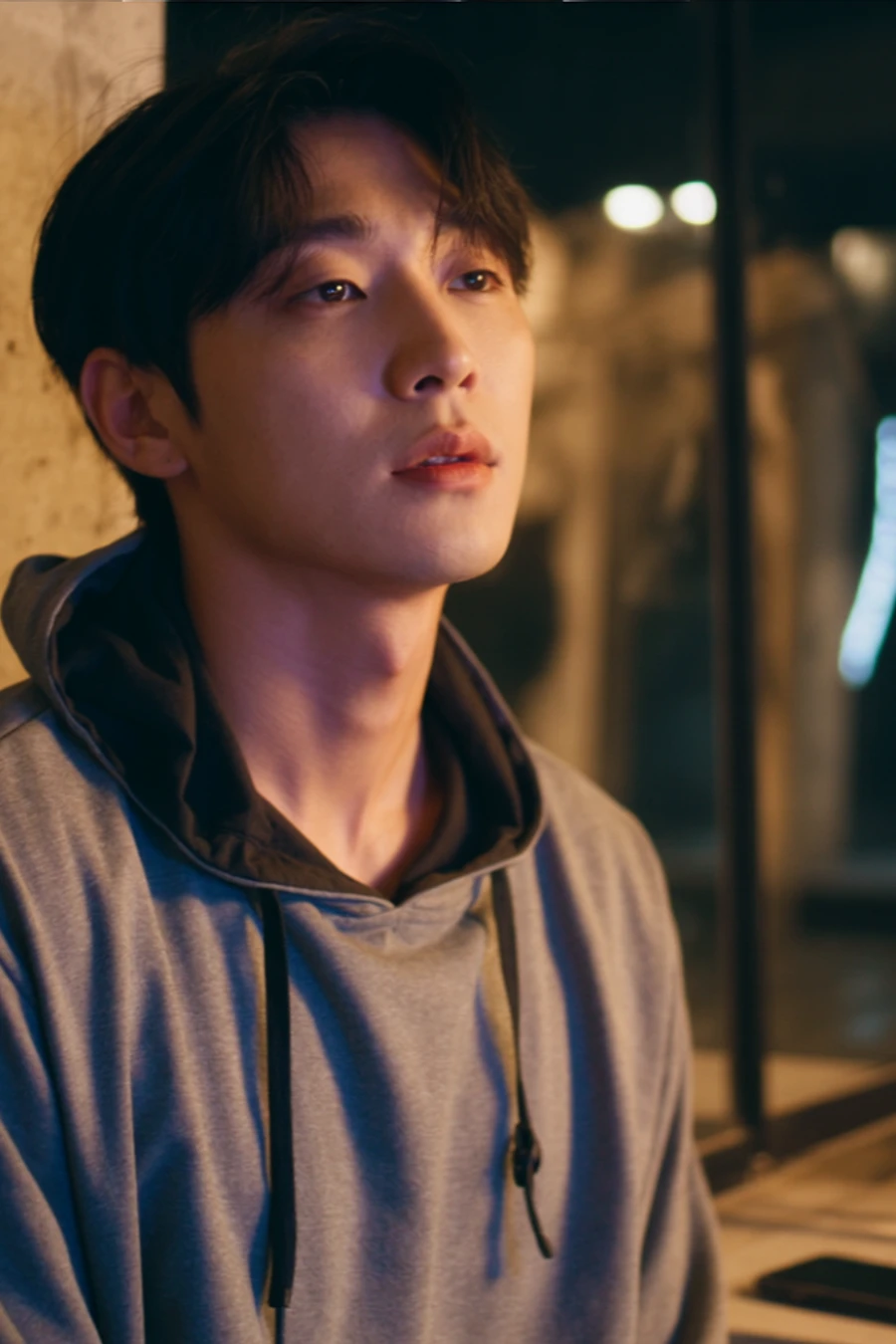
Chapter 1: The Counter at Two in the Morning
The training building had a name and a logo and a glass front so clean it gave back the whole street, and the boys who came out of it at night had none of those things yet. They had hoodies pulled up and bags too heavy for their shoulders and the particular walk of people whose legs have been used badly for sixteen hours, and they came down the alley to your counter because yours was the only light left on, and because the convenience store on the corner had cameras and a manager who watched the trainees the way you watch coins you have already counted twice.
You worked the late shift at a place that was barely a place. A counter, a hot-water tap, a rack of cup ramyeon, a stool by the window, a till that ate every fourth thousand-won note and had to be coaxed. It belonged to your aunt, who slept upstairs, and it stayed open until two because the rent did not care what hour the customers came. The trainees were most of your customers after midnight. You learned them the way you learn weather. Which ones tipped, which ones cried in the corner over their phones, which ones came in laughing and went out silent because someone upstairs had told them a number.
He came in at the worst hour, the dead hour, the one that is not quite night and not yet morning, and he did not pull his hood down, and he did not look at you, and he asked for the cheapest thing on the rack in a voice scraped flat by overuse.
"That one's the cheapest." You pointed. "It's also the worst."
He looked at the rack. He looked at you. There was a long beat where you watched him decide whether he had the energy to be a person, and then, just barely, he did. "What's the best one I can't afford."
"None of them are good." You took down the cheap one anyway and filled it from the hot tap and set it on the counter and did not charge him for the egg you cracked into it, because his hands, when he reached for the cup, were shaking the particular way hands shake after the body has been past its limit for a long time and has stopped sending the polite warnings. "Sit down before you fall down. You're not allowed to die in here. My aunt would kill me."
He sat. He ate the way the very tired eat, mechanically, his eyes half closed, and when he was done he did not get up. He sat at the window with the empty cup and looked at the street giving back the dead-hour light, and you let him, because the till was counted and your shows were watched and there was nobody in the world at that hour but the two of you and a refrigerator that hummed.
"You don't know who I am," he said, eventually. Not proud. Almost hopeful.
"You're the kid who can't afford ramyeon," you said. "Should I?"
Something happened in his face that you would spend a long time trying to name and would only name much later, when it was far too late to do anything with the name. It was relief. It was the specific relief of a person who has been looked at all day by people deciding what he is worth, walking into the one room on earth where nobody was keeping score.
"No," he said. "God, no. Don't ever."
His name was Seol. He told you that night, at the window, in the dead hour, the way you tell things to a stranger you have decided is safe because you will never see them again. He was wrong about that. He saw you the next night, and the night after, and for two years after that, in the only hour of the day that belonged to neither the company nor the cameras nor the number some man upstairs would decide he was worth. He came to your counter to be no one. And you, who had also been working very hard at being no one, recognized him on sight.
Chapter 2: The Goshiwon
You found out where he lived because the rain found out first.
It came down hard one night in the early summer, the kind of rain that turns the alley into a river, and he came in soaked to the bone and stood dripping by the door because he was too polite to drip on your floor, and you took one look at him and said the place you lived was three doors down and dry, and he could come and not be a drowned animal for twenty minutes before he walked back. He hesitated the way he hesitated about everything that was for him and not for the work. Then he came.
The goshiwon was a building that had given up. A corridor the width of your shoulders, doors every two meters, and behind each door a room the size of a held breath: a bed, a desk, a shelf, a window if you were lucky, which you were not. You shared a kitchen at the end of the hall with eleven strangers and a rice cooker that was communal property and a sign above the sink in three languages asking people to please, please wash their own dishes. Your room had a window. His, it turned out, three doors down, did not. He had been living three doors down from you for four months and you had never known, because his hours and your hours only touched at the counter, in the dead time, by accident of the same poverty.
"This is luxury," he said, sitting on the edge of your bed because there was nowhere else to sit, looking at your window like it was a painting. "You can see the sky."
"I can see a wall," you said. "There's sky above the wall if you lie down and look up."
So he lay down. Right there, on your floor, because there was not room on the bed for the looking and he would not have presumed the bed, and he tipped his head back against the cold linoleum and found the strip of sky above the wall, the thin grey rained-out band of it, and he looked at it the way the starved look at a photograph of food. You lay down next to him because it was your floor and your sky and you were tired too. The rain came down on the window. The eleven strangers slept. Somewhere the rice cooker clicked off.
"I'm going to debut," he said, to the strip of sky. He said it the way you confess a thing you are ashamed of wanting. "There's a show. They're putting some of us on a show. If the show goes the way they want, I debut, and then -" He stopped. The sky above the wall went on being grey. "And then this is over. All of this. The being able to lie on a floor. I won't be allowed to be in a room like this. I won't be allowed to be in a room with -" He stopped again, and this time you both heard the thing he had not said land in the small room and lie there between you on the linoleum, and neither of you picked it up.
"In a room with what," you said, which was cruel, because you knew, and you wanted to hear it, the way the young are cruel with each other when they are about to fall and want to be pushed.
He turned his head on the floor and looked at you instead of the sky. His face was very close. The hood was down. There was no one watching, no camera, no man upstairs with a number, just the rain and the wall and the two of you on the floor of a room the size of a held breath.
"You know what," he said. "Don't make me say it where they can take it."
Nobody could take it. There was no one there. But he had already started learning, four months from a stage he had not stood on yet, that the things you say out loud are the things they can use, and the things you keep are the only things that stay yours. You did not understand that yet. You would. You lay on the floor next to him and looked at the strip of grey sky and let the unsaid thing stay unsaid, and it was, in its way, the most either of you had ever told anyone.
Chapter 3: The Practice Room
The show ate him over that autumn the way the sea eats a coast, a little every day, so slowly you only saw it when you measured against where the line used to be.
He stopped coming at two. He started coming at four, then later, then not at all for a week, then once at five in the morning so gutted he could not hold the cup, and you came around the counter and held it for him, your hands over his, and fed him like a child, and neither of you said anything about it because there was nothing to say that the body had not already said louder. The show had cameras. The show had a number on every boy, ranked, posted, public, a number the whole country could vote on, and the number was the difference between debuting and going home to a town that had already had the send-off party, and so the boys did not sleep, they could not afford to sleep, sleep was a thing for people whose number was safe and no one's number was safe.
One night he sent you a message at three. A practice room number, an address you knew because it was the clean glass building, a back door that would be unlocked, a please that was not like him. You went. You were not supposed to be able to go anywhere near that building, but the dead hour has its own rules and the back door was unlocked the way he said.
The practice room was all mirrors. Four walls of yourself, of him, of the two of you multiplied into a crowd, under lights that did not flatter and were not meant to. He was at the barre against the mirror, in socks, his shirt soaked through, and he had been running the same eight counts of choreography for, he told you, six hours, because the formation was wrong and the camera would catch it wrong and the number would drop, and his body had stopped being able to do the thing his mind could see, and he had reached the place past exhaustion where you either weep or break something, and he had not wanted to do either of those alone in a room full of mirrors.
"Show me," you said. "The eight counts. Slow."
He showed you. It was beautiful even broken, even at the speed of someone moving through water, even with his face grey and his shirt black with sweat. You did not know anything about dance. You knew about him. You watched the mirror-crowd of him do the eight counts and you said, "There. The fifth one. You're listening to the count in your head and you're a half-beat behind it because you don't trust your body anymore, you're making it ask permission. Stop asking. You already know it. Your body knew it four hours ago. It's just waiting for you to shut up and let it."
He looked at you in the mirror. Forty of him looked at you in the mirror. He ran the eight counts again and on the fifth he stopped asking, and his body did the thing it had known for four hours, clean, and the formation was right, and he stood in the center of the multiplied room breathing like a drowning man who has found the floor with his feet, and in the mirror you watched his face do the thing it had done that first night at the counter. Relief. The specific relief of the one room where no one is keeping score.
"How do you do that," he said. To the mirror, to you, to the forty of you. "How do you always see the actual thing. Everyone here is paid to see me and none of them see the actual thing."
"I'm not keeping score," you said. "That's all. It's easy to see someone when you're not adding them up."
He crossed the room. The real him, out of the mirror, the soaked exhausted glorious wreck of him, and he stopped in front of you closer than the eight counts and closer than the floor of the goshiwon, and his chest was still heaving and his eyes were wet at the edges with the particular tears of a body past its limit, and he put his forehead down against yours, just that, his sweat and his heat and his ragged breath, his hands at his sides because he would not presume, he never presumed, and the forty of you in the mirrors did the same, an army of two people not quite touching in a room built to watch.
"After the show," he said, against your forehead. "Whatever the number is. After. I want -" And the same wall came down, the learned wall, the do-not-say-it-where-they-can-take-it, except there was a camera in the corner, there was always a camera in that building, and he felt it the way you feel a draft, and he did not finish, and he stepped back, and the forty of him stepped back, and the want hung in the multiplied air and did not land.
Chapter 4: The Night Before
The show ended in November. He won it. Not won, exactly, but his number, when they read it out on live television in front of the whole country, was high enough, was safe, was the number that meant debut, and you watched it on the cracked phone in the goshiwon kitchen with eleven strangers who did not know that the boy on the screen lay on your floor four months ago and looked at a strip of grey sky, and when his number was read you watched his face on the television do the thing it never did in public. It almost broke. He almost let the country see. And then he did the other thing, the new thing, the thing the show had taught him: he put it away. He smoothed it. He stood up under the lights and became, in front of forty million people, cool and flawless and untouchable, and the cameras loved him for it, and you stood in the goshiwon kitchen and watched the ice come down over the boy from your floor like a window freezing over from the inside, and you understood, before he did, that you had just watched something die so that something else could be born.
He came to the counter that night. The last night. He was not supposed to. He had managers now, a schedule now, a debut in nine days and a contract as thick as a phone book that someone had walked him through line by line, and he came anyway, in the dead hour, with the hood up, and you let him in and locked the door behind him and turned off the front light so the alley would not see.
He did not want ramyeon. He sat on the stool by the window where he had sat the first night, and you sat on the counter, and the refrigerator hummed, and for a while neither of you said anything at all, because the saying was the thing you were both trying not to start.
"There's a clause," he said, finally. To the window. To the street giving back the dead light. "In the contract. I read it tonight. I made them let me read all of it, the whole thing, and there's a clause." His voice was very level. He had been practicing levelness for two years and tonight it was nearly perfect and that was how you knew. "No relationships. For the term. It's standard, they said. Everyone signs it. It protects the group, it protects the brand, it protects -" He stopped. "If it gets out that I'm with someone. Not even with someone. If it gets out that there is someone. The fans, the brand deals, the other six, the company's whole - it ends. Not just for me. For all of them. Six other people who lay on six other floors looking at six other strips of sky. I'd be the one who took it from them. For a person."
You did not say anything. There was nothing to say that the contract had not already said louder.
"So I came to tell you," he said, and now he turned, and the levelness was gone, the practiced ice was gone, and what was under it was the boy from the floor, undefended, nineteen, terrified, holding a thing on his open hands that he had carried for two years and could not, now, ever be allowed to put down where you could take it. "Before I sign it tomorrow. I came to tell you the thing I wouldn't say where they could take it. Because tonight there's no them. Tonight the light's off and the door's locked and there's no camera and no number and no clause yet, the clause is tomorrow, tonight I'm still no one, I'm still just the kid who can't afford ramyeon, and the kid who can't afford ramyeon -"
He stood up. He crossed the small dark room the way he had crossed the room of mirrors, and he stopped in front of you where you sat on the counter, close, closer, the closest he had ever let himself come, his hands rising at last, after two years of hands held rigid at his sides, rising to your face the way a starving man's hands rise to bread, and stopping, trembling, a breath away from your skin, because even now, even with the light off and the door locked, some part of him had already signed the thing he was signing tomorrow.
"Tell me to," he said. His voice was wrecked. "I won't take it. I've never taken anything. You have to tell me to. Because if you don't, I'll walk out of here and sign it and be the ice prince for the rest of my life and never once let anyone see the actual thing, and that's fine, that's the deal, I made the deal - but if you tell me to, then for one night, before they take all of it, I was a person who got to want someone out loud."
The refrigerator hummed. The alley gave back the dead-hour light. His hands trembled a breath from your face, held there by two years of learning to keep the only things that stay yours, and the whole of your held breath, and his, hung in the dark of the locked room on the inhale, on the very edge of the thing, with the contract waiting in the morning and the want at last said out loud and nowhere left for either of you to put it but down.
The rest of the story
Finish When He Was No One.
Sign up free, then $2.99 opens the closing chapters.
No payment to start.
Private and discreet.