BF Original
The Winter Tenant
Marit inherits her grandmother's house at the very top of the world, a town where the road ends and the land gives way to iron water and the dark lasts for weeks. The quiet man who tends the coach-house has been the tenant there longer than anyone alive remembers, and he is something far older than any man, and he is the only thing in her life that has never once frightened her. The danger, when it comes for her, wears a human face.
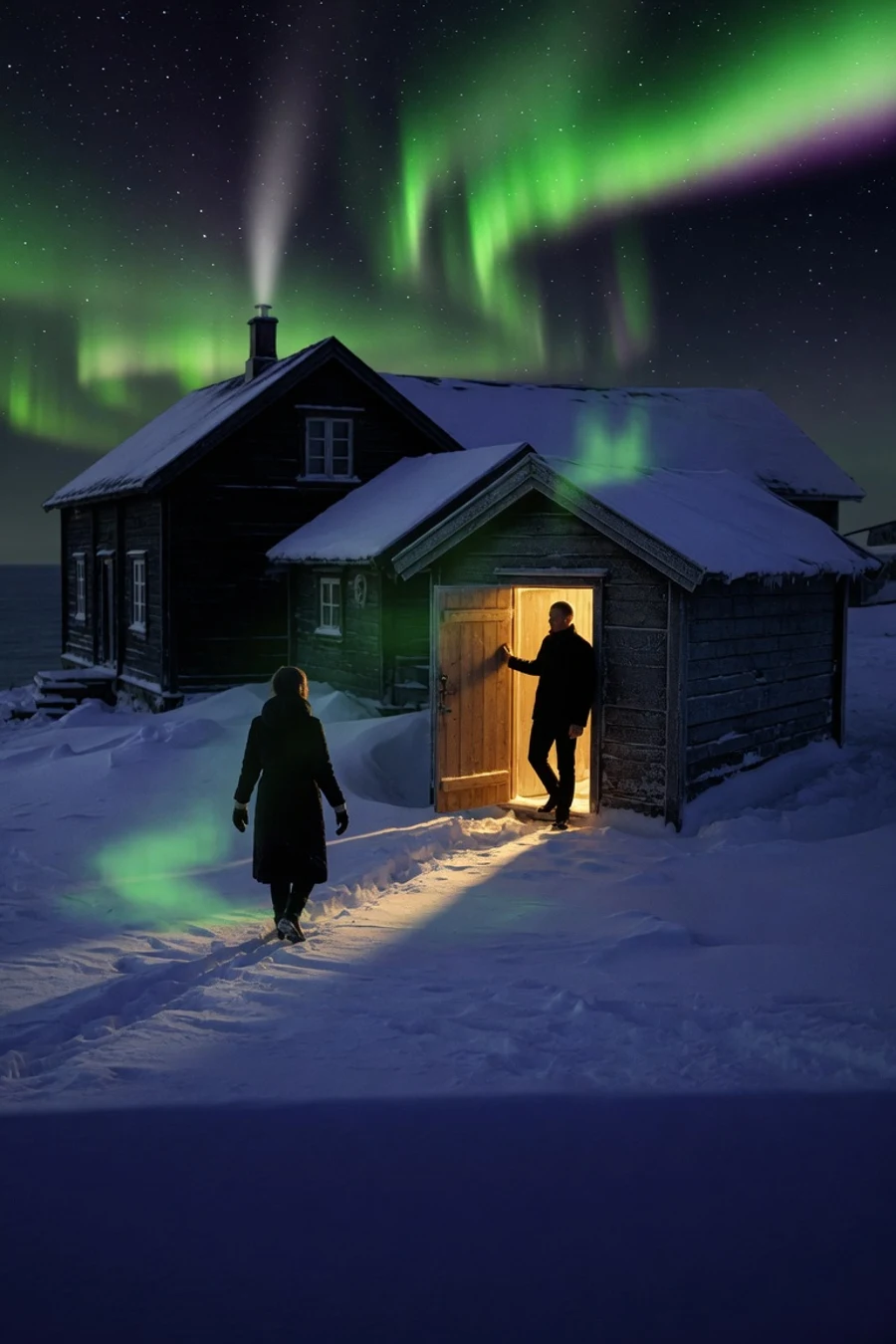
Chapter 1: The House on Halgrove Lane
The lawyer in Tromsø had called it a property. Marit had pictured something with that word's flatness to it, a box on a plot, walls and a roof and a number on a deed. What she got off the last bus, dragging a wheeled case that no longer rolled because the road had quit being a road two kilometers back, was her grandmother's house, and the difference between the two undid her a little there in the cold.
She had not been here in nineteen years. She had been eleven the last time, and the house had been enormous then, the way all houses are enormous to a child who has not yet learned to be disappointed by rooms. It was not enormous now. It was a low, dark, stubborn thing, timber gone the color of wet slate, its windows lit gold from somewhere deep inside even though no one had lived here since Margaret died in October. Snow stood to the sills. The sky behind the roofline was the particular bruised lilac that this far north passes for afternoon in December, and it was already going out.
She remembered the smell of it, was the thing that got her. Not the look. She had not been able to picture the look of the house on the long train and the longer bus, when she tried; she could summon the deed and the lawyer's voice and the word property, and behind all that, nothing, a child's blur. But standing at the gate with the cold needling into the gaps of her city coat, she got the smell of it across nineteen years, woodsmoke and tar and the green animal cold of the sea, and her grandmother's hands came back to her whole, the brown spots on them, the way they had floured a board, and Marit had to set the broken case down in the snow and stand and let that pass through her before she could go on. Grief does that. It does not come in the front door where you have braced for it. It comes in through a smell on the wind, sideways, while you are thinking about a deed.
She stood at the gate and let herself feel it, the whole flat weight of being thirty years old and divorced in everything but the paperwork and standing alone at the edge of a country that ended not far past here. There was nothing past this town. She had looked at the map on the bus. The road went up to Halgrove and then it stopped, because the land stopped, and after that it was only water the color of iron and then the top of the world.
Good, she had thought, looking at the map. Good. Let it stop.
The light in the windows was the caretaker's doing, she decided. The lawyer had mentioned a caretaker, or she thought he had, in among all the words she had not been able to hold onto that week. Someone kept the pipes from freezing. Someone had kept her grandmother from dying alone, she hoped, though she had not asked, because the answer would have required her to account for where she herself had been, which was a flat in Bergen, learning the exact sound a man makes when he has decided to stop loving you and has not yet decided to tell you.
She let herself in. The key the lawyer had couriered turned hard and then easy. The house breathed out at her, warm, and that was the first wrong thing, though she did not know yet to call it wrong. The house was warm. Not the leftover warmth of a stove banked that morning. Lived-in warm. There was woodsmoke in it, and beeswax, and under that something colder and cleaner that she would not be able to name for weeks and that she would think about, later, far more than she would ever admit to anyone.
She found the lamps already burning. Three of them, oil, their wicks trimmed low. She found, on the kitchen table, a loaf under a cloth, still soft, and a note in a hand she did not know, upright and old-fashioned and very plain.
The stove draws best with the damper half-closed. The water is hot if you let the tap run. I am in the coach-house if anything fails. - E.
She stood with the note a long time. Then she went to the window over the sink, scrubbed a porthole in the frost with the side of her fist, and looked.
The coach-house sat across the white yard, a smaller darker shape with one window lit. As she watched, the shape of a man crossed that window once, in no kind of hurry, and was gone, and the light did not move, and that was all.
She did not go out to him. She was too tired, and there is a kind of grief that makes you shy of kindness, because kindness asks you to be a person again and you have not got the materials. She ate the bread, standing at the counter, tearing it with her hands the way you eat when there is no one to eat in front of, and it was good bread, dense and a little sour, made by someone who knew how, and she found herself crying over it without much feeling attached to the crying, the tears just running while she chewed, the body grieving on its own schedule again, ahead of her, the way it did everything ahead of her.
She drank water that ran hot exactly as long as he had promised. She walked the cold rooms with a lamp, not touching much, her grandmother's reading glasses still folded on the arm of a chair, a half-finished square of knitting with the needles still in it, the small evidence of a life set down mid-sentence, expecting to be picked back up. She did not pick any of it up. She left the glasses folded. Then she slept in her grandmother's bed under three quilts in a house she had inherited at the end of the world, and she did not dream, and in the morning the snow had come down past the windows and the man's footprints from the night before were already gone, filled in white, as if he had never crossed the yard at all.
---
His name was Edmund, and she met him properly on the third day, when the pump that fed the house gave out with a sound like a cough and then a long sucking silence.
She had spent two days not meeting him on purpose. She had watched the coach-house the way you watch weather. The light came on at dusk and went out she never saw when. Smoke stood from its chimney, straight up in the still cold, a gray rope holding the low sky down to the roof. Once she had seen him split wood, and she had stood at the window with a cup going cold in her hands and watched the unhurried mechanical certainty of it, the axe up, the axe down, the halves falling away, and she had thought, without wanting to, that he moved like a man who had done a thing so many times that the doing had worn smooth, like a stair tread, like a doorstep dished by feet.
When the pump died she pulled on Margaret's boots, which fit, and crossed the yard. The cold took her breath at the door and gave it back to her thinner. She knocked. She heard nothing, and then the door opened as if he had been standing on the other side of it the whole while, which she did not like to think, so she did not.
He was younger than she had expected and older too. That was the first thing, and she could not have told you what she meant by it, only that his face was a young man's face, thirty-five at the outside, fair, clean-shaven, with a strong straight nose and a wide mouth and gray eyes set well apart, and that the face was wrong on him the way a new coat is wrong on someone who has worn the same one forty years. He wore the youth the way you wear a borrowed thing. He was very still. People are never as still as he was. She had not known to miss it in other people until she met someone who had it.
She thought, standing there in the cold with her dead pump behind her, of how much of her life she had spent reading men for the early signs, the weather before the weather, the small tightenings around the eyes and mouth that told you which way the next hour would go. She had gotten very good at it. It was a useless skill she had paid a great deal for. And she read him now out of habit, fast, the practiced sweep, and got nothing, no pressure, no want pointed at her, no account being opened in which she would later be found wanting. He was simply looking at her, a woman at his door in the cold, with a kind of grave attention, and the attention did not ask her for anything, and she did not know what to do with it, the way you do not know what to do with your hands the first day you are no longer carrying the thing you carried for years.
"The pump," she said.
"Yes." His voice was low and even and he had an accent she could not place, old in the vowels, a little formal. "It does that in a hard freeze. The line runs shallow under the wall. I will see to it."
"You don't have to. I can - "
"You cannot," he said, not unkindly. "It is below the floor and it must be bled in the right order or you will crack the head. I have done it before." A pause. "Many times."
He came. He brought a leather roll of tools that looked older than the house and an oil lamp that he did not seem to need, because he went down into the crawlspace under the kitchen in the dark and worked by feel, and she sat on the cold floor above the open hatch and held the lamp down to him and they did not speak. She could see the top of his head, the pale hair, the working of his shoulders. The space down there was filthy and freezing and full of nineteen years of her not being here, and he moved through it as if it were a parlor.
"You knew my grandmother," she said, into the dark.
The working stopped. Started again. "I rented the coach-house from her," he said. "For some years."
"How many?"
A click of metal on metal. "A good while."
"She never mentioned you. In her letters." Which was a lie of a particular kind, because Margaret had mentioned a great many things in twenty years of letters Marit had answered for the first five and then not, busy, married, becoming the wife of a man who did not like her grandmother's handwriting on envelopes, and so the truth was that Marit did not know what her grandmother had or had not mentioned, because she had stopped opening the envelopes.
"No," he said. "She would not have."
He did not explain that, and she found she did not need him to. The pump came back with a knock and a shudder and then a steady living thrum she felt through the floor, and he came up out of the dark with cobweb in his pale hair and a smear of black across one cheekbone, and the borrowed youth sat so wrong and so still on him in the lamplight that she looked away, and was angry at herself for looking away, because she was thirty and she was done being moved by men, she had decided that on a bus.
"Thank you," she said, to the stove.
"You should let the cold tap drip at night," he said, gathering his tools. "All winter. It is cheaper than my coming."
"And if it freezes anyway?"
He looked at her then, full on, and there was nothing in the look she could put a hand to and yet she felt it move through her like the hot water through the pipe, finding every empty room.
"Then I will come," he said.
He let himself out. She watched from the window. Halfway across the yard he stopped, and stood, and looked up at the sky, which had cleared, and where the green had begun, the slow cold curtains of it shifting north over the water, and he watched the aurora the way she had watched him split wood, with the attention of someone for whom the spectacular has become ordinary and is therefore the only thing worth standing still for. He watched it for a long time. Longer than the cold should have let him.
Then he went in, and his light came on, and Marit stood at her grandmother's window with her hand flat against the freezing glass and understood that she was not, after all, as done as she had told the bus she was.
Chapter 2: What the Town Remembers
Halgrove had a shop, a chapel nobody used, a harbor where four boats iced in for the season, and a woman named Solveig who ran the shop and knew everything, which is the function such women perform in such towns and the reason they are never lonely and never entirely trusted.
Marit went down for flour and matches and the human sound of another voice. Solveig was sixty-some, broad, kind in the brisk way of people who have buried a great many neighbors, and she had loved Margaret, which she established within the first minute, and which made Marit's eyes sting in the warm shop in a way she resented.
"You'll have met Edmund," Solveig said, weighing the flour. It was not a question.
"The tenant. Yes. He fixed the pump."
"He fixes everything." Solveig's hands did not stop. "Fixed my Per's chest the winter the doctor couldn't get up the road. Sat with him three nights. Per's eighty-one now and complaining about it." A small dry sound that was a laugh. "He sat with your grandmother too. At the end. She wasn't alone. I want you to know that, since you'll be wondering and too proud to ask."
Marit put her hand on the cold counter. "Thank you," she said, when she could.
"He's a strange one," Solveig went on, conversational, packing the flour into Marit's bag. "But strange the way the weather's strange. Not the way a man's strange. You understand the difference, you'll have known both kinds." She said it lightly and looked at Marit as she said it, and Marit understood that Solveig knew, somehow, the whole of it, the husband, the not-quite-divorce, the running to the top of the world, all of it weighed and bagged like flour, and that she would never speak of it again unless Marit opened the door first. Small towns. They see you arrive carrying everything, and then they have the grace to pretend you came empty-handed.
There was a girl behind Marit in the shop now, a teenager in a too-big parka stamping snow off her boots, and Solveig handed her a parcel that was clearly waiting and said something about her mother's back, and the ordinary commerce of the place went on around the strangeness, which was, Marit thought, the strangest part. They had folded the impossible into the everyday so completely that it had stopped being remarkable, the way you stop hearing the sea if you are born beside it. The girl had grown up in a town with an immortal in it the way Marit had grown up in a town with a cement works in it: it was simply a fixture, it had always been there, it did a useful thing and you did not stare at it.
"He doesn't take rent," Solveig added, almost to herself, ringing up the girl. "Did you know that? Your grandmother tried to make him take it, for the principle. He'd leave it on the sill in the same envelope, unopened, and split her wood instead, and after a few years she gave up trying to make him a tenant and just let him be a neighbor." She closed the till. "Some things won't be made into the shape you've got a word for. He's one. You'll find that out."
"How long has he rented the coach-house?" Marit asked. It was the only door she felt able to open.
Solveig's hands paused. Just a beat. "Now that," she said, "is a question."
"Meaning?"
"Meaning my mother knew him." Solveig set the bag on the counter and looked at it instead of at Marit. "And my mother's mother. There's a photograph in the chapel, the whole village out front for the new roof, eighteen-and-something, the date's worn off the back. He's in it. Same coat. Same face." She shrugged, a big slow movement, a woman setting down something she had carried a long time and choosing not to make a thing of it. "We don't talk about it. It's not - it's not anything that needs talking about. He keeps the road open in winter. He sat with the dying. He's never once given any of us a reason to be afraid, and we've all of us had reasons to be afraid of one thing or another up here, and never him. So." She pushed the bag across. "We let him be what he is. Whatever that is. And he lets us be what we are. It's a fair arrangement. It's lasted."
Marit carried the flour home through snow that squeaked under Margaret's boots, and she did not think the thing the photograph wanted her to think, because it was not a thing a sensible woman from Bergen thought, and she was a sensible woman from Bergen, she had the divorce papers to prove she had once been sensible enough to marry the wrong man for sensible reasons. She thought instead about he's never once given any of us a reason to be afraid, and she turned it over, and she found that it was the most romantic sentence anyone had said to her in years, and that this said something terrible about the men she had known, and she let herself laugh out loud in the empty white road, once, a sound that startled a raven off the chapel roof.
---
It was four days after that the first wrong thing that was a man came up the road.
She knew the engine before she saw the car, because she had spent two years learning that engine, the particular impatient over-rev of it, the way Anders drove everything the way he drove conversations, too fast and braking late and expecting the world to have moved out of his way. She was at the window when the car slewed to a stop at her gate, German and gray and absurd in the snow, and her whole body did the thing it had trained itself to do, went quiet and small and watchful, hands going still on the dishcloth, and she hated that the body remembered. The mind divorces. The body keeps the marriage.
He got out. He had flowers. Of course he had flowers. He had driven for a day and a half to the end of the world with a bouquet from a petrol station going brown at the edges, and he stood at her gate in his city coat and his good shoes ruined in the snow, and he smiled the smile, the warm one, the one that had made her think for two years that the cold one was the aberration.
She had been the kind of woman, once, who believed that the worst thing a person showed you was the exception and the best thing was the truth. It had taken her most of her twenties to learn it was the other way around, and the lesson had a face, and the face was at her gate now, smiling. The flowers were the tell. He never brought flowers except after, except to paper over, except as the down payment on the next time. A bouquet from Anders was not a gift, it was a receipt.
"Marit," he called. "Marit, sweetheart. You're a hard woman to find."
She did not open the door. She stood behind it with her hand on the latch and her heart going and she said, through the wood, in a voice she was proud of for not shaking, "You need to go home, Anders."
"I came all this way." Reasonable. He was always so reasonable, that was the thing nobody understood, he was the most reasonable man in any room, right up until you were alone with him and the reason ran out. "I came all this way and you won't even open the door? In this cold? Let me in, I'll freeze."
"There's a hotel in Tromsø."
"There's a hotel three hours back the way I came, and I'm not driving it." A change in the voice, small, the first hairline crack in the reason. "Open the door, Marit. I'm not going to stand in the snow and beg. That's not who I am. Open the door and we'll talk like adults and then I'll go, if you still want me to go. I just want to talk. You owe me a conversation. You left in the middle of a sentence."
And the terrible thing, the thing she would be ashamed of for a long time, was that her hand moved on the latch. Two years of being trained to manage him, to defuse him, to give him the small concession that bought the large peace, and the hand moved, because the body keeps the marriage, and a conversation was so small a thing, and the snow really was so cold, and he was right, she had left in the middle of a sentence -
A shadow fell across the gate.
She had not heard the coach-house door. She had not heard him cross the yard. Edmund was simply there, between Anders and the gate, between Anders and her, and he had not hurried and he was not breathing hard and there was snow not yet melted on his shoulders, and he stood with his hands loose at his sides. She would think about that detail for a long time afterward, the hands loose at his sides. A man steps between two people braced for trouble and his hands come up, or they ball, or they go to his pockets, the body readying its small violences. Edmund's hands hung open and easy, because he was not readying anything. He did not need to ready. Whatever he was, it was already entirely present, fully loaded, requiring no windup, and the stillness of his open hands was more frightening than any fist would have been, and Marit, watching through the frost, felt the difference land in her own chest before it landed in Anders, the cold clean certainty of something that did not have to threaten because it had never once in its long life needed to.
He said, to Anders, "She has asked you to go."
Anders laughed. The laugh men do when they are recalculating. He was bigger than Edmund, broader, younger-seeming in the way that meant nothing and that Anders had always believed meant everything. "And who the hell are you?"
"I rent the coach-house," Edmund said. As if it answered the question. As if it were the whole of his name and his right and his standing in the world. "You are on Mrs. Halgrove's land, and she has asked you to go, and so you will go."
"Mrs. Halgrove is dead, friend, this is my wife's house now, and this is between - "
"You will go," Edmund said again, and he did not raise his voice, he lowered it, and Marit, behind the door, felt the cold clean smell of him reach her even through the wood, the thing under the woodsmoke, and she watched her husband's face through the porthole in the frost, watched Anders look into Edmund's gray eyes from a foot away, and watched something happen in Anders that she had spent two years praying for and never once seen.
She watched Anders be afraid.
He covered it fast. He was good at covering. He laughed again and said something about the both of them, something ugly, and he threw the brown flowers into the snow by the gate and got back into the German car and over-revved it and slewed it around and drove too fast and braked late all the way back down the white road until the sound of him was gone into the larger silence.
Edmund did not watch him go. Edmund turned, while the car was still audible, and looked at the door behind which she stood, as if he could see her through it, which she did not like to think, so she did not. And then he bent, without haste, and picked the brown flowers out of the snow, and shook them, and looked at them with what might have been sorrow, and carried them away across the yard to the coach-house, because they were a living thing thrown in the cold and he was the kind of creature that could not leave a living thing in the cold, and that, that small thing, the ruined petrol-station flowers cradled in his pale careful hands, was the thing that undid her, finally and completely, far more than the fear in Anders' face.
She opened the door. The cold came in.
"Edmund," she said.
He stopped, halfway across the white yard, the flowers in his hands, and turned, and the green had started in the sky behind him, the slow cold curtains coming north over the iron water, and he stood between her and the dark with his arms full of someone else's dying flowers and he did not say anything at all, he only waited, the way he waited for the pump, the way he had perhaps waited for a hundred years, and Marit stood in her grandmother's doorway with her heart going and the cold pouring in around her bare ankles, and she was already lifting her foot to the step, already crossing the yard in everything but her body, and there was not a thing on this earth or off it that was going to stop her.
The rest of the story
Finish The Winter Tenant.
Sign up free, then $2.99 opens the closing chapters.
No payment to start.
Private and discreet.