BF Original
The Tithe
Every autumn your village leaves a gift on the old stone at the edge of the Hollow Wood, and in the morning it is gone, and the winter is gentle. This year the harvest failed, and the lot fell to you. But the stories got the Hollow's lord wrong - he cannot take, only bargain; nothing in his wood is his unless it is given freely. Stay until the thaw, of your own will, and the winter will be gentle. The story of the long dark, and what you choose to give.
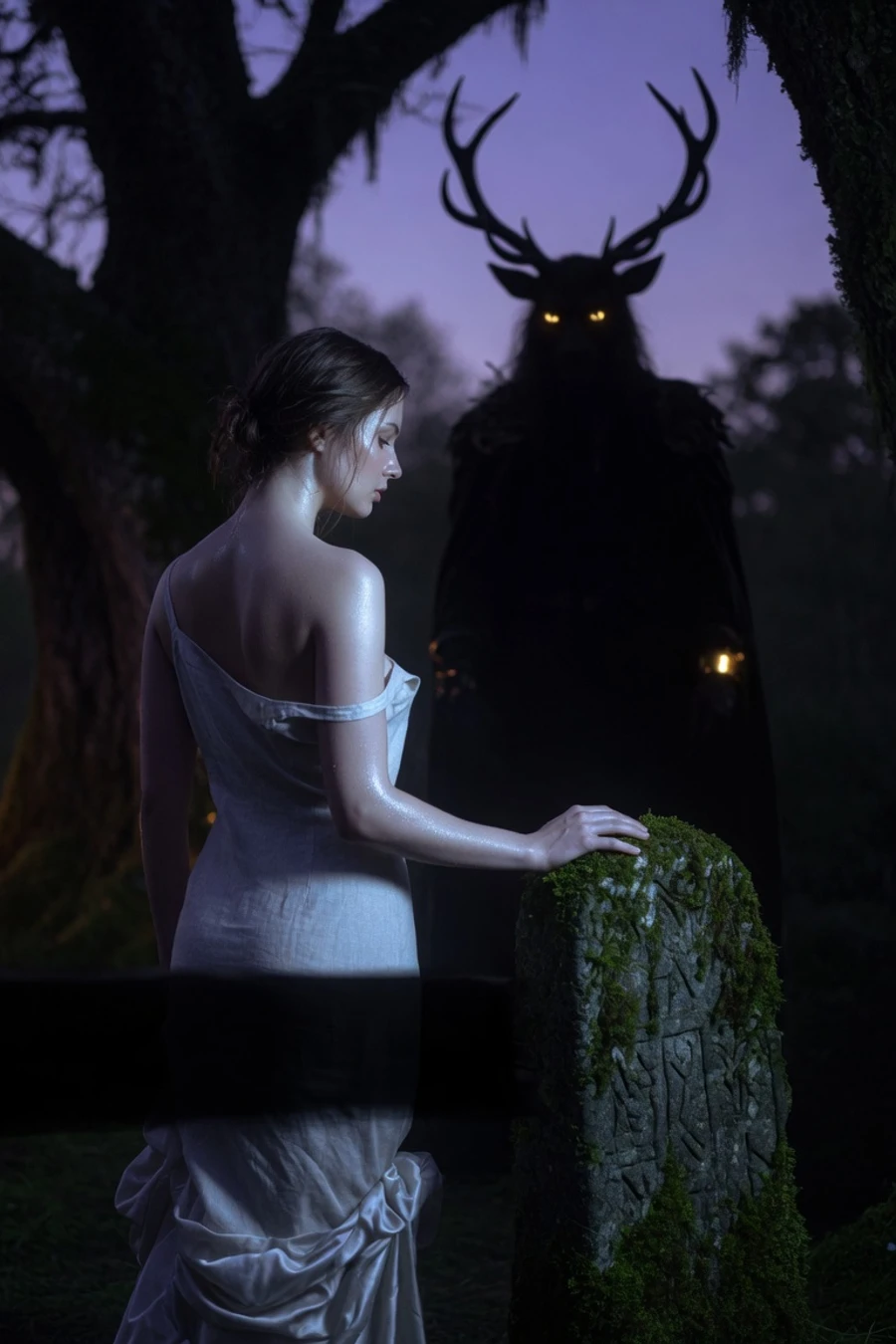
Chapter 1: What the Village Gives
Every autumn for as long as the village has stood, when the last of the harvest is in and the first frost silvers the stubble, the people you grew up among carry a gift to the edge of the Hollow Wood and leave it on the old stone, and in the morning it is gone, and the winter is gentle, and no one speaks of it again until the next year. A cask of the good cider. A wheel of cheese. A heifer, in the bad years. The Tithe, they call it, and they say it the way they say grace, fast and with their eyes down, because to look too long at the thing you are afraid of is to invite it to look back.
This year the harvest failed. There is no cask, no cheese, no heifer to spare. And so the elders met in the long room by candlelight and decided, the way frightened people decide, that the Hollow would have to be given something it could not refuse, and they drew the lots in front of the whole village, in the open, with everyone's hands seemingly clean. But you buried your mother two winters ago and you never married and you keep the bees at the far edge of the commons where no one has to think about you, and when old Harrow's hand came up out of the bowl with your name on the slip, no one in that room looked surprised, least of all you. A lot does not truly fall. It is aimed. You were the one the village could most afford to lose, and every soul in that long room had known it before the bowl was ever passed.
You do not weep. You have watched your whole life the way the village handles fear - by giving it away to someone else - and you find, standing at the edge of the wood at dusk in the white dress they put you in, that you are less afraid than you are furious, and that the fury is the only warm thing in you. The trees of the Hollow do not move in the wind. They have never moved in any wind. You step over the old stone and into them, because the alternative is to stand at the edge and beg, and you have decided you would rather walk in on your own two feet than be dragged.
The wood closes behind you like water. The light goes strange - not dark, exactly, but deep, a violet underwater dusk that does not come from any sky - and the air smells of cold green things and something beneath that, warm and animal and old. You walk a long time, or no time. And then there is a clearing, and a figure standing in it, and you understand all at once and with your whole body that the stories got it wrong, that they made it a monster so they would not have to make it this.
He is tall and still and he is the most beautiful and most wrong thing you have ever seen - a man's shape but lengthened, sharpened, antler-shadowed at the brow in a way your eye refuses to hold, his skin the pale of birchbark and his eyes the flat luminous gold of an animal's caught in firelight. He looks at you the way you imagine he looks at everything that wanders into his wood, unhurried and total, and when he speaks his voice is the low of wind in the high branches.
"They sent you walking," he says. Not a question. "They usually send them weeping."
"I'm not a cask of cider," you say, and your voice does not shake, and you make sure of it. "I'm not yours to keep just because frightened people left me on a rock."
Something moves across the wrongness of his face. Not anger. Interest, and a kind of old hunger waking, and under it - you would swear it, later - something almost like respect.
Chapter 2: The Bargain
"No," he agrees, and the word goes through the clearing like a struck bell. "You are not a cask of cider. A cask of cider cannot consent, and so it cannot be kept. It can only be taken." He tilts his antler-shadowed head. "We do not take, in the Hollow. We bargain. It is the oldest law, older than your village, older than the stone they left you on. Nothing in this wood is mine unless it is given freely. Did they tell you that, the elders? No. They would not. It is easier to be afraid of a thief than to know you have been dealing with something that keeps its word."
You stand very still in the violet dark. "Then I give you nothing," you say. "And you let me go."
"I could." He does not move and yet the distance between you is suddenly less, the way distance is in dreams. "And the winter would come down on your village like a hammer, because the bargain is unfulfilled and the old balance must be paid in cold and crop-rot and the small cruelties of a hungry season. That is not a threat. I do not threaten. It is only the shape of the law. They owe the Hollow, and they have sent you to be the payment, and you have walked in on your own feet, which means you are the only one of them in a hundred years who came as something other than livestock." The gold eyes hold you. "So. Not a taking. A bargain. Stay with me until the spring thaw - of your own will, freely, and you may leave whenever the wanting to leave is greater than the wanting to stay - and the winter will be gentle, and in the spring you will walk out of this wood with more than you walked in with. That is the offer."
"Stay with you," you say. "Doing what."
The hunger in him is very old and very patient and he does not pretend it is not there. "Whatever you give freely," he says. "Nothing you do not. That is the law, and the law does not bend, not even for me, not even when I want it to." A pause, and the wind-voice drops lower. "And I find, looking at you, that I am going to want it to."
You should be afraid. You are afraid. But you have spent your whole life being given away by people who would not look at the thing they feared, and here is the thing itself, looking at you and asking - asking - and you find that the fury in you has banked down into something else, something with heat in it, and you hate that, and you feel it anyway.
"Until the thaw," you say. "Freely. And I leave when I choose."
"When you choose," he says, like a vow, because it is one.
Chapter 3: The Long Dark
He gives you a name to call him - "Ash," he says, "you cannot hold my true one, it would unspool you" - and he gives you the Hollow, and the Hollow is nothing the stories promised.
It is beautiful past bearing. There is a hall grown of living trees with their crowns laced into a vaulted ceiling, lit by drifts of cold blue witchlight that gather where you walk. There is food that is real and not a trick - he is scrupulous about this, tells you which fruit will bind you and which will only feed you, because a bargain made in ignorance is no bargain and he will not have it. There is a long cold winter pressing on the world outside, and inside the Hollow it is always the deep violet hour, and there is him, watching you with the patience of something that measures time in the rings of trees.
He does not touch you. This is the thing that undoes you, slowly, across the long dark: that he could, that you are alone with him in a place outside the world and there is no one to stop him and every story you were raised on swore that this is exactly where the taking happens - and he does not. He keeps the law like it is the only thing holding him together. When you reach past him for the witchlight and your arm brushes his and you both go still, he is the one who steps back. "Freely," he says, low, almost to himself, like a man reminding himself of the edge of a cliff. "Or not at all."
You start to give him small things, to see. Your name - your real one, which he takes like something precious and does not misuse. The story of the harvest, the lots, the white dress. A question, and then another, and he answers all of them, plainly, in the wind-voice, and you learn that he is the last of the wood's old lords, that the Hollow shrinks every year as the world forgets to fear it, that he has kept a bargain with your village for three hundred years and watched them turn him into a monster in their telling because a monster is easier than a neighbor you owe.
And you learn the shape of his wanting, because he does not hide it, because hiding it would be its own kind of lie and he does not lie. He watches your mouth when you talk. When you laugh - you did not expect to laugh, in the Hollow, and the first time you do his whole still face changes like sun coming through branches. The heat in you that you hated has stopped being something you hate. It has become the warmest thing in the long dark, and you are aware, lying in the witchlight at the end of a day that has no clock, that the wanting-to-stay has crept up even with the wanting-to-leave, and is, quietly, beginning to pass it.
He is not always gentle with the truth. You ask him once whether he grieves the hard winters his bargain spares your village, and the gold eyes go flat and very old, and he says, "Why would I grieve them? They have eaten three hundred years of my mercy and called me a monster to their children to make the eating taste sweeter. Let them have one soft winter and be grateful." And the coldness of it, the sheer unbothered age of it, the way he has for a moment forgotten that you are one of those small short-lived things he is being cold about - it frightens you worse than any taking would have. You are alone in a place outside the world with something that remembers when your whole village was forest, and for one breath you cannot find the man in him at all.
That night you go to the edge of the hall, where the witchlight thins and the wood begins, to the dark between the trees that you know, somehow, is the way back. And you think seriously about walking into it. Not in fury - in fear, which is colder and more honest. You had a life, of a kind: the bees, the commons, the small mortal griefs that were at least your own size. You stand at the edge a long time. He does not come to stop you, does not so much as say your name, and that - that he would let you walk out into the dark without a word - is the thing that turns you back, in the end. But you want it understood that you stood at the edge and weighed it, and that the weighing was real, and that the staying, after, was a thing you chose and not merely failed to refuse.
And there is the thing that unsettles you most of all, because it is the one crack in his iron law. As the long dark goes on, the Hollow begins to warm toward you. The witchlight gathers brighter where you sit. The moss softens before you lie on it. The wood leans the way a plant leans at a window, toward the warmth of you - and one evening you catch Ash watching it happen with something like horror on his strange face, and he shuts his eyes, and you feel the whole wood pull back at once, the light dimming, the warmth withdrawing, as though he has hauled it back by main strength. "The wood wants what I want," he says, low and ashamed. "It would warm the way to keeping you. It would put its thumb on the scale of your choosing, if I let it. I will not let it. Whatever you choose, you will choose it cold and clear and your own, or you will not choose it at all." And you understand that even his magic is a thing he has to fight to keep honest, and that the fighting costs him, and that he does it anyway.
One night - if they are nights - he is close, telling you the names of the cold stars that only the Hollow can see, and you turn your head and he is right there, the gold eyes, the wrongness you have stopped flinching from, and the inch between your mouths is the whole of the law, and he holds it, holds himself on the edge of the cliff, will not cross it, waits -
"Ask me," he says, wind-low, wrecked. "I have kept the law three hundred years. I will keep it tonight if you do not. But if you want this - you have to be the one to give it. Freely. Say it, or send me back across the hall, but for the love of the old dark, do not look at me like that and say nothing -"
The rest of the story
Finish The Tithe.
Sign up free, then $2.99 opens the closing chapters.
No payment to start.
Private and discreet.