BF Original
The Speaker Port
Mara has six months of reading vision left. She spends them in a 1928 community theater under restoration, alongside the man rewiring its speaker port - and finds a kind of witnessing she did not know she needed.
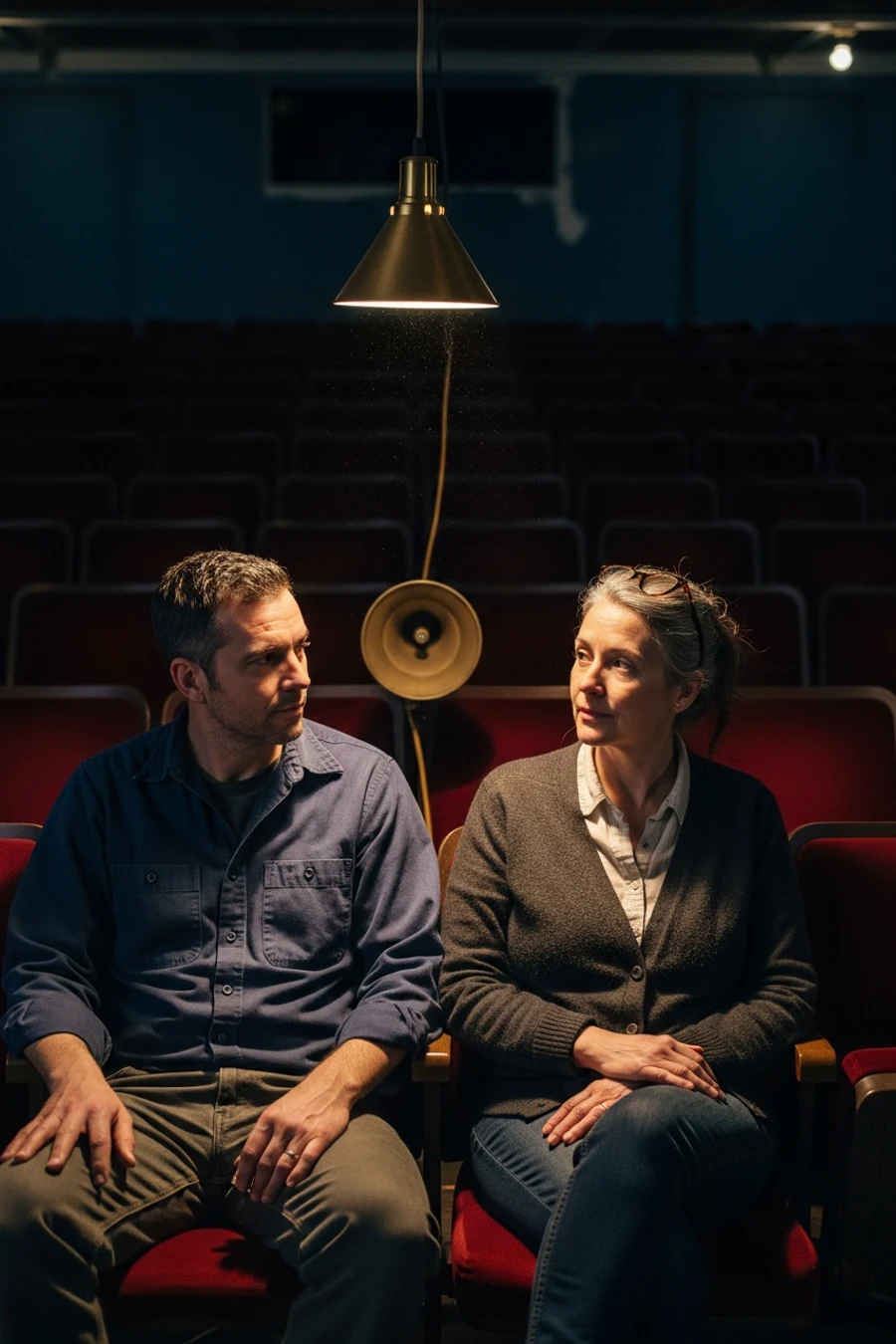
Chapter 1: The Closed Strand
The specialist is a woman about her own age, with a pinned-back braid and unpolished nails, and she has the dimmed look of a person who has said the same sentence to four people before lunch. The room smells faintly of the antiseptic they use on the chin rest. On the wall there is a print of the Hudson at Cold Spring that has been there long enough to have a film of dust along the top of the frame. Mara notices the dust because the dust is in focus.
"Stargardt-pattern, late onset," the specialist says. "Aggressive course. The macula is going, both eyes, more or less symmetrically. You'll keep peripheral vision. You will not keep reading vision."
"How long," Mara says.
"Six to nine months before central vision is gone. Some people get a year. Some people get less. I am not going to pretend to know which you will be."
Mara says, "Thank you for not pretending."
The specialist almost smiles. It is the closest thing in the room to warmth. She passes a folder across the desk. "There are services. Adaptive devices, occupational therapy, a list of clinicians who specialize in vocational transition. You don't have to look at any of it today."
"I won't," Mara says, and takes the folder anyway.
Outside on Madison the air is sharper than it was an hour ago, the kind of October sharpness that wants a scarf. She walks to Grand Central because the subway would put her underground and she does not want to be underground. In the main concourse the ceiling stars are above her and she looks up at them and they are clear, every one. She files that fact. She files everything she sees from now on, she suspects, the way a person packs a house before a move. The 11:15 to Beacon is on the timetable in the upper-left corner of her vision and she reads it twice to be sure.
On the train, with the river coming up out of fog around Croton, she takes off her left glove and reaches into the right pocket of her coat and brings out the paint chip she put there before she left the studio. She had thought of it that morning as superstition. She thinks of it now as a control.
Coral. The warm one. More red than orange, but not as red as the persimmon next to it on the wall at home. The chip is matte and the color sits across it evenly. She holds it on her thigh and looks at it for a long time. The chip looks the way it looked yesterday. Coral. The warm one. She turns it over to be sure she is not making it up out of memory. The back is white and printed with a code she has known by heart since 2014.
She files the chip's color. She files the river.
At the studio she puts the folder from the clinic into the drawer under the drafting table without opening it. She washes her hands at the alcove sink. The water comes out cold, then lukewarm. She watches her own hands the way she has watched them since she was four. The thread-callus on her left index finger catches the light at the kitchenette window the way it has caught light at every window she has ever worked at.
The radiator clicks on at 4:33. She knows the time because the radiator runs on a schedule the building has kept since before she rented the second floor. She crosses to the loom in the corner and stands for a minute looking at the work on it. A throw, commissioned by the Brooklyn buyer, in a coral-and-cream check meant to read across a room from the back of a sofa. She has the warp tied and the first eight inches of weft done. The color is right. She had been on the edge of a small adjustment to the picks-per-inch before she left for the appointment, an adjustment she had been holding in her hands and would have made by feel.
She sits down at the bench. She makes the adjustment.
The sound the loom makes when it is doing what it is supposed to do is a sound she has been hearing in some form since she was small. The throw lengthens by a quarter inch and then by another quarter inch and her hands do not think about what they are doing because they have not had to think for thirty years. She works for an hour and forty minutes. She does not weep. She does not stop. She makes one error and undoes it and makes the right move and the throw lengthens again.
At six she stands and stretches her back. The light on Main Street through the larger window is the late-October light, low and golden in patches between the brick storefronts, the way it has been on Tuesdays in October for as long as she has lived above the bookshop. She looks at it and files it. She looks at the coral on the loom and files it. She picks up the loupe at her sternum and lets it fall back against her shirt; it is reflex; she has nothing to look at through it right now.
She goes downstairs at quarter past six because she has run out of coffee and because the alternative is to keep filing.
Binnacle Books is warm. The owner, Ed, who has worked the counter every Tuesday for the four years Mara has lived above him, is reading the new Sigrid Nunez with a finger keeping his place. He looks up when the door's small hinge complains.
"Ms. Linde."
"Coffee," she says. "The dark one."
"Came in Friday." He goes to the shelf at the back and gets her a tin. He always wraps it in brown paper before she has asked him to. He does it because he is fond of her and because he is from a generation that wraps things. He takes her card and she taps it and the receipt prints with the small chirp it always makes.
"Quiet night," she says, because she has to say something, because if she does not say something she will say what the specialist said.
"It is. It's been quiet since the season turned." He hands the tin across. He glances past her, out the window, the way a shopkeeper glances at the street between transactions. "Old Henry's light is on."
She follows his glance. Across Main Street the second-floor windows above the dark marquee of the Strand are lit, both of them, a soft yellow lamp burning at one and what looks like a kitchen ceiling fixture at the other.
"Old Henry," she says.
"Castille. The projectionist. He never came down off the second floor after he closed the place. That was, what, seven years ago now? Seven this Christmas. Tuesday matinees were the thing he did. He ran the matinees for thirty years before he closed."
"Why did he close."
Ed shrugs the small shrug of a man who has had this conversation before and does not want it to become a long one.
"The kid he was training died. Right out of nowhere, between one week and the next. Heart thing. Henry locked it that Friday and that was the end. The owners pay him to keep the roof on. He keeps the roof on."
She holds the tin against her chest. It is warm where the shop's air has been on it.
"He never opened it again."
"Not once."
She does not ask the kid's name. She does not ask whether Henry has people. She has done enough asking for one day. She thanks him and she says good night and she steps back out onto the sidewalk with the wrapped tin under her arm.
The light has gone while she was inside. It is full dusk on Main Street now, the streetlamps coming up one at a time the way they do, the diner's green awning three doors down still backlit from inside. She does not turn left to her own door. She turns right. She crosses Main Street.
The Strand's facade is brick painted a long time ago in a color that was once oxblood and is now closer to the color of a brick that used to be painted. Above it the marquee, two lines of black letterboard under a curve of unlit bulbs. The letters spell out, still, what they spelled out the week Henry locked the doors: TWO ENGLISH FILMS, ONE FRENCH. WED MATINEE 2 PM. She reads the letters. She reads them twice. The dusk has not taken them.
Above the marquee the second-floor windows are lit. She does not look up at them for long. It is not her business which lamp he is reading by.
She stands on the sidewalk for what she thinks is a minute and is probably three. She has lived three doors down for four years. She has crossed Main Street to the diner perhaps two hundred times. She has not looked at this building, really looked at it, ever. The padlock on the inside of the glass doors catches the streetlamp and sends a small disc of light back at her. Behind the glass the lobby is dim, a few shapes she can read: the popcorn case, the corner of a framed poster, a brass railing.
She thinks, in the closest the evening comes to a thought she lets herself finish, that she would like to know what a movie looks like to someone who has watched it ten thousand times. She thinks it the way she might think of a color she has not used in a year. She does not knock. She does not need to knock tonight. She has only just decided that there is something here to decide about, and she has not decided it in any sentence, and she will not decide it in any sentence tonight.
She takes her hands out of her pockets and puts them back in. The left finds the thread-callus on its own index, the way it has been finding it since she was a child, the small hard place that is the proof her hands have done work. The right finds the coral chip. She has been carrying it since the train. She had forgotten she was carrying it.
She takes it out. She holds it up against the dark facade of the Strand the way she would hold it against any field, to see what the color does when it has a wall behind it. The chip in the streetlamp light still reads as coral. The warm one. More red than orange.
She files that.
She puts the chip back in her pocket and crosses Main Street the other way, the wrapped tin under her arm and her left hand in her left pocket, and at her own door she turns the key with the heel of her left hand because her right hand is full. The marquee is behind her shoulder. She does not look back at it. She does not need to look back at it. The letters are still there. The lamp upstairs above the lobby is still on. She files that fact too, the way she has filed the others, and walks the three doors back to her own building.
---
Chapter 2: The First Tuesday
A week passes the way a week passes when a person has decided something and has not told themselves what.
She works. She runs the second half of the coral throw and sleys a second warp for a runner the Cold Spring shop ordered in September. She takes a call from the Brooklyn buyer and confirms a delivery date she is not sure she can keep and writes it on the wall calendar in pencil so she can move it without leaving a mark. She does not open the folder in the drawer. She does not call her sister. She sleeps badly Wednesday and well on Thursday, the way her body has always done when she is between two things.
On Friday she runs a small madder bath in the studio for the runner's weft. The dye-room is the kitchenette with a hot plate, two enamel pots, and a length of vinyl on the floor. The madder is the one she has been using since 2017, a clean root from a grower in Vermont who keeps the same farm her grandmother used to drive to. She does not think about her grandmother on Friday. She thinks about the temperature of the water and the time on the clock and the color the skein is going to be in twenty minutes when she pulls it out and lays it on the rack.
The skein comes out the right red. She files that.
By Tuesday the coral throw is off the loom, folded in tissue, in a box on the drafting table with the Brooklyn buyer's address on it. The runner is back on the loom. She has eaten a sandwich at the bench. She has not put her coat on yet. The light through the larger window has gone the way it goes on the first Tuesday of November, low and thin where it had been low and golden seven days ago. She looks at the light and files it.
At twenty past six she puts the coat on. She does not eat anything else. She turns the lamp off at the loom and the lamp on at the drafting table because she is going to come back to this room and she would like the room to be lit when she does. She goes down the inside stairs and out through the building's side door so she will not have to cross the bookshop's window. The owner does not need to see her. She is not coming back with another tin tonight.
The Strand at 6:38 pm has not changed since a week ago. The marquee letters spell out the same line. The brick is the same brick under the streetlamp, the diner's awning backlit three doors down. The light in the second-floor window is on.
She crosses Main Street at the unmarked place between the diner and the dry cleaner because that is where her feet take her. She steps up onto the sidewalk on the Strand's side. She walks to the glass doors. The padlock is on the inside. The small disc of streetlamp light that she saw last Tuesday catches it in the same place.
She raises her hand and knocks on the glass with the back of her knuckles, three soft knocks, the way a person knocks on a door that has not been opened by a stranger in seven years.
She waits.
She does not knock again. The wait is long enough that she has time to think she should knock again and to decide not to. There is a sound somewhere above her, behind the marquee, that might be a door on the second floor. After it there is the long silence of a man coming down a flight of stairs slowly and crossing a lobby he does not cross often.
The shape on the other side of the glass resolves. He is taller than she expected and not as old. The streetlamp catches the half-moon glasses on the chain at his collarbone before it catches his face. He looks at her through the glass for a beat. Then he turns the padlock.
He opens the door six inches. The lobby air comes out around him, cool, dry, with a faint smell of old carpet and the cleaner he uses on the brass.
"Yes," he says. Not a question. An acknowledgment.
"My name is Mara Linde. I live across the street, above the bookshop."
"I know who you live above."
"The man downstairs told me last week that you used to run Tuesday matinees here."
"He did."
"I came to ask you something. I will not take long."
He looks at her another moment. Then he opens the door the rest of the way and steps back to let her in. He does not say come in. He moves aside.
She steps onto the inside mat. He closes the door behind her without locking it. The lobby is dim. The popcorn case is where she saw it through the glass last week. The brass railing runs around the half-wall by the auditorium doors. The carpet under her feet is original and worn down through the nap on the path between the door and the railing.
He does not invite her further in. They are standing two feet apart on the inside mat. The light in here is one bulb in a sconce by the auditorium doors and what comes through the glass from the street.
"I am a textile designer," she says. "I work above Binnacle Books. I weave. I dye."
"All right."
"On Tuesday morning a week ago I was at a clinic in Manhattan. The doctor told me I have six to nine months before my central vision is gone. The peripheral will stay. The reading will not. I have not told anyone."
He listens. He does not move his hands. His hands stay at his sides. His face does not perform anything.
"I came across the street last week and looked up at your building because the man at the bookshop mentioned it. I went home. I did not knock."
"I saw you."
"I thought you might have."
"You were on the sidewalk for three minutes. I saw the lamplight on you."
She takes a breath. She has been over this in her head all week and the sentence she has been over is not the sentence that comes out. The sentence that comes out is the truer one.
"I would like to know what a film looks like to someone who has watched it ten thousand times. I would like to know that before I cannot know it. I do not want a public screening. I do not want anyone in the room with me. I would pay you nothing because you would not take it and I would not insult you by offering."
He looks at her for a long time. The half-moon glasses on the chain catch the sconce. His face is not unkind and it is not gentle. It is the face of a man who has been alone with a question for seven years and has just been asked it by another person for the first time.
"I have not threaded a public screening since the spring of 2019," he says. "I closed the building on a Friday in May. A young man named Daniel. He had just turned twenty-four."
"I am sorry."
"I have not threaded for an audience since."
"I am not asking for an audience. I am asking for one chair."
"I know what you are asking."
He is quiet. He looks past her, out through the glass at the street, at the diner's awning three doors down. Then he looks back at her.
"I can thread a private screening if you want."
"I would like that. Thank you."
"What would you like to see."
"I do not know yet. I would rather you choose."
"Then I will choose."
"When."
"Next Tuesday at seven."
"Next Tuesday at seven."
He looks at her. He looks at the floor between them. He looks back at her.
"I have a print on the platter from yesterday," he says. "I was rewinding it this morning. It is up there now. If you wanted, I could run it tonight. You came across the street. I am not sure I will want to do this on a Tuesday I have had a week to think about."
"Tonight is fine."
"You are sure."
"I am sure."
"Take the chair on the front row in the middle. Not the aisle. The middle. The sound from the port lands cleanest there."
"All right."
He turns. He goes to the auditorium doors and pushes the right one open and holds it open for her with the flat of his hand. He does not touch her. He does not look at her face as she passes him. He looks at the carpet.
"I will be five minutes," he says. "I have to thread."
"I will be in the chair."
He lets the door close behind her. The lobby light is gone the moment the door swings shut. The auditorium is the dark she has been imagining for a week. She stands a second to let her eyes find the aisle, then walks down it, one hand on the back of each seat as she passes, counting the rows. The carpet smell is older here. There are seven rows. She finds the middle of the front row by feel and sits down.
The auditorium is large the way old single-screen rooms are large. The ceiling is high enough that the small sound her coat makes when she settles is taken up into it. The screen in front of her is a flat grey rectangle, a little brighter than the dark around it because there is a small house light still on at the back of the booth somewhere and the screen is catching it. She sits with her hands in her coat pockets and waits.
Behind her and above, faintly, she hears him on the stairs. She hears a door. She hears the small mechanical sounds of a man in a room he knows, doing a thing he knows: a metal lever, a sprocket engaged, the soft thud of a film leader on the take-up reel. Then a small click that she will learn later is the intercom switch on the booth side of the speaker port, and his voice comes into the auditorium.
"Mara."
"Yes."
"I am about to start the projector. You will hear it from up here. It is not loud. If anything makes you uncomfortable, you can leave and the door will be unlocked."
"Thank you."
"This is a print of a film called The Heart Is a Lonely Hunter from 1968. I ran it the week I closed. I have not run it since."
"All right."
There is a beat of silence on his end. Then the projector starts. The hum comes down through the ceiling and into her shoulders before the picture comes up on the screen. The light that fills the screen is the light she has been waiting to see for a week without naming what she was waiting for. The Columbia logo, the studio card, the title in white letters on a dim ground. The print has a little jump at the splice between the leader and the first frame and then it settles.
His voice comes through the port again, quieter than before, close to the brass mesh, and she can hear that he has put his face near it.
"The print is good for its age. There is a scratch on the right edge of the frame that runs through the first reel. It came in on a shipping case in 1989. It has been here since. You will see it under the white wall in the courthouse scene."
She is looking at the screen. She finds she is also listening with the muscle at the back of her neck. There is a difference between watching a film and watching a film while being told what it is, and she has not been on this side of that difference before.
The film begins. She knows the story from the book. She has not seen the film. Alan Arkin is on the screen as the man in the small Southern town who hears nothing and is heard by everyone. His face fills the frame and his face is the whole film, and his face is being held a long beat longer than a contemporary print would hold it.
"He held this take," Henry says, through the port. "He held it on Arkin's face for four extra seconds at the end of the dialogue. He did that because the actor was doing something with his mouth that the screenplay did not give him and he wanted us to see it."
"I see it."
"The scratch is about to come in."
The scratch comes in. It is a thin pale line on the right side of the frame, almost the height of the picture, and it sits over the white wall in the courthouse scene the way he said it would, and then the camera moves and it is gone.
"There," he says.
"Yes."
"It has been there since 1989. I have run this print eighty-two times. The line is in the same place every time."
She does not answer. She does not need to.
The film runs. He talks her through it the way a man would talk through a familiar room to a person who has not been in it. He names the actress in the green dress when she comes on; he says her dress reads as a kind of jade that the studio overprinted that year and that nobody has been able to match in a restoration. He names the cut at the end of the cafe scene as the cut that was made to hide a missing reaction shot from a younger actor who had walked off the lot for two days. He does not lecture. He places. The film and his voice move at the same speed and she finds she is following both at once and that neither is pulling on the other.
There is a frame, halfway through the second reel, where the actress's hand trembles on the porch railing in a way that is plainly the actress's hand and not the character's. Henry does not say anything for a beat. Then his voice comes back, quieter than before.
"She did that twice. She did it on the take they printed and she did it on the alternate. She told an interviewer twenty years later that her father had died the day before they shot the porch and she had asked the director if they could move the day and he had said no. The director made the right film. She made the right shot. It is the shot in this print."
Mara has her hands in her coat pockets and her right hand finds the coral chip and her left hand finds the inside seam of the pocket and she does not move either. The actress's hand on the porch railing is the only thing in the frame.
She does not know how long she watches it. The film is two hours and ten minutes and at the end of it the screen goes to the small dark that comes between the final frame and the leader. The hum of the projector changes pitch as Henry shuts it down. The house light at the back of the booth comes up in the small spill it has been giving the screen.
The intercom clicks.
"That was the print."
"Yes."
"Are you all right."
"Yes."
"I will come down and let you out."
"Thank you."
She hears him in the booth above and behind and the small mechanical sounds of a man finishing a thing he knows. She does not get up from the chair until she hears the door at the back of the auditorium. She walks up the aisle one hand on the back of each seat the way she came down. He is standing by the open door with his half-moon glasses pushed up onto his forehead because he has been reading something on a leader strip and has not put them back on the chain.
He does not say anything. She does not say anything. He walks her across the lobby. At the inside mat he turns the padlock and opens the glass door six inches and then the rest of the way.
"Next Tuesday at seven," he says.
"Next Tuesday at seven."
"Take the same chair."
"I will."
She steps out onto the sidewalk. The diner's awning is still backlit three doors down. He closes the glass door behind her and she hears the padlock turn from inside, the small clean sound of a man locking a door he has now opened twice in eight days.
She does not look back through the glass. She knows he is standing there for a second and then walking back across the lobby to the stairs to the booth and that he will be up there a little longer tonight, putting the print away, the way a person does after a thing they have not done in a long time. She walks to the curb. She crosses Main Street the long way, at the corner, because she would like to walk the long way home tonight. The marquee letters above her are dark. Her watch says 10:14.
Her left hand is in her left coat pocket. Her index finger is moving against the inside seam, finding the small hard place at the side of the joint where the thread has worn the skin into a callus, the way her hand has been finding that place since she was a child. She had not noticed she was doing it. She notices it now. She does not stop.
She walks the three doors back to her own building with the print's color in her head: the jade of the dress that nobody had been able to match, the pale line of the scratch on the right side of the frame, the dim green of the courthouse wall, the soft brown of Alan Arkin's coat in the last shot. She files them all. She turns the key with the heel of her left hand. Behind her, across the street, the marquee of the Strand is dark above the locked glass doors, the inside padlock catching the streetlamp the way it caught it a week ago, the small disc of light steady on the inside of the door at the height of a person's hand.
---
Chapter 3: The Third Tuesday
She starts the peony on Thursday afternoon because she has run out of reasons not to.
The drafting table is clear except for the sheet of wax paper and the small scissors and the bone folder and the spool of green floral wire she has had since 2017. She sits down. She closes her eyes. She does not close them dramatically. She closes them the way she closes them at the loupe, to rest the central vision before going back in.
The wax paper has a weight she knows by touch alone. Twenty-five pound. The kind that does not crack along the fold the way the cheaper paper does. She tears a square off the roll without measuring; the loom has taught her hands what a square is. She puts the square down and finds the edge of it with the pad of her thumb. She finds the center by halving with the bone folder. She makes the first cut.
A peony is twelve petals if you are honest about it, eighteen if you want it to look like a peony in a vase to a person across a room. She is making it for herself. She makes twelve.
The first petal takes longer than it should. She nicks the corner of the wax paper with the scissors and feels the nick under her thumb and stops and starts over. The second is closer. By the fourth her hands have remembered what they have been doing for thirty years. The petals come off the paper in a small pile to the right of the cutting line. She knows where the pile is because she put it there. She does not look. She does not let herself look.
The folding takes the longest. Each petal is creased once down the center, once across at the base, and then curled along the upper edge by drawing it between her left thumb and the side of the bone folder. She has done this with her eyes open for two thousand peonies. She does it now with her eyes closed and her left index callus settling against the bone folder the way a key settles into a lock that has been waiting for it.
When the twelve petals are done she gathers them by feel. She binds the bases with a single wrap of wire. She fans the outer petals and tucks the inner ones the way her hands have learned to tuck them, the way her mother's hands tucked them in a kitchen in 1996, before any of this.
She opens her eyes.
The peony is on the drafting table. It is the peony she would have made. It is not the best peony she has ever made; the second-to-outer ring is a little tight. It is a peony a person who has been making them for thirty years would still make if the person could not see.
She files that. She does not weep. She wraps the peony loosely in tissue and lays it in the small drawer where she keeps the loupe at night.
She does not tell anyone what she has done. She does not have anyone to tell.
The week between is the kind of week she has had every week since October. She runs a cochineal bath on Friday for a small commission from the Cold Spring shop. The dye comes off her hands at the cuticles in the slow way it always does; by Sunday the orange is gone from her left thumb and the small red staining at the base of her left index has been replaced by a deeper red staining at the base of her right thumb. She files what she sees of each color while she is making it. She does not look at the peony in the drawer. She does not look at the chip wall. She works.
Her sister calls on Sunday from Connecticut. Ann's voice on a phone is a voice that has been managing things for other people since she was eleven and has not yet noticed that she does not need to do it anymore. Mara holds the phone against her shoulder and rinses two mugs at the alcove sink while Ann talks. Ann is worried about a thing at her son's school. Ann is also worried, Mara can hear it under the school thing, about Mara, because Mara has not called this month and Mara always calls. Mara says she has been busy. Mara says the Brooklyn buyer has been particular. Mara does not say she went to Manhattan ten days ago and sat across a desk from a woman with a pinned-back braid. She will tell Ann when she has language for it that Ann cannot make into a project.
On Tuesday at five she sets the peony out on the drafting table next to the chip wall. She stands at the wall for some time. She is looking for the chip that is the question.
Not the coral. The coral is the control, the chip in her pocket the day at the clinic, the chip she has been pulling out on Main Street in front of the marquee on her way home each Tuesday since the first one. Coral is the thing she trusts. Coral is what she is asking him to confirm, eventually, when there is more dark.
The chip she wants tonight is salmon. The one half a step warmer than coral, with a hair more pink and a softer orange under it. The chip that is close enough to coral that a person who could not tell would call it coral. She wants to know if Henry can tell. She wants to know without asking.
She finds the salmon chip on the wall by its position. She has known where it lives since 2019. She slides it out of the slot. She holds it next to the peony on the drafting table. The peony is wax paper, not pigment, so the chip is not really the question of the peony. The chip is the question of itself.
She wraps the peony and the chip together in tissue and puts them in the inside pocket of her coat.
She crosses Main Street at twenty to seven.
He has been opening the door for her at the same time since the second Tuesday. She has not had to knock since the first. Tonight the door is unlocked when she gets there; he has come down through the lobby ahead of her and gone back up. She has watched him do this through her studio window once or twice and has not mentioned it. She lets herself in. The brass railing is cold under her right hand. The lobby smells the way a closed building smells in November, of cold concrete and the faint sugar of the popcorn case the way a thing can keep the ghost of its own smell for years.
She does not go up to the booth. She has not gone up to the booth. The arrangement is that she goes down the central aisle to the front row and sits.
Before she sits she stops at the booth window, the small one set into the wall above the aisle on the auditorium side. The brass-grilled rectangle of the speaker port is at her shoulder. The small ledge beneath the port on the auditorium side is wide enough for two objects. She has put nothing on it before. Tonight she takes the tissue out of her coat. She unwraps the peony and sets it on the ledge in the center. She unwraps the chip and sets it to the right of the peony, color side up.
She does not look up at the port. She does not say anything to the port. She walks down the aisle and sits in the front row, third seat from the center on the left.
The lights drop. They do not drop completely; he leaves a low amber on at the lip of the stage for her on Tuesdays now, because she has told him on the second Tuesday that she likes to know where the seat in front of her is. The amber comes up. The amber comes down. The intercom switch clicks on its little brass throat in the booth above her shoulder, and Henry's voice comes through the brass mesh of the port the way it has come through it on the first and second Tuesdays, low, unhurried, with the small breath at the front of the sentence that tells her he is about to speak before he speaks.
"A film by Powell and Pressburger," he says. "1948. The Red Shoes. The print is not the BFI restoration. It is the print I have been running since 1991. The reds are a little hotter than they were when it was new and a little cooler than they were in 1991. You will be able to tell the difference if I tell you what to look for."
She nods. He cannot see her nod. He waits the half-beat he always waits, in case she is going to speak. She does not. He starts the projector.
He has been doing this for three Tuesdays now and she has begun to know the shape of how he does it. He does not talk over the dialogue. He talks in the spaces. A reel change in a Powell film gives him a half-minute and he uses it. He tells her where the negative was off by a stop. He tells her which scratch entered the print in 1994 when a careless assistant in Albany ran it on a misaligned platter. He tells her which actress was sleeping with which other actress's husband during the shoot and how the gossip lives in the line readings if you have been told to look. He does not lecture. He places. Each fact comes when she would have asked for it if she had known how to ask.
The Red Shoes is a film about a young woman who is given a choice that is not a choice. Mara has not seen the film. She knew the title and the conceit and a still from a magazine. She does not know about the scene where the dancer walks into the sea. She does not know how long the long red sequence lasts. She does not know that the print's reds, hotter than they were when new, will sit so deep behind her sternum at the long sequence that she will have to put her left thumb to her left index callus to remind herself she is in a seat in Beacon, NY, and that the reds will not be there for her in eight months and that they are here for her now.
Henry's voice through the port at the start of the long sequence says, quietly, "The dress is a single color the whole sequence. The print makes it look like three. Watch what the dress does between the studio shot and the wing shot."
She watches. The dress is three colors. The studio shot is a bright vermilion. The wing shot is something darker and quieter, closer to the oxblood of the Strand's facade in afternoon. The street shot near the end is the color of a thing that has been red for a long time and remembers being red without quite being red anymore.
She watches the dancer walk into the sea. She watches the red shoes come off her feet and lie on the sand.
The print runs out. The take-up reel slows on its bearing. The lobby is very quiet. The amber light at the lip of the stage holds where it was.
There is a beat where Henry does not speak. The beat is longer than the beats he has left in the first two Tuesdays. She knows the length of it because she has begun to know the length of his silences.
Then the intercom click on its brass throat, and his voice.
"Mara."
"Yes."
"You left a peony on the ledge."
"Yes."
"And a paint chip."
"Yes."
There is another beat. She can hear, faintly, the small sounds of the booth above her: the click of the bench, the small shift of the projector cooling, his hand setting something down on the work table. She cannot see the work table. She has not seen the work table.
"Did you make the peony by touch."
"Yes."
"All twelve petals."
"Yes."
"Is the chip the question you are asking me."
She has not thought, until he asks her, that he would name the question in the language of the question. The question has been a thing she has been holding wordlessly in her coat. He has named the shape of it the way he names a scratch in a print.
"Yes," she says, into the dark, at the speaker port above her shoulder.
The beat after this one is shorter. He has the answers he needed. He has been holding the peony in his hand, she can hear it in the small rustle of tissue she did not know was on his side of the ledge.
"The chip is salmon," he says. "It is not coral. The coral chip has more red. This one has more pink under the orange. Whoever printed the card called it salmon and they were right. If you had asked me whether it was coral I would have said no."
"Thank you."
"The peony is a peony. The second-to-outer ring is a little tight. I am not telling you that to correct you. I am telling you because you would want to know. The peony is the peony a person who has been making peonies for thirty years would still make if the person could not see. I have not made a peony in my life, but I have run two films where a woman makes one on screen and I have watched both of them more times than I can say. I know what a peony is when I see one. Yours is one."
She does not say anything. The amber at the lip of the stage holds.
"I am not going to move them," he says.
"I am going to leave them on the ledge. The peony and the chip. They are on the ledge on my side, and on yours. You will be able to see them when you come in next Tuesday. They will be where you put them."
"Thank you."
He does not say goodnight. He does not need to. The amber comes down a little. She stands. She walks up the aisle to the booth window. She does not look up at the port. She looks at the ledge.
The peony is where she put it. The salmon chip is to the right of the peony, color side up. Above them, the brass grille of the speaker port. Behind the grille, on the other side of the wall, she knows, though she has not seen it, an identical ledge, with an identical peony and an identical chip. He has put them there because they were there when he reached through.
She lets herself out the way she came. The lobby door locks behind her on its own when she pushes it closed; she hears the latch. The marquee is dark above her. The diner's green awning three doors down is backlit from inside the way it was three Tuesdays ago and the way it will be the next Tuesday and the Tuesday after.
She does not cross Main Street back to her own door yet. She stands on the sidewalk for a half-minute and turns her face up the way a person turns her face up to feel the temperature of a thing. The second-floor windows above the lobby are lit. The lamp at the one is on. The kitchen fixture at the other is off. She does not know which room he is in. She does not need to know.
She crosses Main Street. She lets herself into her own building with the heel of her left hand. She climbs the stairs to the studio. She does not turn the lights on.
In the dark of the studio the chip wall is a wall of small rectangles she cannot read in the dark and could read if she turned the lamp on and will not turn the lamp on tonight. The loom in the corner has the coral throw on it, eight inches done, the warp going on in the dark with the steady fact of itself. The drafting table has the bone folder and the spool of wire and a single stray petal she did not gather into the peony, a twelfth-and-a-half she cut and trimmed and did not need.
She stands at the drafting table. She finds the stray petal by touch. She puts it in the small drawer with the loupe and closes the drawer.
The peony is not in the drawer. The peony is on a ledge across Main Street, in a building she has not been inside the upper floor of, on a small wooden shelf under a brass-grilled rectangle in a wall between a booth and a dark auditorium. The salmon chip is beside it. The intercom switch on the booth side of the speaker port is in the OFF position now; she heard the small brass click of it before she left. The peony and the chip are on the ledge where she put them and where he did not move them.
She files that.
---
Chapter 4: The Booth
The week between is not the same shape as the weeks before it.
She runs an indigo bath on Wednesday for a buyer in Cold Spring who wants a runner the color of a thing that has been blue for a long time. She works the loom in the afternoons. She does not look at the chip wall except to pull the chip she needs. She does not look at the small drawer where the loupe sleeps because the small drawer is also where the stray petal is.
On Friday her sister Ann calls again. Ann says she is going to come up at Thanksgiving and bring the kids. Mara says yes, that will be nice, and means it the way a person means a sentence that does not require her to do anything until November. Ann says is everything all right and Mara says yes and Ann lets it go because Ann is not yet the kind of sister who does not let it go.
On Sunday she sits at the drafting table for a long time without working. She is looking at her hands. The left index has the callus on it that has been there since 1996 and a faint stain of indigo at the cuticle that will not come off until Tuesday. The right hand is clean. She turns them over on the table. She is trying to understand which of these hands is going to do the work when the work is no longer a thing she can see her way into. The answer, she thinks, is both of them, and what they have always done, and what they are doing now while she sits and looks. She files that.
On Tuesday at twenty to seven she crosses Main Street.
The peony and the salmon chip are not on the ledge tonight because she did not bring them. They are on the ledge across the wall, on his side, where he said they would be and where she has not seen them. She is bringing nothing with her this Tuesday but herself.
The lobby door is unlocked. She lets herself in. The brass railing is cold. The smell of the closed building is the smell she has begun to know, of cold concrete and the ghost of popcorn. She walks down the central aisle the way she has walked down it on the first and second and third Tuesdays. She stops at the third row.
She does not sit.
The amber at the lip of the stage is up. The intercom switch on the booth side has not clicked yet. He has not started to speak. He is waiting. He has been waiting, she thinks, since before she came in, the way a person waits when he has heard the lobby door and counted the steps down the aisle and is sitting at the rewind in the booth with his hand on a leader strip and his half-moon glasses on the chain at his sternum.
She walks back up the aisle to the booth window. She stops under the brass-grilled rectangle of the speaker port. She puts her hand on the wall beside it. The wall is warmer than the rest of the lobby. The booth above her has been heated by the projector and the small kettle and a single body for some hours.
"Henry," she says, into the port.
The intercom clicks on its little brass throat. A small breath at the front of the sentence.
"Mara."
"I would like to come up."
The beat is short. She has thought he might ask why. He does not.
"The back stairs are on the left side of the lobby behind the curtain. The light switch is at the bottom of the stairs on the right wall. The stairs are iron and they will sound under your shoes. There are fourteen of them. The door at the top is unlocked."
"Thank you."
"I am at the rewind. I will be at the rewind when you come in."
"All right."
The intercom does not click off. He has left it on. She finds the curtain on the left side of the lobby and pushes it aside with the back of her hand. The light switch is where he said it would be. The iron stairs sound under her shoes the way he said they would. She counts the fourteen steps because he gave her the number. At the top the door is unlocked.
She opens it.
The booth is narrow as a galley kitchen. A single bare bulb in a porcelain socket overhead. The rewind table on the left wall with the take-up reel on its spindle and the spool of leader film coming off the supply side at the back. The platter to the right with the print just run. The small kitchen alcove of a work table along the back wall with the splice block on it, a metal jig with a cutter at one end and a press at the other, and the small notched edge she has heard him describe through the port more than once and has never seen.
Henry is at the rewind. He turns his face to her when she comes through the door. He does not stand up. The half-moon glasses are on the chain at his collar. He is wearing a wool sweater the color of a thing that has been brown for a long time, and his hands are clean.
She closes the door behind her with the back of her left hand the way she pushed the curtain aside in the lobby. The speaker port is on the wall to her right. The brass grille on this side of it is identical to the brass grille on the auditorium side; she had not been sure. The small intercom switch is on a brass plate beside it. The switch is in the ON position. She can see it. She files that.
She walks the length of the booth, which is four steps, to the work table at the back. She does not touch anything. She stops in front of the splice block.
"This is the splice block," he says, from the rewind. His voice is the voice she has been hearing through the port for four Tuesdays. In the same room with no wall between them it is the same voice. She had wondered.
"Yes."
"The cutter is the end nearest your left hand. The press is the other end. The notch you have heard me describe is in the center of the cutter plate. It is where the blade lives when the blade is up."
"Yes."
She takes the loupe off the leather cord at her sternum. She sets it on the work table beside the splice block. The leather cord pools around it. She has not taken the loupe off in a room she was working in since she was twenty-two.
She turns her face toward the rewind.
"Henry."
"Yes."
"Will you come over."
He sets the leader strip down on the rewind table. He stands. He takes the four steps to the work table the way she took them, without hurry. He stops a half-arm's-length from her at the splice block. He does not touch her. The bare bulb is above them. The brass grille of the speaker port is at her right shoulder and the switch is on.
"Will you guide my hand to the splice."
"Yes."
He puts his right hand under hers, palm up, the way a person offers a thing to a person who needs to take it without looking. She lays her left hand into his. His thumb finds the callus on her left index without searching for it; he has been looking at it on the booth window ledge for three Tuesdays. He turns her hand a quarter-turn so that her thumb is over the cutter notch and her index is along the press plate. His thumb stays against the callus. He does not press. He places.
"The notch is under your thumb. The press plate is along your index. The blade lives where your thumb is when the blade is up. If you put your thumb down, the press comes from your side and the cut comes from mine, but the blade will not move because the blade is up."
"Yes."
She finds the notch with the pad of her thumb. She finds the press plate with the side of her index. The metal is cooler than his hand and warmer than the air. She makes the small downward motion she has watched him describe through the port and feels the press settle. The blade does not move. The cut is not happening; she has only put her thumb where the thumb goes. He has not let go of her hand. The half-moon glasses on the chain are six inches from her shoulder.
She lifts her face.
"Henry."
"Yes."
"Will you describe my face to me."
He does not answer for a beat. He is not refusing. He is the way he is in the booth when he is waiting for the dialogue to finish before he places the fact about the scratch. He takes the half-moon glasses off the chain at his collar and lets them hang. He does not put them back on. He looks at her.
"Yes," he says.
His hand is still under hers at the splice. Her thumb is still on the notch. The bare bulb is above them. She tips her face the half-inch she needs to tip it. He does not move closer. He looks. He is doing the work he has been doing in the dark of the booth for thirty years on a print, in the small lit space between his face and hers.
"Your hair is the dark of a print that has been kept right. There is a fleck of indigo at your left cuticle that has not come off this week and will be gone by Wednesday. The skin at your temple is the color the wax-paper peony would be if the wax paper had been left in afternoon sun for a single afternoon. Your eye, the brown of it, has a darker ring at the outside of the iris. I have not seen that ring on another person. It is the color a walnut bath goes when you take it off the heat at the moment before it would have darkened."
She does not say anything. He has not moved his hand. Her thumb is still on the notch.
"Your mouth," he says.
He stops. He looks. He has stopped not to find the word; he has stopped because he has found it and he is taking the half-beat he takes before he places a fact.
"Your mouth is the color the print of The Red Shoes was in 1987 before the dye-cycle changed. It is coral. The dress was coral. The dress was always coral. Your mouth is the color the dress was."
He has not moved closer. She has not moved closer. The auditorium below them is hearing his voice the way the auditorium has heard his voice for four Tuesdays, low and unhurried, placing a color in the dark.
She does not lift her hand off the splice. He does not lift his off hers. She tips her forehead the last small inch and rests it against his. The chain at his sternum is between them at the level of his collarbone. The half-moon glasses on the chain are warm from his body. His forehead is warm. The bare bulb is above them. Neither of them speaks. The auditorium hears the silence the way it has heard their silences, through the brass grille of the port.
She closes her eyes. She does not close them to be polite to him. She closes them because she has been looking at the splice and at the small space between his face and hers and she would like, for a half-minute, to know what the booth is like with the looking gone and the rest of it still here. The bulb is overhead and warm at the crown of her head. The chain is warm at her collar. His thumb on her left index callus is the only point of weight in her hand. The auditorium below is the dark she has been sitting in for four Tuesdays. The brass grille of the speaker port at her right shoulder is on. His breath is slow and the same length as her breath. She has not, until now, known the length of his breath.
She opens her eyes. She tips her forehead off his. He has not moved his face. He is looking at her the way he has been looking at her since she came up. The half-moon glasses are still on the chain at his collar and he has not put them back on.
"Henry."
"Yes."
"The print you ran tonight before I came up."
"Yes."
"What was it."
He smiles a small smile she has not seen before. It is not the public smile a person has for a person who has crossed a threshold. It is the smile of a person who has been asked the question he was going to volunteer the answer to in another minute.
"The Archers ran a sequence in Black Narcissus in 1947 where Deborah Kerr lights a lamp in a room full of wind. The lamp is a kerosene lamp. The flame in the print I have run since 1989 is a particular yellow. It is not the yellow of the kerosene; it is the yellow the dye-cycle of that year went when they pushed the print through with the new gelatin. The yellow has held in my print better than in any of the other prints I have heard about. I ran it tonight before you came up. I ran the seventh reel. I have run the seventh reel of Black Narcissus seven hundred times. The lamp comes up at the same place each time. It comes up at the same yellow each time, in this print. I have been waiting four Tuesdays to tell you what color the lamp is in the print I have been running since 1989."
"Tell me."
"It is the yellow weld goes when you leave the bath on the heat a half-minute longer than you should. It is the yellow you would call old gold if you were calling it for a buyer who did not know weld. It is the yellow of a thing that has been yellow for a long time and is not pretending to be brighter."
She does not say anything for a beat. Then she says, "I have a skein of weld on the corkboard at the studio. I overshot it last winter. The buyer did not take it. It is the only skein I have not been able to place. The yellow is past where the buyers like it to land."
"I would like to see it."
"You will."
His thumb is still on her callus. Her thumb is still on the notch of the splice. The auditorium below has heard the color of a lamp in a print from 1947 and the color of a skein of weld on a corkboard above a bookshop across the street. The auditorium has nothing in it but dark and a single amber at the lip of the stage that he left on for her four Tuesdays ago and has not changed since.
She takes her hand off the splice. He takes his hand out from under hers. He does not step back; she does not step back. The half-arm's-length is what it was.
"I would like to come up next Tuesday too," she says.
"Yes."
"I would like to sit in the front row for the second reel. The way I have."
"Yes."
She picks the loupe up off the work table and lifts the leather cord over her head. The loupe settles around her neck. The brass switch is still in the ON position on the wall by her shoulder; she can see it; she leaves it. She walks the four steps back to the door of the booth and opens it with the back of her left hand. He has not moved from the work table. He has put his hand on the splice where her hand was, and his thumb is on the notch, and he is looking at the splice and not at her.
She closes the door behind her. She takes the iron stairs by the rail and counts the fourteen down because she is the kind of person who counts the steps a person has told her are there. The curtain at the bottom of the stairs is where it was. She comes back through it into the lobby.
She does not leave. She walks down the central aisle to the front row. She sits in the third seat from the center on the left.
The amber at the lip of the stage is up. The intercom on the booth side clicks on its little brass throat. Henry's voice through the port is the voice that has been carrying her since October.
"The next print is The Red Shoes again. Seven minutes of it. Two reels back. The wing shot of the dress at the end of the corridor before she goes on for the long sequence."
"Yes."
"Watch the dress at the corner of the corridor. The color does not change at the corner. The light changes."
"Yes."
He starts the projector. She hears the small clatter of the leader catching. The amber at the lip of the stage holds. The print comes up.
She watches the dress at the corner of the corridor. The color does not change at the corner. The light changes. She files it. She files the yellow of the lamp in Black Narcissus he has not run for her yet but is going to. She files the splice under her thumb that was warmer than the air and cooler than his hand. She does not file the forehead against forehead because she is not going to take that one out and look at it again; she is going to leave it where it was, on the work table next to the splice block with his hand on the notch where her hand had been.
Above her, Henry names the dress at the corner. The silence after the named frame is longer than the silences he has left on the first three Tuesdays. He does not place the next fact for a half-minute. He places it. He places fewer of them in the rest of the reel. The auditorium hears the silences between the placed facts the way it has heard everything else.
In the booth above the auditorium, the bare bulb in its porcelain socket is on. The brass grille of the port on the booth side has gone dim with the projector running, the way it does when the booth is dark behind it and the auditorium amber is up. The splice block sits on the work table with Henry's hand resting on it, the cutter notch under his thumb. The supply side of the rewind has the spool of leader film he had been threading when she came in, and the spool has not been wound back onto the take-up; it is still unwinding, slowly, off the rewind table onto the floor in a soft coil he has not yet stopped.
---
The rest of the story
Finish The Speaker Port.
Sign up free, then $2.99 opens the closing chapters.
No payment to start.
Private and discreet.