BF Original
The Spare Key
He brings soup. He has a key to your place, for emergencies, and he has used it once. For three years Caleb has been the fixed point in a life that keeps moving - the friend who shows up, the one you let see you when you are not okay. Then comes the night the caretaking tips over the line that has been there the whole time, and the only thing harder than wanting him is what you stand to lose if you reach.
Chapter 1: Tell Me Which One I'm Walking Into
You find out you no longer have a job at 11:40 on a Tuesday morning, in a meeting that has been scheduled on your calendar for two days under the title "Quick sync." You have been to enough quick syncs to know that the quick ones are never the ones that take two days to schedule. You keep your face still while a woman from a floor you have never visited explains restructuring to you in the voice people use for weather. You say thank you, which is insane, and you mean it, which is worse.
By the time you get home you have stopped feeling the specific thing and started feeling the large flat nothing that comes after it. You put your laptop on the table. You do not open it. You sit on the edge of the couch with your coat still on and you look at the wall, and the afternoon goes by in the particular way an afternoon goes by when no one is expecting anything from you anymore.
Your phone lights up at six. It is Caleb. you alive? Then, twenty minutes later, when you have not answered: that's a no on the alive then. Then nothing for a while, which from Caleb is not nothing. Caleb's silences have weather in them. Three years of friendship has taught you to read them the way you read the sky for rain.
You do not answer because answering would require you to decide what to say, and deciding things is exactly the function that has gone offline. You watch the phone go dark. You think, distantly, that you should eat. You do not eat. The light leaves the room in stages and you let it.
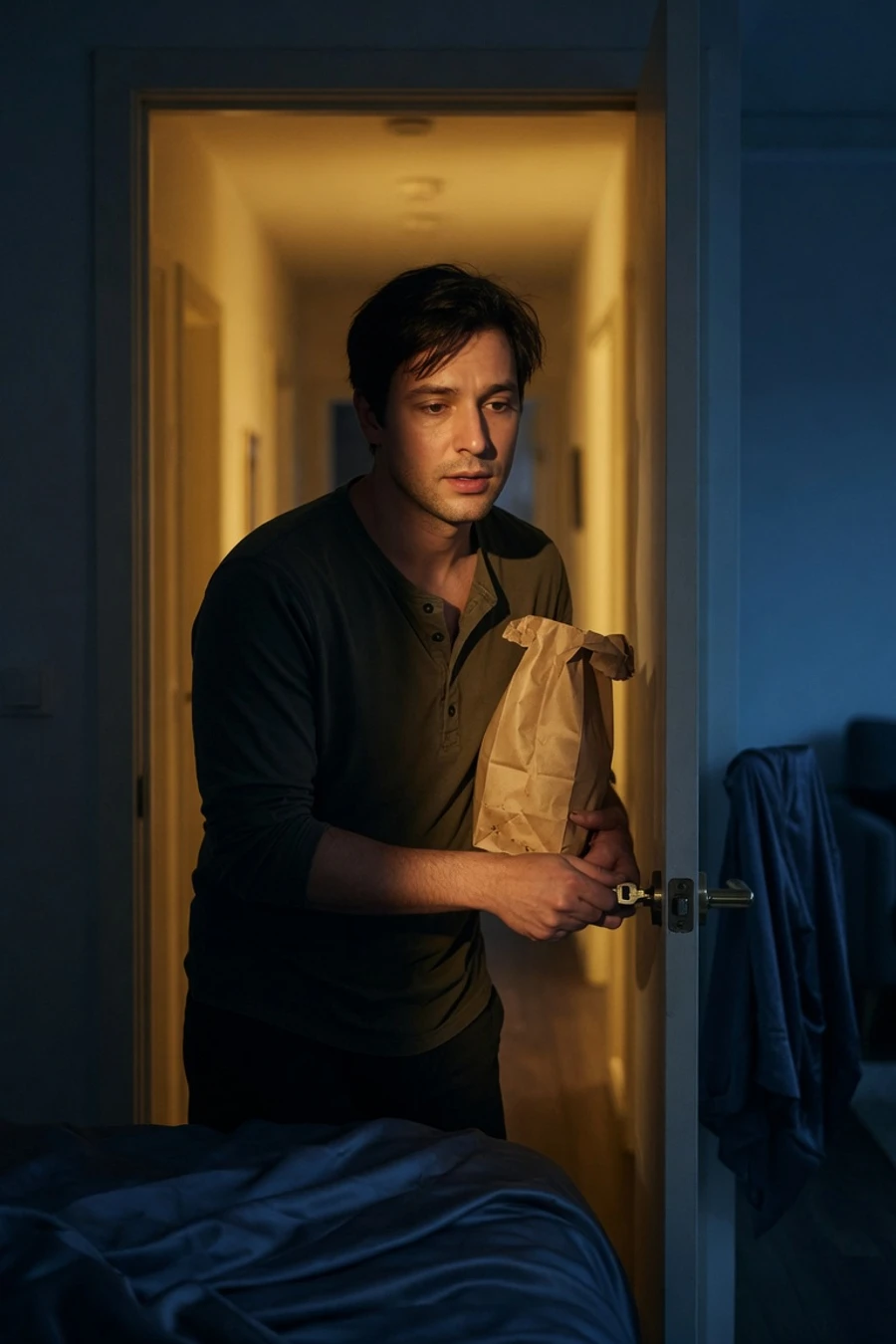
You hear the key at 8:15.
Not a knock. The key. The small specific sound of the spare key, the one you gave him two years ago in a fit of practicality, the one he has used exactly once before, on a night the two of you do not talk about, the night that taught you both what the key was actually for. The lock turns. The door opens. And there is Caleb in the doorway with the hall light behind him and a paper bag in one arm, and he does not say hi, and he does not ask if he can come in, because he is already in, because that is what the key means.
He looks at you on the couch in your coat in the dark. He takes you in the way he takes everything in, quick and total and without any visible reaction, the way you have watched him do across three years of dinners and bad parties and the back of cabs, the way that you understand now, having heard him describe his trauma rotation, is how he walks into a room with someone bleeding in it. He reads you. He sets the bag down on the counter.
"Okay," he says. Just that. Okay. Like he has assessed the situation and arrived at a plan and the plan begins with okay.
"I'm fine," you say. Your voice comes out rougher than you expect, from not using it all day.
"I brought soup," he says, which is not a response to I'm fine, which is the point. "Tell me which one I'm walking into. Is this a we-talk-about-it, or a we-don't-talk-about-it-and-I-stay, or a you-want-to-be-alone-and-I-leave-the-soup. Any of those is allowed. I just need to know which door I came in."
This is the thing about Caleb. Other people, when you are not okay, make you manage their concern. They need you to reassure them that they are helping, so that taking care of you becomes one more thing you are responsible for. Caleb has never once needed that. Caleb shows up with the options already laid out and hands you the choosing, which is the only kindness that has ever actually reached you, and you do not have the strength tonight to keep it out.
"The middle one," you say.
"We-don't-talk-about-it-and-I-stay."
"Yeah."
"Good," he says. "That's my best one." And he takes off his jacket and hangs it on the hook by the door, the hook that does not have anything else on it, and you realize with a small lurch that he has hung his jacket on your hook before, more than once, that there is a version of your doorway in which his jacket belongs there, and you have just never let yourself notice it.
He is still in his scrubs under the jacket. He has come from the hospital. You do the math on what time his shift would have ended and what it costs him to be standing in your kitchen instead of horizontal in his own bed, and you start to say something about it, and he says, "Don't," without turning around, ladling soup, and you don't.
He has been your friend for three years. You met at a dinner party thrown by a mutual friend who has since moved to a different city, both of you stranded at the wrong end of a table among strangers, and Caleb had leaned over and said something dry and exactly correct about the host's taste in wine, and you had laughed for the first time in a week, and that had been that. You have a category for him in your head and the category is Caleb, its own thing, not boyfriend and not brother and not the men you have dated who needed so much from you, just Caleb, the one who shows up, the fixed point. You have built a great deal of your stability on the fact that the fixed point does not move.
He brings you the soup. He sits on the floor with his back against the couch, near your knees but not touching them, his own bowl balanced on one knee, and he does not look at you while you eat because he knows that being watched while you fall apart is its own kind of work, and he lets you not fall apart, and somewhere in the warmth of the soup and the warmth of him a few feet away in the dark, the flat nothing cracks, just slightly, just enough for one true thing to come up through it.
"I don't know who I am if I'm not at that job," you say, to the dark, not to him.
"You're the person I drove across the city to bring soup to," Caleb says, like it is obvious, like it is the most obvious thing in the world. "I have a list."
You don't ask what else is on the list. You are afraid of the answer in a way you do not examine. Outside, a car goes by, then the long quiet of a Tuesday. He stays. He stays past when his body must be screaming at him to leave, past the soup, into the late, and you fall asleep on the couch with your friend three feet below you on the floor, and it is the first thing that has felt like rest in days.
Chapter 2: Two in the Morning
You wake at two because you always wake at two, your body's bad habit, and the apartment is dark except for the stove light, and Caleb is still there.
He has moved to the armchair. He has found the blanket off your bed, which means he went into your bedroom to get it, which means he stood in the doorway of your bedroom at some point tonight, and you file this fact away in the place where you have started, without permission, filing facts about Caleb. He is not asleep. He is looking at his phone with the brightness all the way down, and when you stir he looks over, and neither of you says anything for a moment, and the apartment holds the particular intimacy of two people awake in it at two in the morning when the rest of the world is not.
"You should be home," you say.
"Probably," he agrees, and does not move.
You get up. You are stiff from the couch and your face feels swollen from the day, and you go and sit on the arm of the chair he is in, because the floor is cold and because you do not entirely decide to, and he shifts to make room without being asked, his hand coming up to steady you at the small of your back and then going away again, a touch that lasts exactly as long as it needs to and not one second longer, and you feel the place where it was after it is gone.
"Can I ask you something," you say, "and you don't make it weird."
"I'm extremely good at not making things weird. It's my entire personality."
"Why do you do this." You gesture, vaguely, at the room, the soup bowls in the sink, the hour, him. "You have a twenty-eight-hour day. You set bones and tell people their husbands didn't make it and you have not slept since the Clinton administration. And you drove across the city to sit on my floor."
He is quiet for a second. Caleb's quiets, you have learned, are not the quiet of a man deciding whether to answer. He has already decided. They are the quiet of a man deciding how much of the truth the moment can hold.
"Because in there," he says finally, and in there means the hospital, the trauma bay, the thing he carries and does not bring home, "it's all strangers. I'm good at it. I'm good at the worst night of a stranger's life. But you go home after and there's nobody who - " He stops. Recalibrates. "You're not a stranger. That's the whole thing. You're the opposite of a stranger. I drove across the city because this is the one place I don't have to be good at it. I just have to be here."
You do not have a response to this that is safe. Every response you can think of moves the fixed point. So you say nothing, and you look at him, really look, the way you have spent three years not quite letting yourself, the lines that the rotation has put around his eyes, the steadiness of him, the fact that he is the most restful person you have ever known and also, you understand all at once, sitting on the arm of his chair at two in the morning, that you have wanted him for longer than you have admitted, that the category in your head labeled Caleb has had a false bottom this whole time and you have been very careful never to lift it.
His pager goes off.
It is an ugly sound, a hospital sound, and it cuts the room in half. He looks at it. You watch him look at it, watch him read whatever is on the little screen, watch the small private arithmetic of a man who has a whole second life full of people who need him more than you do, who are by any honest measure bleeding when you are merely sad, and you brace for him to stand up, because of course he stands up, that is what the pager means, the pager always wins.
He turns it off.
He does not answer it. He turns it off, and sets it face down on the side table, and the silence after it is enormous, and he looks back at you like nothing happened, except something happened, you both felt it happen, a man who runs toward emergencies for a living choosing, for once, to stay at the small one.
"You can't do that," you say. Your voice has gone strange.
"I'm not on call," he says. "I'm just bad at being off." And then, because he is Caleb, because he will give you the out every time, he says, "It's late. I'll take the couch. I'll be gone before you wake up and you can pretend none of this happened, if that's the door you want."
And there it is, laid out, the choosing handed to you the way he always hands it to you. The we-pretend-none-of-this-happened door. It is right there. It is the safe one. It keeps the fixed point fixed.
You are so tired of being the person who chooses the safe one.
You don't say anything. You just don't move off the arm of his chair, and the not-moving is its own answer, and he goes very still beneath you, the particular stillness of a man who has just felt the ground shift and is afraid to breathe in case he was wrong about what he felt. The two of you stay like that, not touching, three years and two in the morning and the pager dark on the table, the thing finally in the room, naked and unsaid, and neither of you reaches for the safe door, and neither of you yet reaches for each other, and the air between you is so full it hums.
Chapter 3: The Turn
"I'm going to say a thing," Caleb says, into the dark, very quietly, "and then I'm going to let you decide what it was."
"Caleb."
"I know. I know what it costs. I have done the math on what it costs more times than I have done the math on anything in my life, and I do it every single time I use that key, and the answer is always the same, the answer is that I would rather have this and risk losing it than keep being careful and never have had it at all." He says it plainly, the way he says everything, no music in it, which is what makes it land like a struck bell. "Three years. I have been not-saying this for three years. I'm tired. I'm too tired tonight to keep not-saying it."
You slide off the arm of the chair. You do it slowly, and you end up in front of him, your knees against the edge of the cushion between his, your face level with his face for the first time all night, close enough now that you can see he is frightened, actually frightened, this man who is not frightened of the worst nights of strangers' lives is frightened of you, of this, of the next ten seconds, and the sight of his fear is the thing that finally takes the floor out from under you, because his fear means it is real, means it is not a thing he does, means you are not about to make the worst mistake of your life alone.
"If we do this," you say, and your voice is shaking now, you let it shake, "and it doesn't work, I don't just lose a guy. I lose the person who brings me soup. I lose the fixed point. Do you understand that you are the fixed point."
"Yes."
"That's not nothing. That's the opposite of nothing."
"I know exactly what it is." His hand comes up. It does not touch you yet. It hovers at the side of your face, close enough that you can feel the warmth coming off his palm, a doctor's hand, a hand that has been inside the worst moments of a hundred lives and learned to be gentle anyway, and he says, "I'm not going to be the one who moves first. I've been not-moving-first for three years. I need you to be sure, because I'm only going to survive this if you're sure."
So you be sure.
You close the last inch yourself. You put your mouth on his, and it is nothing like you imagined and you have imagined it more than you will ever admit, it is not careful and it is not a question, it is three years arriving all at once, his hand finally landing against your jaw and his other hand fisting in the front of your shirt and a sound coming out of him that you have never heard him make, low and undone, the sound of a steady man coming apart, and you understand in a single bright collapsing instant that the carefulness was the cost, that he has been holding this the entire time you have known him, that every soup and every silence and every spare-key emergency was this, held, and now it is not held, now it is here, his mouth and his hands and the heat of him and the chair creaking as you climb into it, into him, the fixed point moving at last and the whole room moving with it -
and then he pulls back, just far enough to put his forehead against yours, both of you breathing like you have run somewhere, his hand spread wide and warm over your racing heart, and he says, against your mouth, wrecked, certain, "Not on a chair. Not tonight, you've had the worst day. I want -" and he stops, because Caleb does not make speeches, and what he gives you instead is the truest unfinished sentence you have ever heard, his hand over your heart and the want pouring off him and the dark full of three years finally answered, the thing begun and not yet done, the door open and both of you on the threshold of it, every safe version of your life behind you and the unsafe one breathing against your mouth, waiting.
The rest of the story
Finish The Spare Key.
Sign up free, then $2.99 opens the closing chapters.
No payment to start.
Private and discreet.