BF Original
The Long Dusk
You came to the edge of the world to pay a debt that was never yours - the thread your sister sold a fae lord three winters ago, called in now across her child and her husband who lived. You cannot pay what is not yours, he tells you. But you may strike your own. Step through his thorn-gate and give him a year of your days, and her thread is his no longer. His name is Vaelen, and his court is caught forever in the single hour after sunset, and he is the most beautiful thing you have ever been afraid of, and he is, you slowly understand, the loneliest. He engineered a debt across a whole human life for the chance of being crossed toward instead of away from. A dark, aching, intense fae romance about a creature who has taken from kings and gods and will not take the one thing he wants unless you hand it to him.
Chapter 1: The Debt at the Door
You came to the edge of the world to pay a debt that was never yours.
Your sister sold her name three winters ago, the way the desperate do in the border villages, where the wood thins and the wood listens. She bought a season of luck off a lord of the fae - a good harvest, a husband who lived, a child who breathed - and the price was a single thread of herself, owed and unspecified, to be called in when he chose. He has chosen. The summons came as frost-script across her windowpane in a hand too old to be human, and your sister, who has a child now and a husband who lived, sat at her own table and wept, and you watched her weep, and you put on your dead mother's cloak and you walked north until the trees went silver and the light stopped being daylight and started being something else.
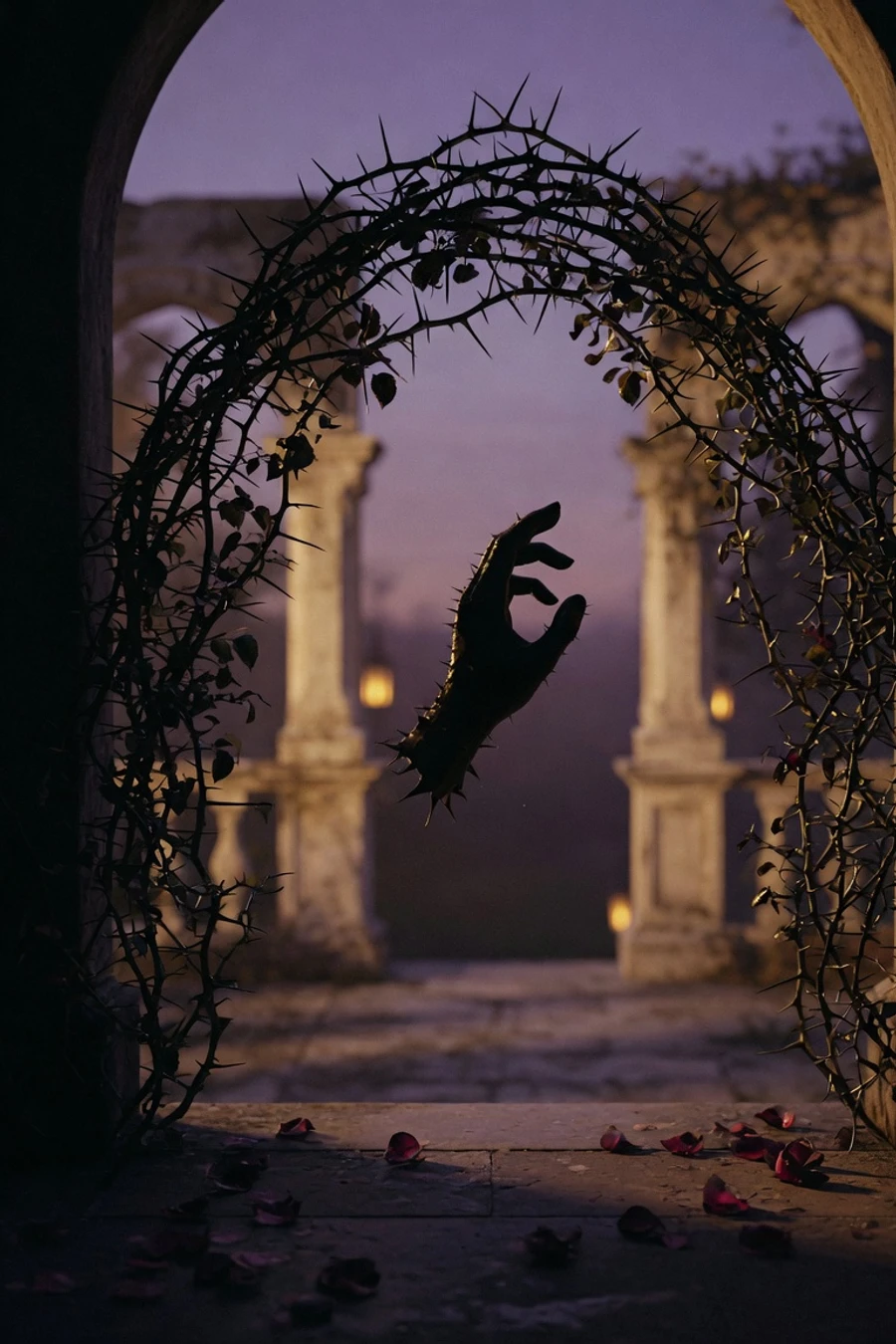
The door to his court is not a door. It is a place where the dusk thickens, where the air has a grain to it like running water, and a gate of black thorn stands grown into the shape of an arch with no wall on either side. You could walk around it. You understand, standing there with your breath smoking in the cold, that walking around it would do nothing - that the gate is not in the forest, the gate is in the asking, and the only way through is to offer the thing it wants.
"You are not the one who owes me." His voice comes from inside the dusk before you can see him, low and unhurried, a voice that has had centuries to learn exactly how little it needs to raise itself. "And yet you stand at my door wearing a dead woman's wool and a living woman's fear. That is interesting. I have not been interested in some time."
He steps out of the thorn-light and he is the most beautiful thing you have ever been afraid of. Tall, dark-haired, dressed in the deep grey-violet of the hour after sunset, and his eyes hold no white at all - the color of a winter star, edge to edge. He looks at you the way a collector looks at a thing that has wandered into his collection by mistake and turned out to be rare.
"I have come to pay her debt," you say. Your voice does not shake. You are proud of that, later.
"Have you." He tilts his head. "You cannot. A bargain is bound to the one who struck it; that is the whole of its nature. You may not pay what is not yours." A pause, and something moves at the corner of his beautiful mouth, not quite a smile. "But you may strike your own. Step through my gate, and you give me a year of your days to spend as I please. In exchange, her thread is mine no longer - I will burn it in front of you, and the harvest stays good, and the child keeps breathing, and you are mine until the dusk has turned a full year round. That is the price of the threshold. No one crosses it for free. Decide."
The thorn-gate waits. The dusk waits. He waits, and you understand already that waiting is a thing he is very good at, that he could stand in this hour for a hundred years and the cost of the waiting would be yours and not his.
You think of your sister at her table. You step through.
Chapter 2: The Court of the Long Dusk
It is always the hour after sunset here. That is the first thing you learn, and the deepest. The Court of the Long Dusk is caught in the single moment when the light has gone and the dark has not arrived, held there the way a held note hangs - the sky a bruised violet that never blackens, never pales, the first star out and fixed and the rest forever about to follow. He calls it his court. You come to understand it is also his condition. Time does not pass here unless he lets it, and he is in no hurry, and he has nowhere he would rather be than wherever the cost is not his to pay.
His name is Vaelen. He gives it to you on the second evening - which is the same evening, which is always the same evening - and he gives it the way a man hands over a blade hilt-first, watching to see whether you understand what you have been given. "Names are bargains too," he says. "You have mine now. You may call me with it. Be careful what you call me to."
He shows you the court because, he says, a thing he owns should know the shape of what owns it back. Halls of black thorn grown into vaulting, the wood living and slow, putting out a white flower here and there that opens only in your presence and closes when you pass. Floors of poured starlight that holds your weight like cold glass. Tables set with fruit you are warned, with great gentleness, never to eat - "that is a different bargain, and a worse one, and I would not have you strike it by accident; I want what I take from you taken on purpose." Doors everywhere, and every door a price. A room you may enter only by giving up a memory. A balcony you may stand on only by speaking aloud the thing you most regret. You learn to read the court the way you learned to read your sister's silences: by what each threshold asks of you before it lets you cross.
And under all of it, the loneliness. You feel it before you can name it - in the flowers that bloom only for you, in the way he watches you eat the bread he has had made safe, in the centuries stacked behind his winter-star eyes like rooms no one has lit in a long time. He is feared. You see it the first time a lesser fae of his court crosses the hall and will not raise its face to him. He is feared, and he is alone, and you begin to suspect, with a slow cold dread, that he did not call your sister's thread because he wanted it at all.
Chapter 3: The Bargain-Room
There is a room at the center of his court that you are not made to enter and cannot stay out of.
He takes you to it on the seventh evening that is the same evening. A round chamber under the highest vault, and in it, hung in the still air like frost on a thousand windowpanes, the bargains. Every debt he has ever been owed or has ever owed, written in that old frost-script on threads of cold light, each one tethered at one end to him and at the other end trailing off into the dusk toward whoever struck it. Your sister's is there. He keeps his word in front of you: he takes the thread of her between two pale fingers, and he says a word you do not know, and it burns out clean from the far end inward, and somewhere a hundred leagues south a weeping woman feels three winters of dread lift off her chest in a single breath and does not know why.
"It is done," he says. "She owes me nothing. You owe me a year." He looks at the thread of you - and it is there now, your own, struck at the gate, glowing among the thousands. "I have collected a great many of these. Kings. Armies. A god, once, who has regretted it ever since. I have never once been owed a thing I could not name the use of." He is quiet. The star-light moves on his face. "I do not know what to do with you. That is also new."
You ask him the thing you have been afraid to ask. Why her thread, why a poor woman in a border village, why call a debt so small. And Vaelen, lord of the Long Dusk, feared by his own court, older than the language you asked it in, does not answer for a long moment. Then he says: "Because every century or so I call in a small one. A village. A poor house. Someone who cannot pay it themselves and must send another." He does not look at you. "I have been alive a very long time, and I have learned that no one comes to this court for love of it. They come because they owe. So once in a while I make someone owe, so that someone will come. It is the only way I am ever crossed toward instead of away from." Now he looks at you, and the winter-star eyes are undefended for the space of a breath. "I did not expect the one who came to be worth keeping. That was careless of me. I am rarely careless."
You should be afraid. You are. But under the fear, which is real, is the thing that will undo you both: you have just watched the most powerful creature you have ever met confess that he engineered a debt across a whole human life for the chance of company, and instead of monstrous, it landed on you as the loneliest thing you have ever heard, and your treacherous heart moved toward him the way the white flowers open when you pass.
Chapter 4: What He Owes You
The change is small and you feel the whole court hold its breath around it.
It is the thornmaze that does it. There is a maze of living black thorn at the edge of his court, and you wander into it on an evening when you cannot bear the bargain-room one more time, and the thorn closes its paths behind you the way it closes its flowers, and you are lost in it, truly lost, the dusk-light failing for the first time since you came, going toward a dark that has waited a thousand years to arrive. You call his name. You did not decide to. It comes out of you - Vaelen - the way breath comes out, and you remember, too late, what he told you at the start: be careful what you call me to.
He comes through the thorn as though the thorn is not there, and the maze opens for him in a long silent wound of parting branches, and he is at your side faster than a thing his size should move, and his hands - the first time he has touched you, his hands - close around your arms, cold and certain, and he looks at you with something on his face that no one in his court has seen in a very long time, which is fear. Not your fear. His.
"You called me by my name." His voice is not steady. You have never heard it not steady. "Do you know what that costs me. When you call me by my name I must come, wherever I am, whatever it costs - that is the law of the giving, that is why I do not give it - and I came, and I find that I do not mind the cost, and that is - " He stops. The thousand-year composure is cracked clean through and the light comes out of the crack. "That is a debt I did not know I had. You did not strike it. I cannot find when it was struck. But I owe you something now, and I have not owed anyone anything in four hundred years, and I do not know how to be in a room with you and owe you and not - "
He does not finish it. His cold hand has come up to the side of your face, the way it has wanted to for evenings, and he is looking at his own hand against your warm human cheek as though it has betrayed him, and the whole Court of the Long Dusk has gone so silent that you can hear the first star burning.
"Tell me to stop," he says, "and I will stop, and I will keep stopping for as long as you are mine, a year or a hundred, and I will never name this again. Or do not tell me to stop. But you must choose it. I will not take what is not handed to me. I have taken from kings and gods and I will not take this. Decide."
The dusk holds. His hand is cold on your face and your face is warm under it and the whole unfinished want of him hangs in the air like a thread not yet struck, glowing, waiting for the word that binds it.
The rest of the story
Finish The Long Dusk.
Sign up free, then $2.99 opens the closing chapters.
No payment to start.
Private and discreet.