BF Original
The Hired Man
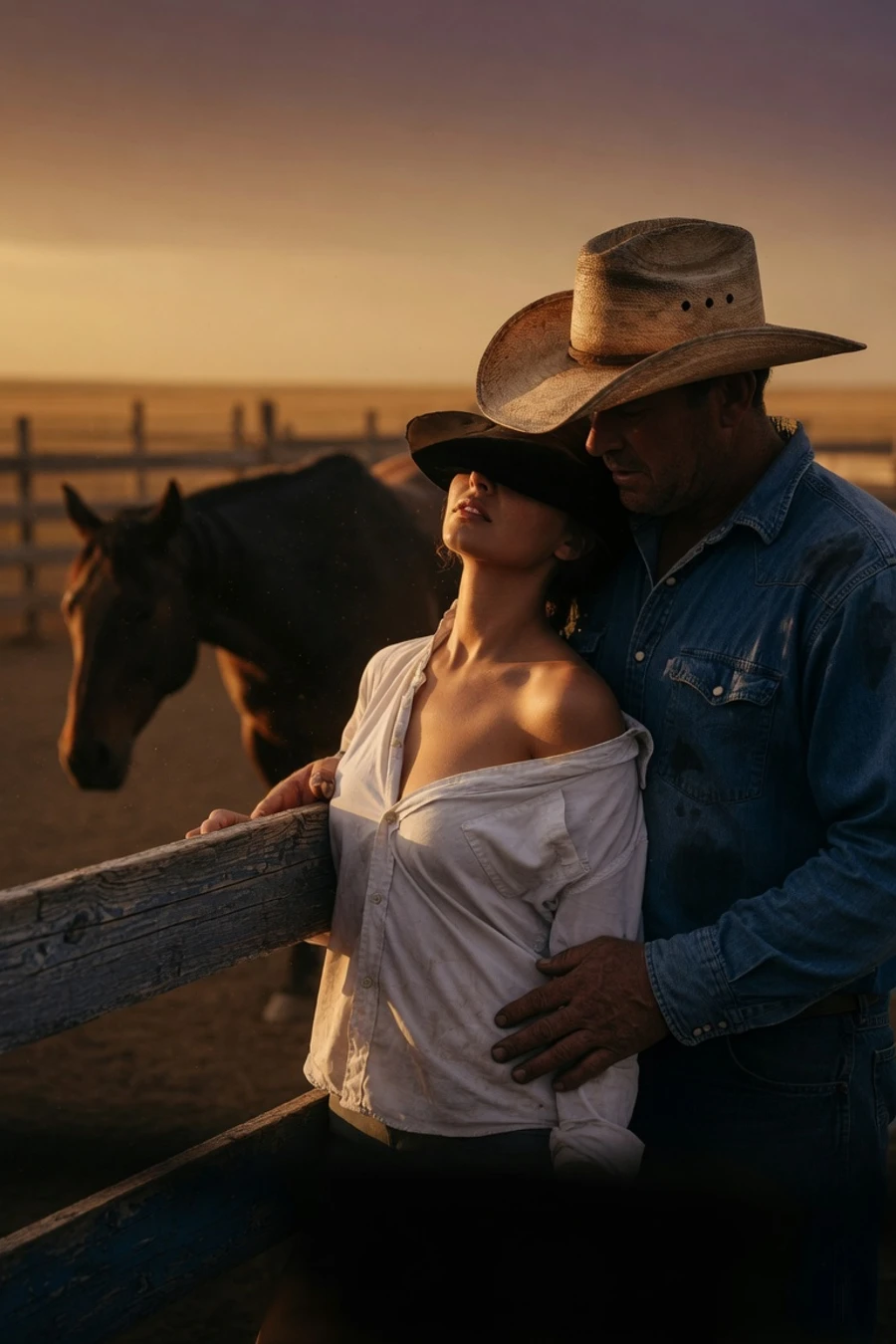
The ranch is yours now, on paper - three thousand acres of high dry country your father left you without asking whether you wanted it, and Wade, the foreman who came with the land and knows every fence line and water gap and the temper of every animal on it. You mean to sell. He gentles horses for a living: you cannot break a good one, he says - break it and you get a thing that hates you; gentle it and you get a partner. He will not reach for what is not handed to him. The story of the season you stayed.
Chapter 1: The Deed and the Foreman
The ranch is yours now, on paper, which is the only place it has ever been yours. Your father left it to you the way he left you everything - without asking whether you wanted it, certain that blood was enough to make a thing fit. Three thousand acres of high dry country, a herd you couldn't count, a house with his boots still by the door, and Wade.
Wade is the foreman, and he came with the land the way the wells came with it and the weather comes with it, a fixed feature you inherited without choosing. He has run this ranch for eleven years, through your father's good seasons and his last bad one, and he knows every fence line and water gap and the temper of every animal on it, and he knows, the first morning you come down onto the porch in clothes that have never seen work, that you know none of it. He doesn't say so. He just looks at you from under the brim of his hat, unhurried, the way he looks at weather, and touches two fingers to it, and says, "Ma'am," in a voice like dry ground, and goes back to the horse he's working in the round pen, and leaves you standing on your own porch feeling like the guest.
You mean to sell. You tell yourself this on the long flight out and the longer drive in - sell the whole thing, the acres and the herd and the house with the boots, take the money back to the city and be done with the man who never once asked whether you wanted what he gave you. You know how to sell land. In the city you spent ten years writing the acquisition memos for a firm that bought family operations exactly like this one and broke them up for the pieces, the ground to one buyer and the herd to another and the name to no one, and you were good at it, good enough that the men who called land "inventory" knew yours. You have signed away a hundred places like this. You did not expect one of them to be your father's. You tell Wade you mean to sell on the second day, mostly to see his face do something.
It doesn't. "Your land," he says. "Your call." And then, because he is honest the way the country is honest, all the way down: "Sells better in the spring, after calving, if it sells at all out here. Take you a season to learn what you're holding before you hand it off cheap." He settles the hat. "Or don't. Like I said. Your call."
You stay for the season. You tell yourself it's about the price.
Chapter 2: How a Thing Gets Gentled
He puts you to work, because you ask him to, because standing on the porch in clean clothes watching men sweat is its own kind of shame, and Wade does not coddle you and he does not mock you, which is somehow worse, because it means he expects you to be capable, and you find you would crawl over broken ground before you'd prove him right to expect less.
You make the mistake, once, of saying out loud that the place might list better if the south fence got rebuilt before it went on the market. Wade is coiling wire and he doesn't stop, but something goes still in his hands. "Easy thing," he says, even and quiet, not looking at you, "selling what somebody else stayed to keep standing." Then he goes back to the wire, and he doesn't say anything more, and he doesn't take it back, because it's true and you both know it - your father left you the deed; eleven years of Wade left you the thing the deed describes - and it sits on the fence between you the rest of the afternoon like a third pair of hands.
You learn the country through your hands. Wire and post and the particular ache of a full day's honest work, the kind the city never gave you. And you learn Wade the way you learn the land - slow, by watching. He gentles horses. That's the heart of what he does, you come to understand; the rest is fences and cattle and water, but the thing he's good at, the thing that's almost beautiful, is the round pen and a half-wild colt and the patience he spends, hours of it, never forcing, never breaking, just waiting the animal toward trusting him until the moment it chooses to come to his hand on its own. "Can't break a good one," he tells you, when you ask, the most words you've gotten out of him at once. "Break it, you get a thing that does what it's told and hates you. Gentle it, you get a partner. Takes longer. Worth it." He doesn't look at you when he says it, and somehow that's how you know he's not only talking about the horse.
He has a way of being near you at the fence, at the gate, in the close dark of the tack room with the smell of leather and dust, that never crosses a line and never quite stays on the right side of one either. His hands when he shows you a knot - rough, careful, certain. The heat coming off both of you at the end of a day, sun and sweat and the long charged quiet of two people doing hard work side by side. You catch him reading you the way he reads a green colt, patient, taking your measure, waiting, and you understand that Wade does not break things, that whatever this is between you he will not force it an inch, that he is going to wait you toward his hand and let you be the one to choose to close the distance.
You hate that it's working. You feel it work anyway.
Chapter 3: The Porch After Dark
It's branding done and the long day finished and the men gone back to the bunkhouse, and you're on the porch in the blue dark with a bottle of your father's bourbon you found in the cabinet, and Wade comes up from the barn and you hold up the bottle in the dark, an offering, and he stops at the foot of the steps and considers it the way he considers everything, and then comes up and takes the other chair.
You drink in the quiet. The country is enormous and black around you, more stars than the city ever let you see, the herd a low murmur out in the dark. Eleven years he's given this place. You ask him why he stayed, through your father's bad last season, when he could've hired on anywhere. He's quiet so long you think he won't answer.
"Land's honest," he says finally. "Animals are honest. A man knows where he stands with all of it." He turns the glass in his rough hand. "People are the hard part." And then he looks at you, full on, the first time he's let you have the whole weight of it, the hat off now and his eyes pale in the dark, and the porch goes very still around the two of you. "You're the hard part," he says, low, like a man stepping onto ground he's tested and knows won't hold him forever. "Been the hard part since you came down those steps in your city clothes looking like you'd fight the whole sky. I don't force things, ma'am. Not horses, not this. So I'm going to sit here and finish this drink, and then I'm going to walk down to that barn, and you're not going to say anything to stop me - unless you want to. And if you want to, you're the one that has to say it. Because I've waited out greener things than you, and I'll wait this out too. But I won't reach for what isn't handed to me."
He finishes the bourbon. He sets the glass down on the porch board, careful, and he stands, and the night is huge and black and full of the choice, and he takes the first slow step down toward the barn, waiting, the whole charged season strung on the held breath of whether you let him go -
The rest of the story
Finish The Hired Man.
Sign up free, then $2.99 opens the closing chapters.
No payment to start.
Private and discreet.