BF Original
Sweetgrass
You come to Hawthorn in the first week of June to decide what to do with your grandmother's eighty acres at the dead end of Colton Creek Road - the lie you tell the lawyer and the larger one you tell yourself. Wade Colton's land runs up against yours. He gentles horses for a living: you can't break a good one, he says. He will not reach for what isn't handed to him. The story of the season you stopped meaning to leave.
Chapter 1: The End of the Road
You come to Hawthorn in the first week of June, when the high country has finally gone green and the sweetgrass along the county road is knee-high and smells, when the wind lays it over, like vanilla and cut hay and something older underneath. Your grandmother left you her place - eighty acres and a slumped farmhouse at the dead end of Colton Creek Road, the last mailbox before the land turns to range - and you have come to decide what to do with it, which is the lie you tell the lawyer and the larger lie you tell yourself. You do not know yet that you have come to stay. You only know that the city got quiet in a way that frightened you, and that the one place that ever felt like ground was here.
The road runs out at your gate and keeps going past it as a pair of dirt ruts that climb into the Colton land. That is how you meet him - not at the rodeo, not at the diner, but on your own washed-out driveway the second morning, when your rental car sinks to the axle in the spring mud and you are standing in it to your shins, swearing at the sky, and a truck comes down off the range and stops.
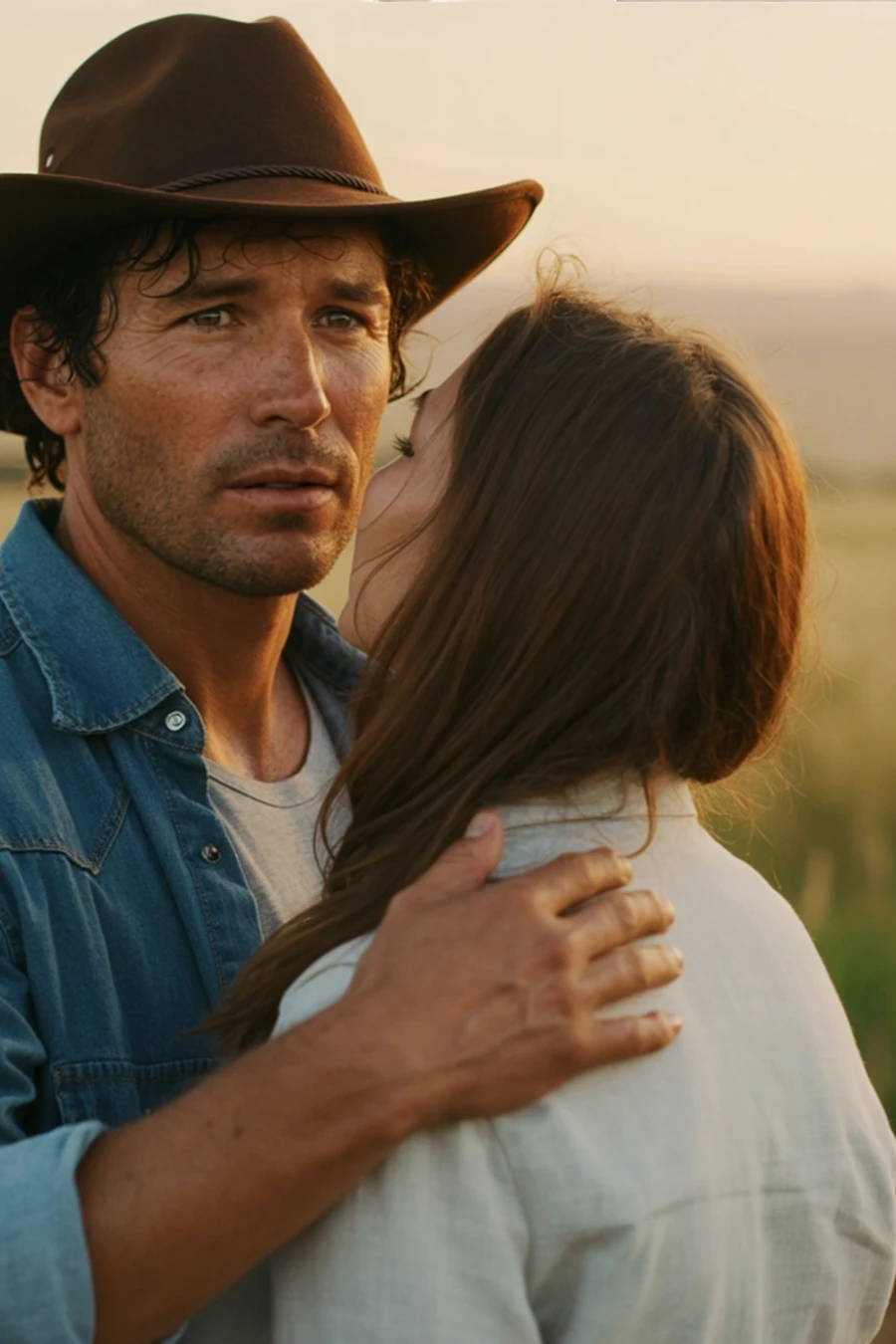
The man who gets out is tall and unhurried and he takes the whole of the situation in the way you imagine he takes in weather - fast, total, without alarm. Mid-thirties. A broad-brimmed hat gone soft with age, a chambray shirt with the sleeves turned back, sun-bronzed forearms marked with fine pale scars. He does not laugh at you, which you brace for. He does not offer pity either. He just looks at the car, and the mud, and you, and says, "You'll want to take your boots off before you try to walk out of that. Easier to lose a boot than a foot."
He hitches a chain to your bumper and pulls you free with the truck in a single slow pull, no drama, and when you start to thank him too much he is already coiling the chain. "Wade Colton," he says. "Your grandmother's land runs up against mine." A beat, looking up the green slope behind your place. "She was a good neighbor. Sorry for your loss." And he touches two fingers to the brim of his hat and gets back in the truck and is gone up the ruts before you have finished saying your own name to the empty road.
Chapter 2: You Can't Break a Good One
You mean to be in Hawthorn two weeks. You are still there when the sweetgrass goes to seed.
It is the land that keeps you first - the eighty acres your grandmother kept, gone to thistle and slumped fence, and the slow honest ache of putting a day's work into ground that answers. And it is Wade, in the way a fixed feature of a landscape becomes a thing you orient by without deciding to. His truck on the ruts morning and evening. The far-off sound of him working cattle. The fence between your land and his, which he mends from his side without comment the same week you start mending it from yours, so that one afternoon you meet in the middle of it with a roll of wire between you and neither of you quite knows what to say.
What he says, when you ask what he's doing down in the round pen one evening with a half-wild colt, is the most words you've gotten from him at once. "Gentling her." You watch him - hours of it, never forcing, never a rope drawn hard, just patience, just standing in the center of the pen and waiting the animal toward trusting him, until the moment it crosses the dust on its own and puts its nose to his open hand. "Can't break a good one," he tells you, not looking at you, and you understand later he was not only talking about the horse. "Break it, you get a thing that does what it's told and hates you. Gentle it, you get a partner. Takes longer." He runs a hand down the colt's neck. "Worth it."
You learn the shape of him the way you learn the land - slow, by watching. The dry humor that arrives a half-second late and rarely. The way he tips his hat to your grandmother's photo on your mantel the first time he comes inside for water, the same as he'd tip it to a person. The way he reads you the way he reads a green colt - whether you lean in or hold back, whether you're tired and won't say so - and never says what he sees. He is the most contained man you have ever met, and somewhere in the long June light you stop finding it cold and start finding it the steadiest thing in your unsteady life.
Chapter 3: What the Ground Cost Him
The town takes you in the way small towns do - all at once and forever, the moment you stop being a stranger. You learn Hawthorn through its people: Eliza, Wade's younger sister, who runs the general store and has his same steady eyes and twice his words, and who watches the two of you with a carefulness you don't understand yet. Old Jim Harper, a retired rodeo man who taught Wade to ride and tells you, leaning on your gatepost, things Wade never would.
That Wade's father died on the Colton land when Wade was twenty-six - a cattle stampede, a wet spring, a thing that happens and is nobody's fault and that Wade has spent every year since deciding was his. That Wade took the ranch up the next morning and has not put it down since. That a year ago a young hand named Ty got caught against a fence by a bull that should have been penned, and lived, but barely, and that Wade works the fence line at dawn now partly so he doesn't have to be still with the blame he's decided to carry there too.
You don't let on that you know. But you watch him differently after - the stillness you'd read as peace, you see now is a held thing, a man keeping his own weather from breaking. And the evening you bring a thermos of coffee down to the round pen and set it on the rail beside him without a word, the way he sets a plate beside you when you've forgotten to eat, he goes very still, and looks at the coffee, and looks at you, and for one moment the held thing in his face moves. "You been talking to Jim," he says. Not a question.
"He talks," you say. "You don't."
Wade is quiet a long while, the colt circling soft behind him in the dusk. "Some things," he says finally, low, "a man can't gentle. Just has to carry." He picks up the coffee. He drinks it. He doesn't say anything else. But he doesn't go back up the ruts that night until your kitchen light is on and he knows you're inside, and you understand that this, too, is a thing he does without saying.
Chapter 4: The Hawthorn Fair
The county fair comes in August - the rodeo, the livestock pens, the dance on a board floor laid down in the fairground under strings of bulb light. You go because Eliza makes you, and Wade competes because he always has, and you find yourself at the rail watching him ride a bronc out of the chute with your heart in your throat in a way that tells you something you've been not-telling yourself for two months.
He places. He comes off the dust grinning the rare grin, dirt on his jaw, and the first thing his eyes do is find you at the rail, and the second thing is look away too late. After, when the band starts up, he is the one person at the whole fair who doesn't ask you to dance, and you understand by now that this is not indifference - it is the iron rule of the man, that he will not reach for a thing that hasn't been handed to him. So you cross the board floor through the two-stepping couples and the bulb light and you stand in front of him and you hold out your hand, and the look on his face is worth every step.
He dances the way he does everything - unhurried, certain, his rough hand warm and careful at the small of your back, matching his stride to yours without being told. You are close enough to smell the dust and sun on him. The band slows. His hand spreads a little wider on your back. You tip your face up and his is right there, the held weather of him, the steady hazel eyes, and the whole loud bright fair narrows to the two inches of air between your mouths -
and a voice cuts in, easy and mean. Marcus Hale, a neighboring rancher with a grudge as old as the fence line, saying something just loud enough about the city woman playing at country, about Wade Colton finally finding someone who'll have him before the bank does. And you feel Wade go still under your hands - not toward violence, but away from you, the old shame closing over him like water, the ranch's trouble said out loud in front of the whole town. He steps back. He touches his hat. He says, "Evening," to no one, and he is gone into the dark beyond the bulb light, and the dance goes on without you.
Chapter 5: The Porch at the End of the Road
You don't see him for four days. Then on the fifth evening his truck comes down the ruts and stops at your gate, and he sits in it a moment the way a man sits before he does a hard thing, and then he comes up your porch steps with his hat in his hands, which you have never once seen.
"I left you on a dance floor," he says. "In front of the whole town. That was a coward's thing and I'm sorry for it." He turns the hat in his rough hands. "Hale wasn't wrong about the bank. I might lose the ground my father died keeping. I've known it a year and I've told nobody, and I let it walk me off that floor away from the one good thing that's come up this dead road since I don't know when." He stops. He makes himself hold your eyes. "That's you. In case I'm being too plain about it. The good thing is you."
The sun is going down red behind the range. The sweetgrass has gone to gold seed in your yard and lays over in the evening wind, vanilla and dust. You have a glass of your grandmother's whiskey in your hand and you set it down on the rail, and you come to the top of the steps where he's standing one below, which puts you eye to eye, and you can feel the heat coming off him, four days and two months of it, the held weather finally at the edge of breaking.
"I don't reach for what isn't handed to me," he says, low, the half-step-down voice, wretched and certain at once. "Not horses, not a woman, not anything. I'd stand on this step the whole of the fall before I'd take a thing you didn't give." His jaw works. "So you have to be the one. I'm asking you to be the one. But I'll get back in that truck right now and be your neighbor and nothing else till the day I die, if that's what you -"
And the wind lays the sweetgrass over, and the red light is on his face, and you take a fistful of his shirt -
The rest of the story
Finish Sweetgrass.
Sign up free, then $2.99 opens the closing chapters.
No payment to start.
Private and discreet.