BF Original
Squall
Iona is thirty-two. She lost a pregnancy ten months ago and her marriage has gone quiet. A storm cuts the road on the Pembrokeshire coast, traps her old flatmate at the cottage for four days, and she finds an asking she has been carrying since October.
Chapter 1: Friday
The road down to the house at Solva is a single track between hedgebanks of gorse and a low slate wall, and in February at half past four the sun is already a yellow line under the cloud and the wall is the colour of old pewter. I drive slowly. I have driven this road three hundred times in three years and I still drive it slowly because the lay-by at the third bend is invisible until you are on it and a tractor in February is a tractor in any month.
I am bringing Joanna down. I picked her up at Haverfordwest station because Joanna does not drive. Joanna has not driven since she was twenty-four and put a Polo into a hedge near Bath and decided the hedge was a sign.
She is asleep in the passenger seat. She slept from Carmarthen onward. She came up from London on the seven o'clock train and changed twice and arrived at Haverfordwest with the kind of tiredness that is not sleep but the absence of it. I have not seen her in two years.
The house is at the end of the track. It is a small slate-roofed cottage on the cliff above Solva harbour. We bought it three years ago with the money from Will's mother, who left him everything because she had no one else to leave it to. We bought it to be a thing we drove to. We were going to move down properly when the baby came. That is the sentence I do not finish in my head anymore, even by accident.
I cut the engine. Joanna does not wake. I sit a moment with my hands on the wheel and I look at the house. The kitchen light is on.
The kitchen light is on.
The kitchen light is on, which means Will is here.
Will is meant to be in Glasgow until Sunday. Will is meant to be in the office in Cowcaddens that has a leak in the men's loo, working on the hospice plans, until at least four o'clock on Sunday afternoon, because that is what he said on Wednesday when he rang from the office and I was at the kitchen sink in London washing the small grey plates we have and he said he could not get away.
The light is on.
"We're here," I say to Joanna, because I do not know what else to say.
Joanna stirs. She opens her eyes and looks at the dashboard clock, then at the kitchen window, then at me. Joanna's eyes are slow to come into focus. She has always been like this. She used to wake up in the flat in Bristol and stare at the kettle for a full minute before she could remember what it did.
"You said he was up north," she says.
"He was meant to be."
"He's here."
"He's here."
She looks at me. Joanna has a face that does not lie about what she is thinking, which is an inconvenient face for a commercial property lawyer and a useful face for a friend.
"Do you want me to ring a taxi back to the station," she says.
"No."
"I will."
"No," I say again. "Don't be stupid. Come in. We're already cold."
She watches me a second longer. Then she nods. She gets out and goes round to the boot and lifts her bag, which is small. Joanna packs the way she always has, which is for two nights and three changes and the assumption that anything she has forgotten she can buy on Saturday morning at a Boots she will find. There are no Boots in Solva. There is one shop. The shop sells gas canisters and bread and a kind of cheese that is mostly rind.
We walk across the gravel. The wind is from the south-west. The wind is from the south-west at a force I will look up later and find is about a five going to a six. The cliff path at the end of the garden is whistling at the same pitch the wind always whistles it at, the small high note like a child blowing across the top of a bottle.
The front door is unlocked because Will is inside. The kitchen door from the hall is open. The kitchen is warm. There is a smell of onions and something done in butter. Will is at the stove with his back to us. He has on the jumper I bought him three years ago and a pair of the soft wool socks that are mine and not his, and his hair at the back of his head needs a cut.
He turns round.
"Iona," he says, as if he is meeting me for the first time. He has not heard the car. The wind is loud, and the extractor fan over the stove is loud, and he was at the stove. He looks at me and his face does the thing his face does when he is glad and frightened in equal measure, which is mostly nothing. He has a face I have spent ten years learning to read.
He looks past me. He sees Joanna. His face does a different thing.
"Joanna," he says.
"Will."
He puts the wooden spoon down. He wipes his hands on the tea towel that I left on the kitchen rail when I came down at Christmas. He crosses the kitchen and he kisses Joanna on the cheek without giving her time to take her coat off, the way he kisses any woman who is an old friend. He does it correctly. He does it in the right number of seconds. Then he turns to me.
He does not kiss me. He puts his hand on my upper arm. The hand stays there a moment.
"Hello," he says, quietly, only to me.
"You're early," I say.
"Yes."
"Why."
He thinks. He thinks like a man who has been thinking for the entire flight from Glasgow to Cardiff and the train from Cardiff to Haverfordwest about how he would answer this question, and who is going to tell me the answer that is not the true answer because he has not found a way to say the true one out loud.
"They sent me home Wednesday," he says. "They didn't need me for the rest of the week. The drawings are with the planner."
"You didn't tell me."
"No."
"You came down without telling me."
"Yes."
Joanna has taken her coat off behind us. She is standing in the doorway with her coat folded over her arm. She is doing what Joanna does when she has walked into a room mid-conversation, which is to be very, very still and let it pass through her without participating.
"I'll get my bag upstairs," she says.
"No," I say. "Wait. Sit down. He's done the onions. Have a drink with us."
She looks at Will. Will looks at me. I look at the pan on the stove. There are onions, butter, what looks like cream coming together to something. The smell is the smell of a kitchen that has been worked in.
"Iona," Will says.
"Yes."
"I was going to ring."
"I know."
"I was going to ring tomorrow morning. I wanted to drive up and meet you at the station."
"Joanna doesn't drive."
"I know. I was going to drive up there."
"Will."
"Yes."
"It's all right."
He looks at me. He looks at me the way he has been looking at me for ten months, which is not the way he used to look at me. It is the look of a man who is in his own house and does not know what to do with his hands. He has not put his hand back on my arm.
"I'll open a bottle," he says.
"Yes," I say. "Please."
He goes to the cupboard. Joanna comes the rest of the way into the kitchen. She puts her coat on the chair. She watches me across the table.
"Iona," she says, very low.
"It's fine."
"It's not fine. You said he was up north until Sunday."
"It's fine. He's come home early. He sometimes does that. He's done the dinner."
"Iona."
"Joanna."
She watches me. She knows it is not fine, the way Joanna knows things. But she does not say anything else. She sits down at the table the way she sat down at the kitchen table in the flat in Bristol when we were twenty-three, with one leg folded under her, the way she has always sat. The kitchen we are in now is not the kitchen in Bristol but Joanna in this chair is exactly Joanna in that one.
Will opens a bottle of the white from the case at the back of the larder, which is a case my mother sent us at Christmas. He pours three glasses. He brings them over. He sits down opposite Joanna and beside me. The seat I am in is the seat I always sit in. The kitchen has its geometry. He kept the geometry when he set the table.
"To you finding your way to Solva," he says to Joanna.
"To being found," Joanna says.
We drink. The wine is fine. The kitchen is warm. The stove is humming. Outside the wind is a five going to a six and the cliff path is whistling and the gulls are not out, the gulls are gone in the cliff face below the headland because gulls in winter know what's coming.
"There's a forecast on," Will says.
"What kind."
"Storm Atalanta. Hits late tonight. They've got a yellow warning to nine in the morning."
"How yellow."
"Yellow yellow. Not amber. But the road might be down by Sunday morning."
"The road as in the lane to the village."
"The road as in the lane and the B4341. The cut at Llanteg goes early. Always does in a south-westerly."
I look at him. He looks at his glass. He has come home for the storm. He has come home for the storm and not told me. He has come home because he could not stand to be in Glasgow knowing the storm was coming and I was in the cottage alone and he had not been here for two months in a way that mattered.
He has also, I realise, come home thinking I would be alone. He had forgotten Joanna was coming.
He looks up and meets my eye. He sees that I have understood this.
"Iona," he says.
"It's all right," I say. "Eat the onions before they catch."
He gets up. He goes back to the stove.
Joanna lifts her glass. She is watching me with her lawyer face, which is the face she has had since she stopped being twenty-two.
"Iona."
"What."
"This is going to be a weekend, isn't it."
"Joanna."
"All right," she says, and drinks.
The wind is moving the casement of the window above the sink. The casement does not seat properly when the wind is from the south-west and it tonks against the frame every fourth or fifth gust. I should have had it fixed. I have been meaning to have it fixed.
I drink the rest of my glass.
"Yes," I say. "It's going to be a weekend."
Chapter 2: Saturday
We go to bed late.
Will sleeps in our room. I sleep in our room. Joanna sleeps in the second bedroom under the eaves with the small skylight and the woollen rug we found in a shop in Newport and the framed map of Pembrokeshire on the wall.
Will and I sleep in our bed in the way we sleep, which is not touching. We have not touched in bed in a way that mattered since October last year, when the result came back from the obstetrician and the world tilted and did not come back upright. We sleep in our bed not touching, with my back to him and his arm folded under his pillow, and his breathing changes after twenty minutes and goes deep.
I do not sleep.
I do not sleep because the storm came in at half eleven and the wind got up to something the man on the radio called a force eight in the gusts and the casement above the sink tonked all night and the slates on the porch roof lifted twice with a sound like a card being snapped. I do not sleep because the bed beside me has a body in it that I love and that I have not known how to reach for in ten months. I do not sleep because Joanna is in the room above me, sleeping the way Joanna sleeps, on her front with one arm hanging off the bed, and Joanna is here because I asked her to come, and Joanna is here because she is leaving a marriage of seven years and has not slept properly since June.
I lie still. I count the gusts. I count the casement tonks. I do not move.
At a quarter past five the wind drops, which means the eye is somewhere offshore. At half past five the rain starts in proper, a horizontal kind, and at six the kitchen extractor fan kicks on by itself because the pressure drop outside is doing strange things to the ducting. I get out of bed.
I dress in the kitchen. I put the kettle on. I sit at the table with a mug of tea and I watch the dark window get less dark.
Joanna comes down at twenty past seven, in the long grey jumper I lent her last night and her own pyjama bottoms and the wool socks I keep in the hall basket. She does not say anything. She gets the second mug down from the rack. She makes herself a tea. She sits across the table from me in the chair that was Will's chair last night.
"Storm Atalanta," she says.
"Yes."
"Road's going to be down."
"Yes."
She looks at me. Her hair is up in the kind of knot she does in two seconds with one finger. Her face is the face of a woman who has slept properly for the first time in a season.
"I slept," she says.
"Good."
"I haven't slept like that since June."
"I know."
She drinks her tea. The rain is sideways at the window. The light is starting to come on. The light is the wet steel-grey it is on a February morning at the cliff with cloud all the way down to the water.
"Iona."
"Yes."
"Are you going to tell me why he came down."
I think about it. I think for the time it takes the tea to go warm.
"He came down because he could not stay up there knowing the storm was coming and I was here."
"And he forgot I was coming."
"He forgot you were coming."
"And you forgive him for that."
I think about it again.
"I don't know if forgive is the word."
"Iona."
"Yes."
"What is the word."
I look at her. Joanna is the kind of friend who has been in my kitchen for twenty minutes and is already inside the only sentence I have not been able to say.
"He's been away for ten months," I say. "He hasn't actually been in Glasgow for ten months. He's been at the hospice site for chunks of it and at the office in Glasgow for chunks of it and at home with me in London for the rest. But he hasn't been in the room with me for ten months."
"Since October."
"Yes."
"Since the baby."
"Yes."
"Iona."
"Joanna."
She puts her hand across the table. She puts it over mine. Joanna has small hands with short, very clean nails. She has not painted her nails since she was twenty-six.
"I'm here," she says.
"I know."
"I'm here for as long as you want me to be."
"You're meant to leave Monday at lunchtime."
"The road's going to be down past Monday."
"I know."
"So I'm here longer than that."
"You have work."
"I have leave."
"You don't have leave. You took the long weekend."
"I have leave. I took three weeks. I told you the weekend because I didn't want you to feel like a project."
I look at her. The kitchen is very quiet. The rain at the window has settled into the patient horizontal rain of a Welsh winter, and the casement is finally not tonking because the wind has shifted by ten degrees.
"Joanna."
"Yes."
"That is the kindest manipulation anyone has ever done to me."
"I love you, Iona."
"I know."
We sit with our hands across the table for a while. Will is asleep upstairs. The light is coming on. The gulls are still in the cliff face. The road to Llanteg is being cut, I imagine, in the way roads are cut.
Joanna takes her hand back to drink her tea.
"Tell me what you need," she says.
I think. I think for the time it takes the kettle to go off the boil.
"I need you to be here," I say. "I need you to be here for as long as you can. I need you to not be a guest. I need you to use my kitchen and my towels and the wellies in the porch. I need you to come walking with me. I need you to argue with Will about politics if you feel like it, because he hasn't been argued with in two months and it sets him right. I need you to be here in a way that fills up the rooms because the rooms have been very empty."
"All right."
"That's not nothing."
"No. It's not. But it's a thing I can do."
"Joanna."
"Yes."
"Will I be all right."
She thinks. She thinks for a long time.
"Yes," she says, finally. "You will. Not because of me. But yes."
We walk down to the cove after breakfast. Will is up by then, in the jumper and a different pair of socks, and he has made bacon and the eggs from Mrs Vaughn at the farm. He eats with us. He does not eat very much. He looks at Joanna with the open friendliness of a husband who has known his wife's oldest friend for ten years, and he looks at me with the look he has been using all autumn, and he asks Joanna about her job and she answers and Will laughs at the right places.
After breakfast I put on my big coat and Joanna puts on the spare jacket I brought her and we go out the kitchen door. Will is washing up. He stands at the sink with his back to us. He does not turn round.
"We're going down to the cove," I say.
"All right," he says.
"Half an hour."
"All right."
Joanna and I take the cliff path. The wind is at our backs going down and we lean into the going-down. The grass is flat where the wind has flattened it. The thrift is all brown and clipped close. The path is mud and slate scree in alternating bands. We do not talk for the first ten minutes because the wind is too loud.
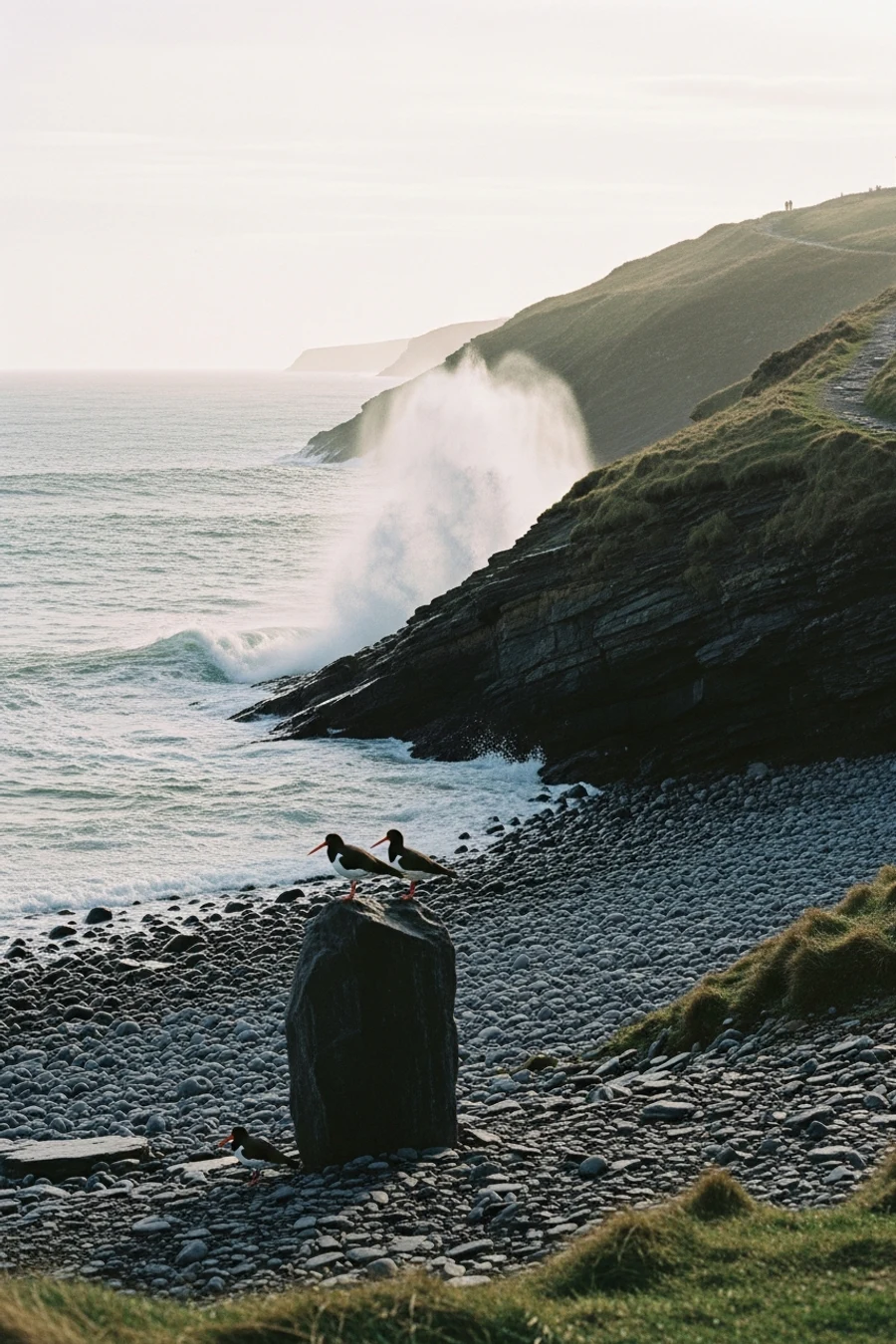
The cove at the bottom is a horseshoe of dark sand and slate cobbles and one black rock the size of a Land Rover that the children climb in summer. There are no children today. There is nobody. The sea is breaking on the slate at the headland in white columns that come up the cliff face about thirty feet.
We sit on the dry rock under the lee of the headland. The wind here is broken by the rock and we can hear each other.
"He doesn't know how to come back into the room with you," Joanna says.
"No."
"He loves you."
"I know."
"He's grieving the way men grieve. Which is in a different country."
"I know that too."
"What do you want him to do."
I think.
"I don't know," I say. "I don't know what I want him to do. I have wanted him to do something for ten months and I do not know what."
"Iona."
"Yes."
"Have you slept with him in ten months."
"Yes."
"Properly."
"No."
"How."
"Once. October the seventh. The night before the call. We have not done it since."
"He has not asked."
"He has not asked. I have not asked. Neither of us has asked. We have been in the same bed every night I have been in our flat in London and we have not asked each other once."
"And he came down because he is still trying."
"Yes. And because something turned over in him on Wednesday and he flew back to Cardiff without telling me."
"All right."
The sea breaks. The columns come up. There is a flock of oystercatchers on the slate further down the cove and they are not flying. They are sitting in a hollow in the slate the way oystercatchers sit when the wind is too much for them.
"You are doing me a kindness by being here."
"I am not. I needed somewhere to go."
"Both."
"Both."
She looks at me. The wind has put colour in her face. She is not pretty in the way I am sometimes told I am pretty. She is striking. She has been striking since she was nineteen and she will be striking when she is sixty. She has a wide mouth and a small chin and brown eyes set far apart. She has a small chip in her front left tooth from where I hit her in the face by accident with a pillow when we were twenty-two. The chip is not visible from across a room. It is visible from across a kitchen table.
"Iona."
"Yes."
"How long has it been since anyone has touched you."
I look at her.
"Joanna."
"It's a fair question. I am not pressing it."
"I know."
"I am asking because it might be useful to know the answer."
"My mother hugged me at Christmas."
"That is not what I am asking."
I look at her.
"Ten months," I say.
"Iona."
"I know."
"Iona."
"I know, Joanna."
We sit on the rock. The sea breaks. The oystercatchers do not fly. The wind moves the spray off the columns in long flags. We sit there a long time without speaking, because there is no thing left to be said about that.
We walk back up. Will is at the kitchen window when we come over the brow of the path. He sees us. He raises a hand. We raise hands back. He turns away from the window.
Joanna at the back door, with her hand on the handle, stops me.
"Iona."
"Yes."
"It is none of my business. But you should think about what you actually want this weekend to be."
"Joanna."
"I am here. Whatever you want. Whatever happens here, I am here for it. I am also here for nothing, if nothing is what we do. I am saying so. You do not have to ask me again."
I look at her.
"Joanna."
"Yes."
"I don't know what you mean."
"I think you do."
She opens the door. She goes in.
I stand on the slate at the back step for one minute longer in the wind.
Then I go in too.
Chapter 3: Saturday Evening
I do not say anything to Will about the cove.
I do not say anything to Joanna about what she said at the back step.
We make the afternoon into a normal afternoon. Joanna goes upstairs to ring her mother. Will takes the Land Rover up the lane to see if the cut at Llanteg is down yet, and he comes back forty minutes later, wet from the waist down, and says yes, the cut is down, and the man at the farm said it would not be cleared before Tuesday and possibly not before Wednesday because the council does Llanteg last after the Tenby road and the Cardigan road.
So we are here. The three of us. Through Tuesday at least.
I make a soup with the squash and the leeks. Will lays the fire in the front room because the front room is the warmer of the two rooms in this weather and the kitchen has a draught under the back door we have not fixed. Joanna sits on the sofa and reads a P. D. James I had on the shelf. The afternoon goes in the way an afternoon at the cottage goes in February, which is to say it goes early. By half past four the kitchen lamp is on. By five the front room is lit.
We open a second bottle of wine at six.
The fire is doing its work. The wind has come round to the south and dropped a little and is no longer screaming at the casement above the sink, only complaining at it. The soup is in the pot on the back of the wood stove. We are in the front room. Joanna is in the armchair by the fire with her feet up under her. Will is in the other armchair. I am on the sofa with my legs out and the throw across them. The throw is the throw Joanna gave us as a wedding present, which I had forgotten.
"Joanna," I say, because I have noticed. "This is your throw."
"Is it."
"Look at the corner."
She looks at the corner. There is a square of red embroidery thread sewn into the underside of the corner, the way Joanna marks anything she has had her hands on. She did the marking when she was twenty-five and decided that she would not let anything she had ever owned go out into the world unmarked. It was a phase. The phase lasted four months. The throw is from that phase. So is the umbrella Will bought from a charity shop in Camden that turned out to have her thread inside the handle. So, probably, is a great deal of north London.
"So it is," she says. "I had forgotten that."
"You used to embroider the inside of your shoes."
"I did. I stopped because of the blistering."
"Wedding present," Will says, looking at the throw.
"Yes."
"Five years," he says.
"Six in June."
"Six in June," he says, and lifts his glass slightly, and drinks.
We are quiet. The fire moves a log. Will pokes it. He sits back.
"Tell me a Bristol story," Will says to Joanna.
"Will."
"What."
"I have been hearing Bristol stories for ten years."
"And I have liked all of them."
"You like them because they make Iona seem like a stranger to you."
"They make her seem like a stranger I would have liked to know at twenty-two."
He says it lightly. It is a thing he can say lightly because he says it the way an old husband says a kind sentence about his wife in front of an old friend who knows him. It is not a thing it costs him to say.
But Joanna, in the chair, looks at me.
She looks at me for half a second longer than she would have a year ago.
I feel it across the room.
"All right," she says, turning back to Will. "A Bristol story. Did Iona ever tell you about the time we lit the wrong incense?"
"No."
"Iona had bought a pack of three from a shop on Park Street," Joanna says, "and the pack said sandalwood and the box looked like sandalwood and we lit one in the kitchen because Mr Aziz from the flat below us had complained about the smell of the meat I had cooked. And after about a minute we noticed it smelled the way the inside of a man's underwear smells if he has been at the gym for an hour."
Will laughs. He laughs properly. It is the first proper laugh I have heard out of him in a fortnight. He laughs so that he has to put his glass down.
"Sandalwood," he says.
"It was not sandalwood."
"What was it."
"It was musk. The kind of musk a stupid shop on Park Street sells. We could not put it out because it was an incense stick and incense sticks burn for forty minutes. We could not open the windows because of the rain. We had to leave the flat. We had to sit in the pub on the corner for an hour and a half and come back when it was done, and the flat smelled of gym for a week."
"Iona never told me this story."
"There are many."
"Iona, why don't you tell me your Bristol stories anymore."
"They have a Joanna in them," I say. "I cannot tell them without her."
He looks at me.
He looks at me a beat longer than he should.
I take a drink of the wine. The wine is the wine. I do not look at Joanna and Joanna does not look at me. The room becomes very quiet. The fire moves another log. The wind has come down again outside.
Will sets his glass on the side table. He stands. He says, in a normal voice, "I am going to bring in the soup. Joanna, you eat in here?"
"I eat in here, yes."
"Iona, you?"
"In here."
"All right," he says, and goes out to the kitchen.
The kitchen is across the hall from the front room. We hear him cross the slate of the hall. We hear the wood stove door.
Joanna looks at me from the armchair.
"Iona."
"Yes."
"Are you all right."
"Yes."
"Are you sure."
"Yes."
She watches me.
"He looks at me," I say, very low. "He looks at me the way he used to. He has done it twice today."
"Yes."
"He does it because you are in the room."
"Iona."
"He has not looked at me like that since October."
"Iona, listen to me."
"Yes."
"It is not because I am in the room. It is because he is in the room with you again. You being looked at is not because of me. He has come back into the room. He came back into the room on Wednesday and got on a plane on Friday and he has been on the threshold of the room ever since."
I look at her.
"You looked at me too," I say. "Earlier, when he said the Bristol story thing. You looked at me."
"Yes."
"Why."
She thinks.
"Because I love you," she says. "Because I haven't been in this room with you in two years. Because I forgot what your hands were like."
"Joanna."
"I am not saying anything I would not say sober."
"Joanna, this is the second glass of wine."
"It is a true second glass of wine."
We sit. The fire moves. Will is opening cupboards in the kitchen.
"Joanna."
"Yes."
"I do not know what to do with what either of you is doing tonight."
"That is all right."
"Joanna."
"You do not have to know. You have to eat the soup."
He comes back in with the bowls. He has heated them on the wood stove. He hands one to Joanna, one to me, sits down with his own. We eat. The soup is good. The fire is good. The wind is down to a four or a five with squalls. Will tells Joanna about the hospice project. Joanna asks the right questions and I love her, suddenly and stupidly, for being the kind of person who knows when to ask the right questions about a man's work in the middle of a kitchen that is humming with something none of us has said.
We finish the soup. We finish the wine. The bottle is empty by half past eight.
"Bed," Joanna says, because Joanna has always been the first to bed.
"Bed," I say.
Will stands. He gathers the bowls.
"Iona."
"Yes."
"Sleep well."
"Yes."
He puts his hand on the back of my neck as I am getting up. He puts his fingers in my hair, briefly, at the nape. It is the smallest gesture. It is the smallest gesture he has made toward me since October. He puts his hand there for two seconds and then he picks up the bowls and goes out.
I stand in the front room with the throw still over my arm.
Joanna is at the door with her own glass in her hand. She has stopped. She is watching me.
"Iona."
"Yes."
"What was that."
"I don't know," I say. "I don't know what it was."
She watches me.
"All right," she says, after a second. "All right. Goodnight."
"Goodnight, Joanna."
She goes up.
I stand in the front room for another minute with my hand at my own nape, where his hand was, and the wool of his sleeve still on my skin even though his sleeve is not on my skin.
Then I go up.
Chapter 4: Sunday Morning
I do not sleep until two.
When I do sleep, I sleep without dreams. When I wake, it is half past six and the wind has dropped completely. The cottage is utterly still. I have not heard the cottage utterly still since November.
Will is asleep, on his front, with one arm out. His hand is across the place where my hip would be if I had not got out of bed at quarter past six to put my hand on it. I had stopped myself. I had put my own hand on my own hip and lain still for fifteen minutes counting his breathing.
I am up now. I dress in the cold of the bedroom. I do not go downstairs. I go out the back door in my boots and my coat and a hat from the basket and I walk the cliff path in the half-dark.
The wind has dropped. The sea is high but quiet. There is a layer of cloud sitting on the cliff at about two hundred feet, and the cloud is very still, and the path under my boots is wet but the rain is not falling. The world has the breath-held quality the morning after a storm has.
I walk to the headland. I sit on the bench Will and I put there two summers ago, on the slate plinth, looking out at where the sea is and where I cannot see it through the cloud.
I think.
I think about Will's hand at my nape last night.
I think about Joanna in the chair, looking at me.
I think about what Joanna said at the back step, you should think about what you actually want this weekend to be.
I think about the ten months. I think about the October the seventh, the night before, when we did not know the call was coming the next day and we had a late dinner and the lamb was good and we went to bed and Will laughed in bed in the way he used to laugh and I came twice and we slept against each other afterwards and he had his hand on the small of my back and woke me at three in the morning to say I love you, very quietly, into my hair. I think about him saying that. I think about not having heard it in that voice since.
I think about the call. I think about the room at the hospital, the kindness of the doctor who was a woman about my age in a green dress with her hair tied up. I think about Will's face in the chair beside me. I think about the silence in the taxi back to the flat.
I think about Joanna at twenty-two coming home with me from a club at three in the morning and sitting cross-legged on the kitchen floor with me eating cold leftover pasta out of a pan with our fingers, and she said something to me that night that I have never told Will. She said: if I ever come back to you, Iona, in any year of my life, in any state, I will not knock first.
I think about that.
I think about what Will would do if I came back inside the bedroom in twenty minutes and got back into bed and put my hand on his shoulder and woke him and said I have been thinking about a thing. I think about the look on his face. I think about him being afraid before I have finished the sentence. I think about him not saying no.
I think about Joanna sleeping above us, on her front, with one arm hanging off the bed.
I sit on the bench for forty minutes.
The cloud lifts at five past seven. The sun is not out, but the cloud lifts and the sea is visible. The sea is grey and flat and high and there is a thin pearl light on it that is the kind of light there is one morning a winter, and a person who lives somewhere else does not know there is.
I get up. I walk back.
I come in the back door. Will is in the kitchen, at the kettle, in his pyjamas and the wool socks, with his hair very flat at the back of his head.
"Iona."
"Hello."
"Where were you."
"On the bench."
"Long bench."
"Yes."
He looks at me. He looks at me with the look he had on him last night by the fire. He does not look away.
"Iona."
"Yes."
"Sit a minute."
"All right."
I take my coat off and my hat off and my boots off at the back step and I come in in the wool socks and I sit at the kitchen table. He sets a mug of tea in front of me and one at his place and sits down opposite. He has the kitchen cloth in his hand and he is folding it.
"Iona."
"Yes."
"I do not know how to begin a sentence to you."
"Will."
"I know. I have not for a long time. I am going to try to make one. I am going to make a bad one. Will you let me."
"Yes."
"Iona. I have been away from you. Even when I was here. I came home Friday because I could not stand to be on the other end of the line one more night."
He stops. He looks at his hand on the cloth. He has lost the rest of the sentence somewhere between his mouth and the cloth. He folds the cloth again.
"That is what I have," he says. "I have more. I will say them on a different morning. I am saying this one now because I think you are about to ask me something and I want you to know I am inside the room with you when you ask."
I look at him.
I have not heard him say a thing like that in ten months. I have not heard him say a thing like that in three years. I have heard him say it twice in our entire life together, both before the wedding.
"Will."
"Yes."
"Joanna is going to be here until Tuesday. The road is down."
"Yes."
"I want her to stay until Wednesday, even if the road comes up Tuesday."
"All right."
"That is not the thing I am asking."
"No."
"Will."
"Yes."
"I want to ask you something tonight. I am not going to ask you now. I am going to ask you tonight after dinner, when Joanna is in the room. I am telling you now because I do not want you to feel ambushed by it, and I do not want you to say yes or no out of the way you have been saying yes and no for ten months. I want you to think about it from now until tonight."
"Iona."
"Yes."
"All right."
"You do not know what I am going to ask."
"No."
"And you have said all right."
"Yes."
"Will."
"Iona, I am inside the room with you. That is the thing I have just said. If you ask me something tonight that you have thought about that long, I will hear it. I am not promising I will say yes. I am saying I will hear it."
"All right."
"All right."
He puts his hand across the table. He puts it palm up. I put mine in it. He closes his fingers around mine, slowly, in the way that is his way and that I have not let myself remember.
I am going to weep.
I do not. I drink the tea.
He looks at the window. The light outside is grey and pearl and the gulls are out, the gulls are flying again. The wind has dropped to a calm. The world is at the bottom of the storm.
"Joanna will be up in twenty minutes," I say.
"Yes."
"I want to make breakfast for the three of us."
"All right."
"Will you do the bacon and I do the bread."
"Yes."
We stand up. We go round the kitchen the way two people who have been together a long time go round a kitchen. The bacon goes on. The bread goes in. The tea goes warm. The wind stays down. The cottage stays still.
At twenty to eight Joanna comes down the stairs in the long grey jumper and the wool socks, with her hair up in a finger-knot and her face the face of a woman who has slept again, properly, two nights running, which has not happened to her since June.
She sits at the table where my chair was.
She looks at me. She looks at Will. She looks at me again.
She does not say anything. She does not have to.
"Bacon," Will says.
"Please," she says.
He puts the plate in front of her.
I sit down with my tea. I am looking out the window. The light on the cloud is the pearl light. The gulls are out. The wind is down. The road is cut at Llanteg until Tuesday or Wednesday. Joanna is here. Will is here. The cottage is still.
I will ask tonight.
The rest of the story
Finish Squall.
Sign up free, then $2.99 opens the closing chapters.
No payment to start.
Private and discreet.