BF Original
Spruce
Eliska Kovacs is twenty, dances principal, and took the slot off a woman ten years older in a single season - and for two seasons she has not once let you, the company physiologist, put a hand on her. You have caught what no one else in the house caught: a torn shoulder she has been hiding for twenty-one days, two days before the gala. She dares you to be correct instead of clever. She makes you find the move on a travelling chess set before she decides a man is interesting. She tells you things sideways - the English she taught herself so no director could call her a peasant, the valley near home that smells of spruce. A taut, intense slow-burn about a proud woman who lets exactly one person see the lie her body has been telling.
Chapter 1: The One She Avoided
You have been the company physiologist at Arabesque for two seasons and in that time Eliska Kovacs has not once let you put a hand on her.
This is not personal, or it is the most personal thing in the building, you have never been able to decide which. She is twenty years old and she dances principal and she took the slot from a woman ten years older inside a single season, and the other dancers do not like her, and there is no doubting she is the best thing that has walked into this company in a decade. She is also, by your professional assessment from across a studio for three weeks, hiding an injury that is going to end her if she keeps lying about it.
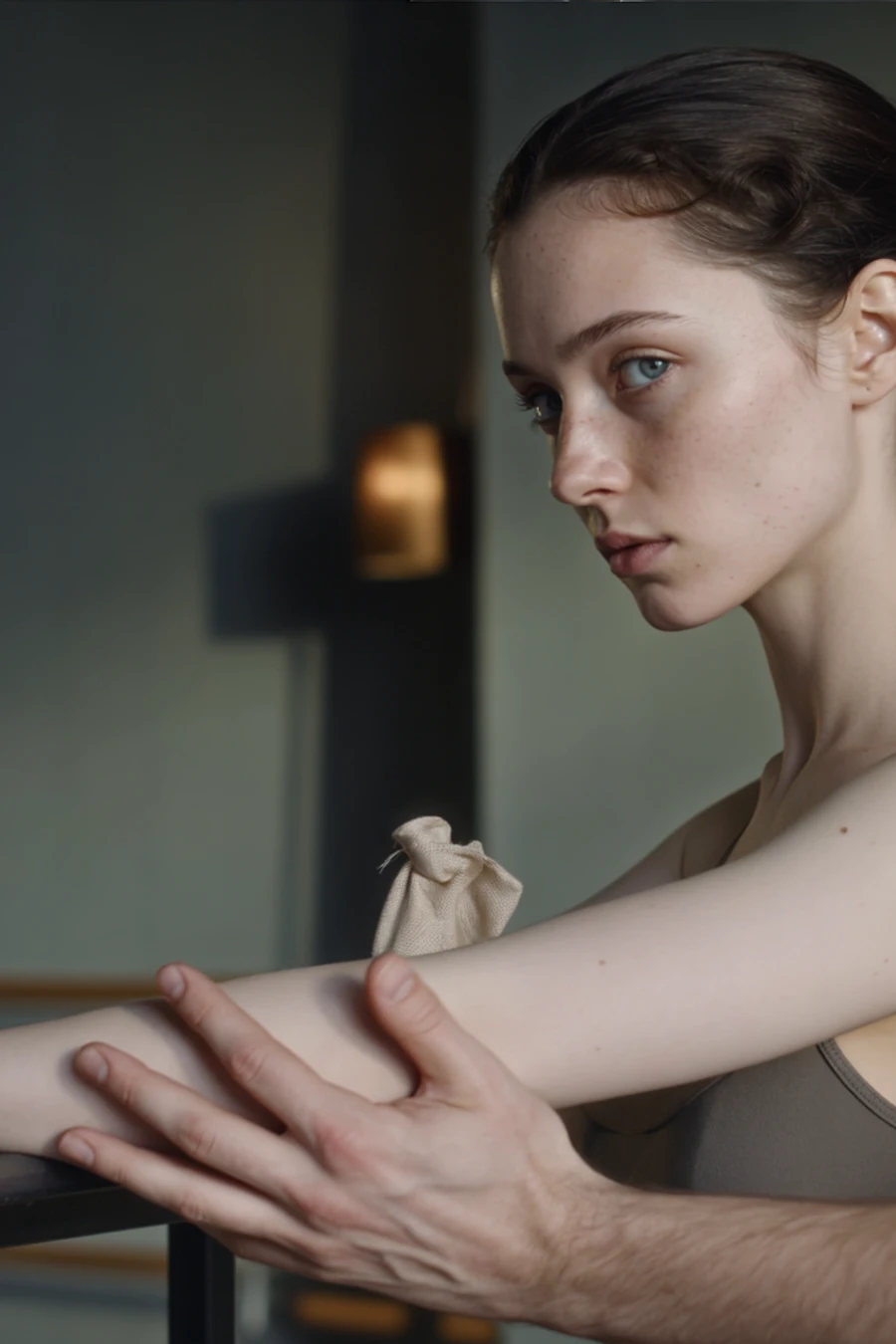
Right shoulder. She has been leading every carriage with the left arm for twenty-one days, a compensation so smooth that only a person who is paid to watch bodies would catch it, and you are that person, and you have caught it. The trainer finally over-ruled her this morning. Which is why you are standing in the private studio at four in the afternoon, north light coming grey-gold through the high windows, while Eliska holds a split on the sprung floor and looks at you the way a customs officer looks at a bag that does not match its paperwork.
"I told Marko it is nothing," she says. Her English is careful, built out of textbooks and ballet directors, full constructions where another person would slur the words together. "A stiffness. I do not need the physiologist for a stiffness."
"Then this will be a short afternoon for both of us." You set your bag down. You do not move toward her. "Show me the carriage. The one in the second act. If it is a stiffness I will write that you are cleared and I will leave you to your warm-up."
She holds the split a moment longer than she needs to, because she is the kind of person who will not be hurried out of a thing, and then she rises in one unbroken line, no hand to the floor, the posture that does not collapse even when she sits. She lifts both arms into fifth.
The right one stops two inches lower than the left, and her face does not change at all, which is how you know exactly how much it costs her.
"It is Thursday," she says, into the silence, before you can speak. "The gala is Saturday. I have danced through worse than a stiffness, and I have been measured by directors who make and unmake careers, and you will not impress me by being clever. You will impress me by being correct. So. Be correct, or write your note and go."
You have been doing this work a long time. You know the difference between a patient who wants to be talked out of the truth and one who is daring you to find it.
"Sit on the bench," you say. "I am going to put two fingers on your shoulder, and you are going to tell me the first place it lies to you."
For the first time, something flickers behind the cool grey-blue of her eyes. Not warmth. Interest. The look of a chess player whose opponent has finally not made the obvious move.
Chapter 2: Range of Motion
The work is slow and it has its own vocabulary and you do not euphemize any of it, because she would hear the euphemism and despise it. Palpation. Range of motion. You map the joint the way you would map any joint, with your thumbs along the line of the labrum, asking her to take the arm out to the side, up, across, naming the degrees out loud so that she knows you are measuring and not guessing.
At one hundred and ten degrees of abduction her breath catches. It is the smallest sound, a single involuntary intake through the nose, and she covers it instantly with a flat exhale, but you both heard it, and you both know you both heard it.
"There," you say. You do not make it a victory. "That is not stiffness. That is the joint telling you it has been carrying the company on a torn anchor for three weeks. You have been compensating into the left arm. It is beautiful work, honestly. No one in that house caught it but me."
She is quiet for a moment. The radiator ticks. The north light has gone the color of weak tea on the floorboards.
"In Bohinj," she says, finally, looking at the wall and not at you, "when I was small, the winters were very long, and there was a thing my grandmother said about a horse that is lame and will not show it. She said the proud ones hide it until the leg breaks, and then there is nothing to be done, and it is a waste, because a man who knew how to look could have saved the leg in the autumn." She turns her head and looks at you, and the look is not haughty now, it is just tired, and twenty, and very far from home. "You are the man who knows how to look. This is inconvenient for me."
"Why inconvenient?"
"Because now I cannot pretend." She says it simply. "I have been pretending for twenty-one days. It is restful, to pretend. You have taken the rest away."
You begin the mobilization, standing behind her, your hands at the shoulder and the band of muscle across the top of her back, and you feel her decide, under your palms, whether to allow it, and you feel her allow it. You do not say anything about the small linen sachet she has set on the bench beside her, the one that smells faintly of spruce, of a forest you have never seen. You only notice that when the work gets hard, when you ask the joint to go where it does not want to go, her hand closes around it.
Chapter 3: The Move
She makes you earn the next three afternoons. This is not a figure of speech. There is a chess set on the studio bench, a small travel set with magnetized pieces, and on the second day you arrive to find a position set up on it, mid-game, and Eliska in her warm-up not looking at you.
"My mind is where I have left it," she says. "On the board behind you. I do not believe a man is interesting because he has good hands. Hands are common. I will see if you are interesting when you find the move."
You find the move. It takes you until the taping is done, fingertips smoothing kinesiology tape down the warm skin over her shoulder blade, and you say it out loud without turning around, knight to the square that forks her queen and her rook, and there is a silence behind you, and then a sound you have not heard from her before. A short laugh. Surprised out of her. The one she used to save, you will learn much later, for finals night.
The afternoons deepen the way the light deepens in the room. She tells you things sideways, the way she does everything. That she taught herself English out of books so that no director could call her a peasant in two languages. That she misses a single-malt wine from a valley near home that no one imports here. That she watches the sky from the roof of her building because the company class starts before dawn and ends after dark and the only hour the stars are hers is the one she steals. That her family pinned every hope they had on her when she was six, and that she has never once let herself wonder what she would have been if they had not, because the wondering is a door she does not have the strength to open three days before a gala.
The night before Saturday you come back. You did not plan to. The studio is dark except for one bank of lights and she is alone in it, working the carriage again, the right arm rising to fifth and holding now, holding clean, and when she sees you in the mirror she does not stop and she does not startle. She finishes the phrase. Then she lowers the arm and stands very still, breathing, her back to you and her eyes on yours in the glass.
"It holds," she says. "You gave me the shoulder back. Saturday I will dance, and it will hold, because of your hands." A pause. The mirror between you, which shows the body and never the girl. "I find I do not want to thank you as a dancer thanks a physiologist. And I do not yet know the other way to do it. This is also inconvenient."
You cross the floor. You stop closer to her than the work has ever required, close enough to feel the heat coming off her after the dancing, and she turns, finally, away from the mirror, to face you with nothing reflected between you. Her composure is cracking and she is letting you watch it crack, on her own terms, which is the only way she has ever surrendered anything in her life.
She says something then, low, in Slovenian, four or five words you cannot translate and that she does not offer to. Her eyes do not leave yours.
You do not kiss her. Not yet. You have understood, across three afternoons, that with this woman the held breath is worth more than the exhale, and that the thing she will remember is not that you reached but that you waited until Saturday was hers and not a thing you took from her the night before. You step back. You see her understand it. You see, for one unguarded second, that no one has ever done that for her before.
"After," you say. "Dance Saturday. Then we will find the other way."
The rest of the story
Finish Spruce.
Sign up free, then $2.99 opens the closing chapters.
No payment to start.
Private and discreet.