BF Original
Small Hours
Milo plays the last set at the Nightjar, the smallest man in every room, furniture that makes a sound. Vera works the door - six foot two, scarred knuckles, the worst outcome in any room she stands in. Fourteen months of the same twenty feet of floor and never the same sentence, until a regular puts a hand on Milo he did not ask for and Vera crosses the room at the one speed she has. The story of the small hours after close, the empty club and the one lamp, the night the largest, most feared thing in the room comes into the light and kneels, and lets the smallest man decide.
Chapter 1: The Last Set
Milo
There is a particular hour at the Nightjar when the room stops needing me, and I get to play for the first time all night.
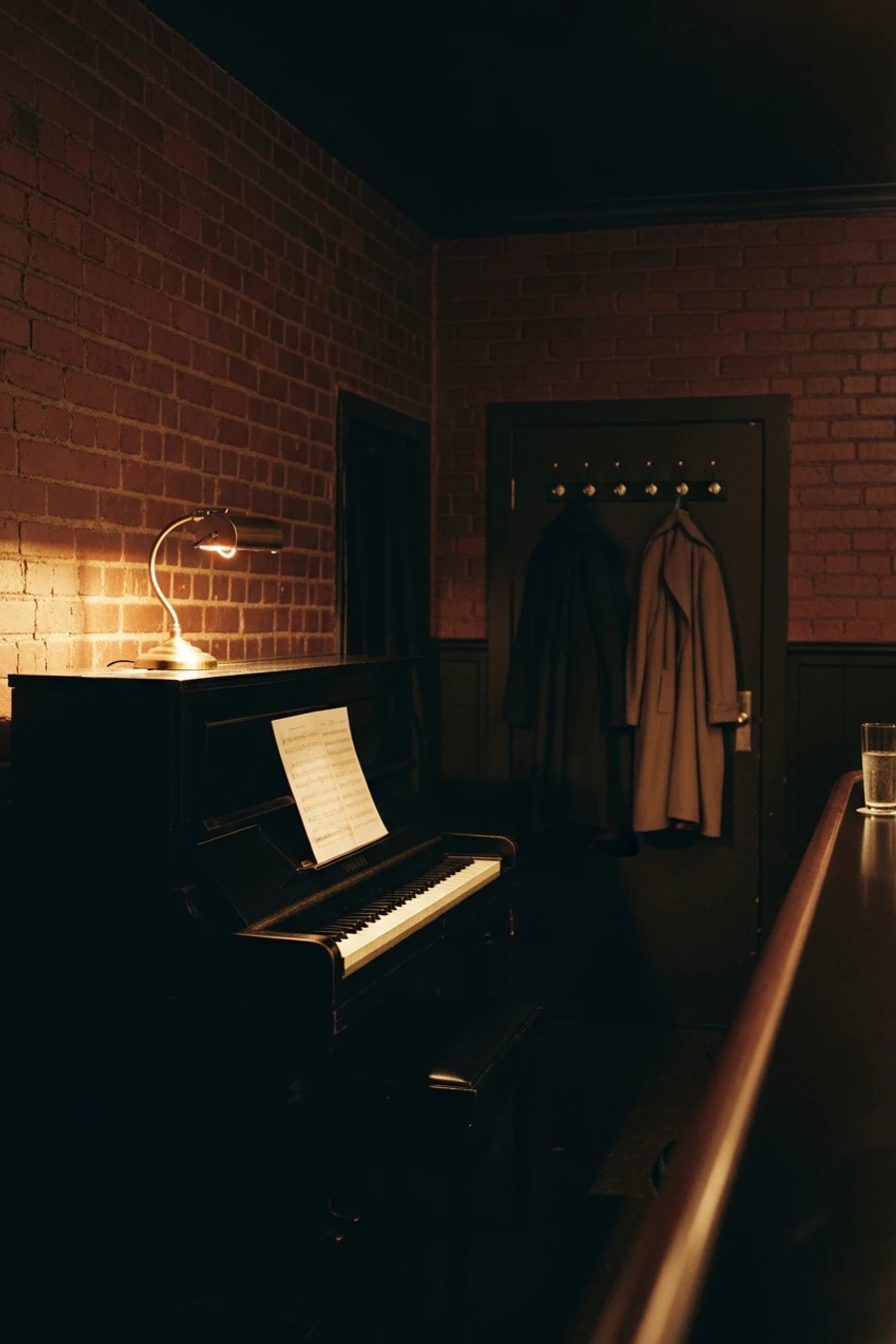
It comes around one in the morning. By then the kitchen has gone dark and cold, the pass wiped down, the last ticket spiked. The two-drink tables have paid and pulled on their coats and said the thing people say on their way to the door, that was lovely, meaning the evening and not me, which is correct, I am furniture that makes a sound. The busboys stack chairs at the far end of the room with the particular tenderness of men who want to go home, lifting each one and setting it on the tabletop without a knock, a whole silent choreography of almost-done. And the room, which for six hours has been a machine for selling small plates and cocktails at a markup, exhales, and becomes, for about twenty minutes, only a room. Low ceiling. Brick painted a red so old it has gone brown, the color of a healed thing. One brass lamp on the closed lid of the piano that Renata keeps because she likes the way it looks, and I keep because it is the only light I have ever wanted to be seen in, which is to say almost none.
That is the hour I play the thing I actually came to play. Not the standards. Not the requests, not Someone to Watch Over Me for the anniversary couple, not the Ellington the man with the good watch always wants. The other thing. The one with no name, that I have been writing four bars at a time for a year and will never finish, because finishing it would mean I would have to decide what it is about, and I have found it is possible to love a thing very much precisely by refusing to know that.
But it is not that hour yet. It is only half past midnight, and there is still one table that will not leave, and at that table there is a man in a camel coat.
I have learned the entire vocabulary of the man in the camel coat without ever once learning his name. He comes on the good nights, the Fridays. He orders rye, neat, and he tips in a manner that is meant to be overheard, folding the bill lengthwise and setting it down like a card he is playing. He has a laugh he uses the way a man sets down a heavy bag, a big exhausted ha, and he deploys it after his own sentences, so you know where the joke was. And somewhere around his third rye, every single time, he decides that I am his. Not unkindly. That is the part that is impossible to explain to anyone who has not lived at my scale. He is never unkind. Unkind would be easy. Unkind has a door in it you can walk out of. What he is instead is warm and certain, and the certainty is the whole problem, the flat unshakable certainty that a person my size who plays a piano this well must be a small warm thing that belongs, by natural law, to whoever notices it first.
"Play me the one," he says.
He has crossed the room without my hearing him, because I was inside a chord, down in the middle of it where the room goes away. Now he is standing at the curve of the piano with his rye, closer than the piano is built for anyone to stand. Up close he is younger than the coat wants him to be, forty trying to read as fifty-with-money. "You know the one," he says. "The sad one. The one you did earlier. Play it and then come sit, we'll have a drink, I want to hear your whole deal. Guy plays like you, there's a story."
"I don't drink on the clock," I say. My voice does the thing my voice does, which is stay level and quiet and pleasant, an instrument a small man builds over thirty years for the specific purpose of moving through rooms full of larger ones without ever giving them a reason. "But thank you."
"After the clock, then."
"After the clock I go home."
"Come on." He smiles. He sets his rye on the lid, on the good wood, a wet ring blooming under it, and I watch it and do not say anything about it. "Don't be like that. I'm being nice to you."
And then he puts his hand on my shoulder.
I want to be precise about the next part, because it matters for everything that comes after, and because it is the part nobody believes when I tell it later. I was not afraid. Put that on the record. I have been the smallest man in every room I have ever walked into, and somewhere back in my twenties I made a durable peace with the arithmetic of that, and one of the things you build, along with the voice, is a way of removing an unwanted hand from your shoulder. A small cold quarter-turn, and a sentence delivered flat, and it has worked, I would estimate, ninety-nine times out of a hundred, on men considerably worse than this one. I was already reaching for it. I had the turn loaded and the sentence chambered. Please take your hand off me. It was right there.
I did not get to use it, because the room changed.
You feel her before you see her. That is not a romantic observation, it is a fact about physics. The Nightjar is a narrow room, a shotgun room, and Vera Kovac is not built for narrow rooms, and when she moves through one the room reorganizes itself around her the way water reorganizes itself around a piling in a river, the current bending, everything downstream of her rearranged before it knows why. Conversations she is nowhere near go quieter. Men who have never met her and never will sit up an inch. She works the door, she is the door, six foot two in flat black boots with shoulders that fill the frame of any entrance she chooses to stand in, and a face that has decided, permanently and on purpose, to give away nothing at all. And the hands. I had noticed her hands months ago, from across the room, the way you notice a change in the weather without meaning to, hands with knuckles that have been broken and set and broken again, the topography of a life I knew nothing about.
She does not hurry. That is the other thing about her, the thing that empties men out. Everything Vera does she does at exactly one speed, and that one speed communicates, without a word, that there is no version of events in which she does not arrive.
She arrives.
She does not touch him. I have gone back over this more times than I will admit, and it is the detail I keep returning to, because she could have moved him the way you move a coat rack, one hand, and everyone in that room including him knew it in his spine. She chose instead to simply come and stand at my other shoulder, the one his hand was not on, and be there, all of her, the whole architecture of her, a wall that had gotten up and walked over on its own. She looks down at his hand where it sits on me. Then she raises her eyes and looks at him. She has still not said one word.
He takes his hand back. He does it with the laugh, the heavy-bag ha, and some sentence about how everyone's awfully serious tonight, and he collects his rye off my piano and goes back to his table for his coat, and then he is gone through the door into the cold, and the entire transaction has taken perhaps eight seconds and no volume whatsoever. The busboys have not even looked up.
"You had it handled," she says.
To me. Quietly. Aimed at the side of my face, the first complete sentence Vera Kovac has ever directed at me in the fourteen months we have worked the same twenty feet of floor.
I look up at her. It is a long way up, and from this angle the lamp catches the underside of her jaw. "I did," I say, and I hear immediately how it lands, defensive, a small man insisting on his own competence, and I brace, the old reflex, for the flicker of amusement that is the standing tax on sentences like that one.
It does not come. "I know," she says. "I watched you get ready to do it. The turn, and then you were going to say something." A pause. She is not good at pauses. I can see what they cost her, a kind of held breath. "I just didn't feel like watching him make you do it."
And then, because I am an idiot, or because it is half past midnight and something in the way she said watched you has come loose in my chest and is rolling around in there, I say the true thing instead of the safe thing. I have a whole life built on knowing the difference and choosing the safe one, and I set it down.
"You were listening," I say. "Earlier. During the Monk, the second set, the Ruby My Dear. You come off the door during the Monk. You've done it for months. I thought you were watching the room." I look at her. "You weren't watching the room."
Something happens in her face. It is very small. If you have not spent your entire life reading rooms for the precise instant they decide to turn, you would miss it completely, it is nothing, it is a flicker at the corner of the eye. It is the expression of a person who has just discovered that a thing she believed was a mirror is in fact a window, and that someone has been on the other side of it the whole time.
"I watch the room," she says.
"Sure," I say.
She straightens. I actually see the wall reassemble, brick by brick, behind her eyes, the give closing back up. "Renata wants the lot locked by two," she says, in a completely different voice, the door voice, the flat one with the boots in it, and she turns and is gone back across the room, and the room reorganizes itself again in her wake, the current closing over the place where she stood, and I am left at the piano with my hands in my lap and my heart going like something small trying to get out of a box.
I did not play the nameless thing that night. I could not. It had stopped being safe. It felt, all at once, like a door I had left standing open for a year without worrying about it, because no one ever came down that hall, and now someone had walked past it, and slowed, and I had heard the footsteps stop.
Chapter 2: Closing
Vera
Here is the thing nobody tells you about being built like me.
It is not that men are afraid of you. Some are, the small mean ones, and that fear is useful, it is a tool, I have run doors on it for fifteen years and I have never once minded it. No. The thing nobody tells you is that you never get to be the one who is taken care of. Not once. Not in thirty-four years. You are the coat that gets checked so that someone else can go and dance. You are the largest object in every room you enter, and everyone has therefore quietly, unanimously, without a meeting, agreed that you are the object that needs nothing. Nobody carries your bag. Nobody stands closer to the road than you. Nobody, drunk at the end of a long night, ever puts their head on your shoulder, because you are the shoulder other people are put on. You are the shelf. You are never the thing on the shelf.
I made my peace with all of it at nineteen, in a parking lot behind a bar in a town I do not drive back to. Standing over a man who had put my little brother into a cinderblock wall. My knuckles were opening up across all four fingers and I could not feel them yet, and my brother was somewhere behind me making a sound I still hear, and the certainty came down over me in that lot like cold water pouring down the back of my collar, total and clarifying: this. The standing-over. The wall-of-me. This is the shape your life is going to take, and you had better go and find the places where that shape is useful, and be useful there, and stop wanting the other thing.
So I did. I work doors. I am extremely good at it. I keep a room safe by being, at all times, the worst outcome available in it, and I go home when the lot is locked to an apartment where nothing is soft, because soft things break, and I have never in my life owned a thing I was not prepared to break. I do not, as a general rule, want. Wanting is for people built to a scale where the world occasionally hands them the thing back.
Which is why I do not have any idea what I am doing, three nights after the man in the camel coat, standing in Renata's cramped office at one in the morning being told to walk the piano player home.
"He's fine," I say. "It was nothing. I handled it."
"The one in the coat waited for him Tuesday." Renata does not look up from the ledger. She is seventy years old and she has run this room for thirty of them and she has the eyes of a woman who has watched every possible kind of person try, across a bar, to lie to her, and found all of it boring years ago. "Across the street, by the shuttered dry cleaner. Milo took the long way and doubled back through the Korean grocery on Orchard and came out the other door. He didn't tell me. Sun told me." She turns a page. Wets her thumb, turns another. "So you'll see him to his."
"He'll hate it."
"It's six blocks. You walk past four of them to reach the train." She still has not looked up, and this, the not-looking-up, is how I know she is not really talking about the man in the coat. "So."
"He'll hate it," I say again, which is true, and is also not the reason, and Renata knows it is not the reason, because now she does look up, and she holds my eyes for exactly one second longer than the conversation requires, the way she does when she has decided something about you that she has no intention of sharing.
"Then be quick," she says, and goes back to her book.
He does not hate it. That is the first thing that goes wrong.
I find him at the service door working his way into a coat that is a size too big for him, a good coat gone soft and pale at the cuffs from years of exactly this, and I say, "I'm walking you," in the flat voice, the voice that ends conversations, and I watch him not do any of the four things men do when I use that voice. He does not flinch. He does not square up. He does not perform gratitude. He does not do the small-man thing of insisting he is fine, which I had braced for, which I would honestly have preferred, because it would have let me stay a wall. He just tips his head a fraction, taking it in, and then he says, "Okay. But you're buying the coffee. There's an all-night place on Ludlow and I am not letting a bodyguard march me past it dry."
And something low in my chest does a thing I do not have a name for and do not care to learn one.
The street is cold and wet-black and empty, the good empty of very late, the shopfronts shuttered and the sodium lights buzzing and every third one out. We walk. I have to shorten my stride for him. I notice myself doing it about half a block in, the automatic arithmetic of my own body quietly making itself smaller to keep pace with someone, and I nearly stop dead in the street, because I do not do that. I have spent my entire life making other people do that. I match no one. I put him on the inside, away from the road, without deciding to, my body filing itself between him and the gutter the way it files itself between a room and trouble, and he notices. He does not say anything about it. But I watch him clock it, a flick of the eyes down and over at the fact of where I have put myself, and the corner of his mouth does a small private thing, and he lets it stand.
He talks. Not much, and never to fill the air, which I would have hated, I have walked a hundred men who talk to fill the air. He talks the way, I will learn, he plays, a phrase and then a rest, room built around every line so the line can breathe. And he asks me things. Real things. Not the things men ask me, which are always, underneath, some version of testing the wall to find out how hard it is. He asks whether I sleep in the daytime, and what that does to a person over years. He asks what the worst night on a door is, not the most violent, the worst, and waits like he actually wants the true answer and not the story. He asks, on the corner of Ludlow and Broome with the light going amber over us, whether I ever wanted to do some other thing, and when I say, "Like what," meaning it as a wall, meaning it to close the subject, he does not retreat.
"I don't know," he says. "That's the whole reason I'm asking. I can't read what you'd have been. I can usually read it on people, what they'd have picked in some other life. I can't get a fix on you." He looks up at me, six blocks of broken streetlight sliding over that quiet, watchful, older-than-his-body face. "You keep it somewhere I can't see."
I am not going to tell you everything we said between the club and his door. Some of it is mine. I have so little that is only mine that I am going to keep it.
But I will tell you that I laughed once. A real one, torn out of me sideways, on that corner, at something dry he said about the man with the good watch who requests the Ellington. I heard it come out of me and it surprised me more than it surprised him. And I watched him catch it. I watched him take the laugh and set it down somewhere careful and interior, the way you set down a thing you have wanted for a long time and cannot quite believe you are holding, both hands, no sudden moves, and I had to look away down the empty avenue and let it pass.
At his building, a walk-up with a stoop, he does the thing that takes me apart.
He goes up two steps and turns around. And for the first time all night we are the same height, his eyes exactly level with mine, and he looks at me the way nobody looks at me. Without running the calculation. Every human being who meets my eyes runs the calculation first, how dangerous, how fast, can I take her, will she, and only afterward, if at all, do they look at the person. He skips it. He just looks at me, at the actual me, standing on a cold stoop at two in the morning, and he says, "Thank you. And not for the walk." He thinks about it, gets it exactly right, the way he gets everything exactly right. "For the door voice. That you didn't use it on me. You've got a different one for me. I don't think you know you have it. You've had it since you said I had it handled."
And I want, with a force that genuinely frightens me, more than I have wanted anything in fifteen years, to lift my hand and lay it against the side of his face. To find out, finally, whether he is as warm as he sounds. My hand actually starts. I feel the tendons in my forearm commit, the weight shift.
I put it back.
Because I do not know how to want a thing without it becoming, in the same motion, a thing I could break. My hands have only ever learned the one grammar. Everything they know how to do to a person is on the list of things you do not do to someone you have just watched set a laugh down carefully with both hands. So I take the whole feeling, all of it, and I fold it back down into the place where I keep things, and I feel my own face close over like ice going back over a hole in a river, and worse, I watch him watch it happen. I watch the window I did not know I had left open fog over from the inside. And I say, "Lock your door," in the flat voice, the wrong voice, the door voice, on purpose, aimed at him, the one person I have a different one for, and I turn and go before I have to see what it does to his face.
I walk to the train too fast. I stand on the empty elevated platform in the iron cold with my broken hands shoved down in my jacket, and I am furious, a low, hot, closed fury with absolutely nowhere to put itself, because for one second on a stoop on Ludlow Street I had wanted to be soft, out loud, with my hand halfway to a man's face, and soft is the one thing a woman built like me is not permitted to be, everyone has always known that, I have known it since a parking lot at nineteen with my knuckles open.
And the worst part. The part I cannot set down the whole cold ride home, the part that is still with me when I let myself into the apartment where nothing is soft and stand in the dark not turning on the light.
He had left the window open for me.
He had left it open, and I had looked right at it, and I had chosen the wall.
The rest of the story
Finish Small Hours.
Sign up free, then $2.99 opens the closing chapters.
No payment to start.
Private and discreet.