BF Original
Sea Glass
She drove six hours back to the coast town to sell her late mother's house - which meant coming back to Cal, the boy from five teenage summers, now fifteen years and a marriage each later. Sea glass is just broken bottles the sea takes its time to smooth into something you would pick up off the sand. Some things get better for the time they spend apart. The story of the last night in the house on the point.
Chapter 1: The House on the Point
I came back to Thornmouth in October to sell my mother's house, which meant I came back to Cal, though I told myself for the whole six-hour drive that it didn't.
We had five summers. That was all it ever was, and all it ever needed to be - the summers I was sixteen to twenty, when my family still kept the grey house out on the point and I ran wild from June to September with a boy from the boatyard who had salt in his hair and a way of going quiet that I mistook, back then, for not having much to say. I learned later it was the opposite. Cal had everything to say. He just didn't waste it.
The last summer ended the way those things end - not with a fight but with a leaving. I had a place at a university four hundred miles inland and a whole bright life pulling me toward it, and he had the boatyard and a father with a bad back and the kind of roots you can't dig up without killing the thing. We didn't promise each other anything. We were twenty and we thought there'd be time, that the world was wide and we'd loop back around to each other when the pulling stopped. The pulling didn't stop. It never does. I married a good man in a city of glass and traffic, and then ten years later I un-married him, gently, the way you set down something you've carried too long, and somewhere in all of it the grey house went quiet and my mother got old and then she was gone, and the lawyer said the house should sell quickly, it's a good house, and I drove six hours telling myself this was about a house.
Cal was on the quay when I pulled in, because of course he was, because Thornmouth is the size of a held breath and there is nowhere in it you can stand and not be seen. He'd gone grey at the temples. He had a coil of rope over one shoulder and fifteen years on his face and he looked up at my car the way you look at weather coming in off the water, and he didn't smile, not right away, and neither did I, and the not-smiling told both of us everything we'd spent fifteen years not saying.
Chapter 2: What the Sea Keeps
He helped me with the house. I didn't ask him to. He just started showing up - a ladder I needed, a stuck window, a box too heavy for one person - the way he used to show up at the point with no warning and no reason except that the showing up was the reason.
We were careful with each other. Fifteen years makes you careful. We talked about the easy things, the boatyard and his father (gone now too) and the people we'd both known who'd stayed or left or died, and we did not talk about the summers, the way you walk wide around a thing on the path that you're both pretending not to see. But the grey house remembered, even if we wouldn't. The kitchen where he'd taught me to shuck oysters and I'd thrown the shells at him. The back step where we'd sat through a whole August thunderstorm wrapped in one blanket. The house was full of us at twenty, and we moved through it at thirty-five trying not to brush against it.
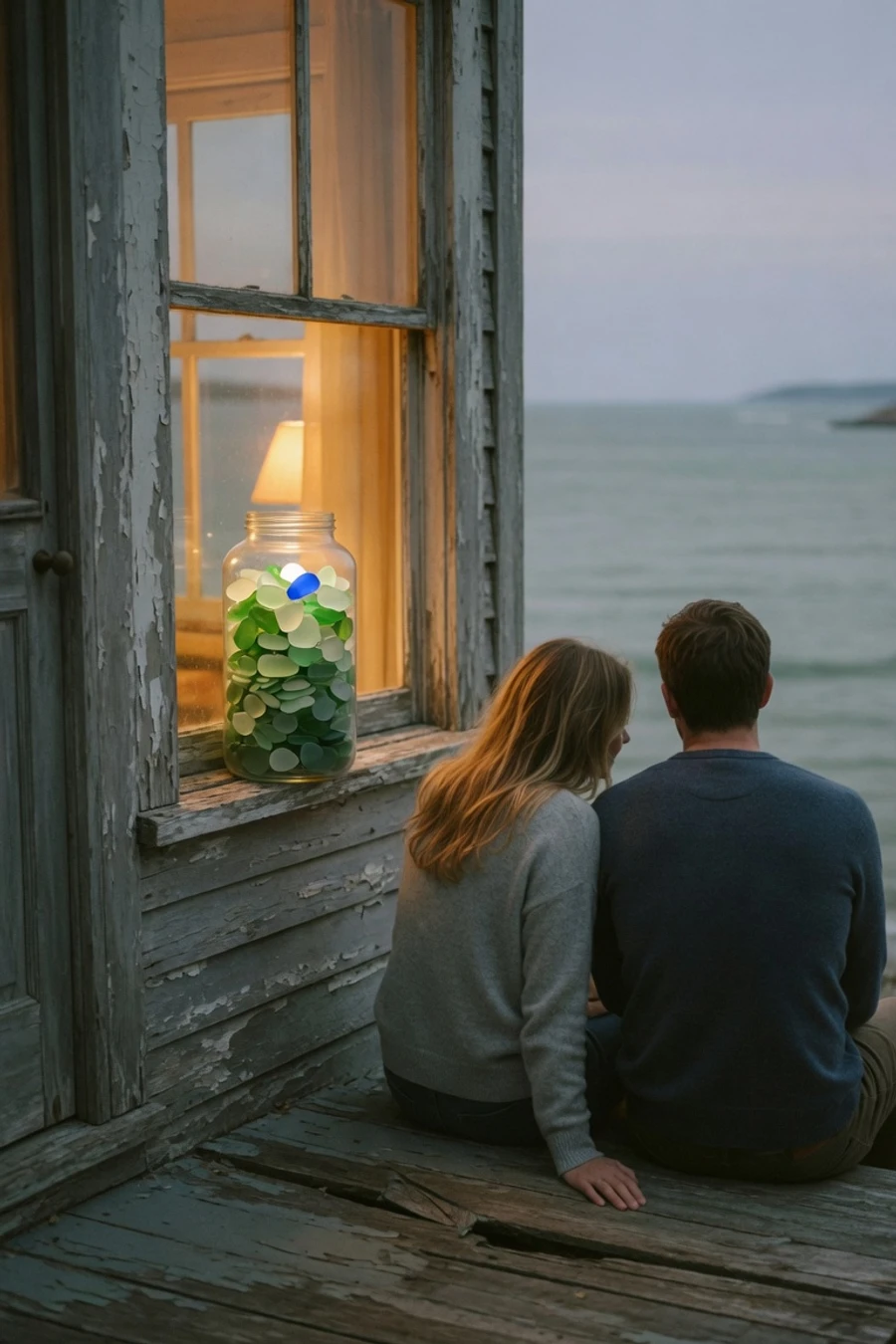
On the third day I found the jar. It was on the windowsill of my old room, where I'd left it - a tall glass jar full of sea glass, fifteen years of dust on it, the greens and whites and the one rare cobalt blue we'd found together the last August and argued over and finally agreed to keep here, in the house, in the middle, so it belonged to both of us. I'd forgotten it the way you forget a thing precisely because it mattered too much to look at. I stood there with it in my hands and Cal came to the door with a box and saw what I was holding and went very still.
"You kept it where we left it," he said. The first true thing either of us had said in three days.
"I forgot it," I said, which was a lie and we both knew it, and he came across the room and took the jar from my hands and turned it in the grey window-light, and the sea glass clinked, fifteen years of it, every smooth broken piece the sea had spent decades turning from something sharp into something you'd want to hold, and he said, not looking at me, "That's the thing about sea glass. It's all just broken bottles. The sea takes its time. Makes them into something you'd pick up off the sand." And then he did look at me, finally, the full weight of it, fifteen years. "Some things get better for the time they spend apart. Don't they."
Chapter 3: The Last Night in the House
The house sold on a Friday. A nice couple from the city, glass-and-traffic people like the person I used to be, who wanted a quiet place on the point and would never know what the back step had held through a thunderstorm. I had one last night in it before the keys changed hands, an air mattress on the floor of my old room, my mother's reading glasses still folded on the kitchen windowsill where she'd left them and her last shopping list still pinned to the cork by the door in her slanting hand - milk, bird seed, ring Sandra back - the small unfinished business of a life that the nice couple would scrape into a bin without ever knowing whose hand had written it. The jar of sea glass was packed in newspaper in my car. I sat on the back step in the cold with a glass of my mother's sherry and watched the light go off the water, and I was not at all surprised when I heard his truck on the gravel.
He sat down beside me on the step. There was room for two if we sat close, there had always only ever been room for two if we sat close, and we did, and neither of us said anything for a long time while the dark came up off the sea. Fifteen years. A marriage each, his ended by the slow drift of two people who'd married the wrong summer, mine by the same. All of it had happened in the time the sea spent turning a broken bottle smooth.
"I used to think we ran out of time," I said, finally, to the water. "That we'd have looped back around if there'd just been more of it."
He was quiet a moment. "I didn't think that," he said. "I thought you'd chosen right. Gone off to the bright life and left the small one behind because the small one was the sensible thing to leave. That was worse than running out of time. I could have made my peace with running out of time." He turned the glass in his hands. "I spent about five years hating you, if you want the truth of it. Not for leaving. For making it look so easy - getting in that car at twenty like the leaving was the most natural thing in the world. I believed you. Took me a long while to work out you'd just been better than me at not letting it show." Then the old quiet came back into his voice, the quiet I'd mistaken at sixteen for having nothing to say. "So no. We didn't run out of time. We had all of it. We just had to spend it apart first." He turned his head, and he was close, the salt-and-grey of him, fifteen years and a hand's breadth away. "I'm not twenty anymore. I'm not going to pretend I don't know what I'm sitting on this step hoping for. But you leave tomorrow, and I've spent fifteen years learning how to let you do that, and I won't do it again unless you tell me to. So tell me. Either way. But tell me before I do something I've wanted to do since you got out of that car."
The sea moved against the point the way it had every night of every summer. I set down the sherry. I had spent fifteen years being careful, and a six-hour drive pretending this was about a house, and I was so tired of being smooth and sad and far away.
The rest of the story
Finish Sea Glass.
Sign up free, then $2.99 opens the closing chapters.
No payment to start.
Private and discreet.