BF Original
Opposing Counsel
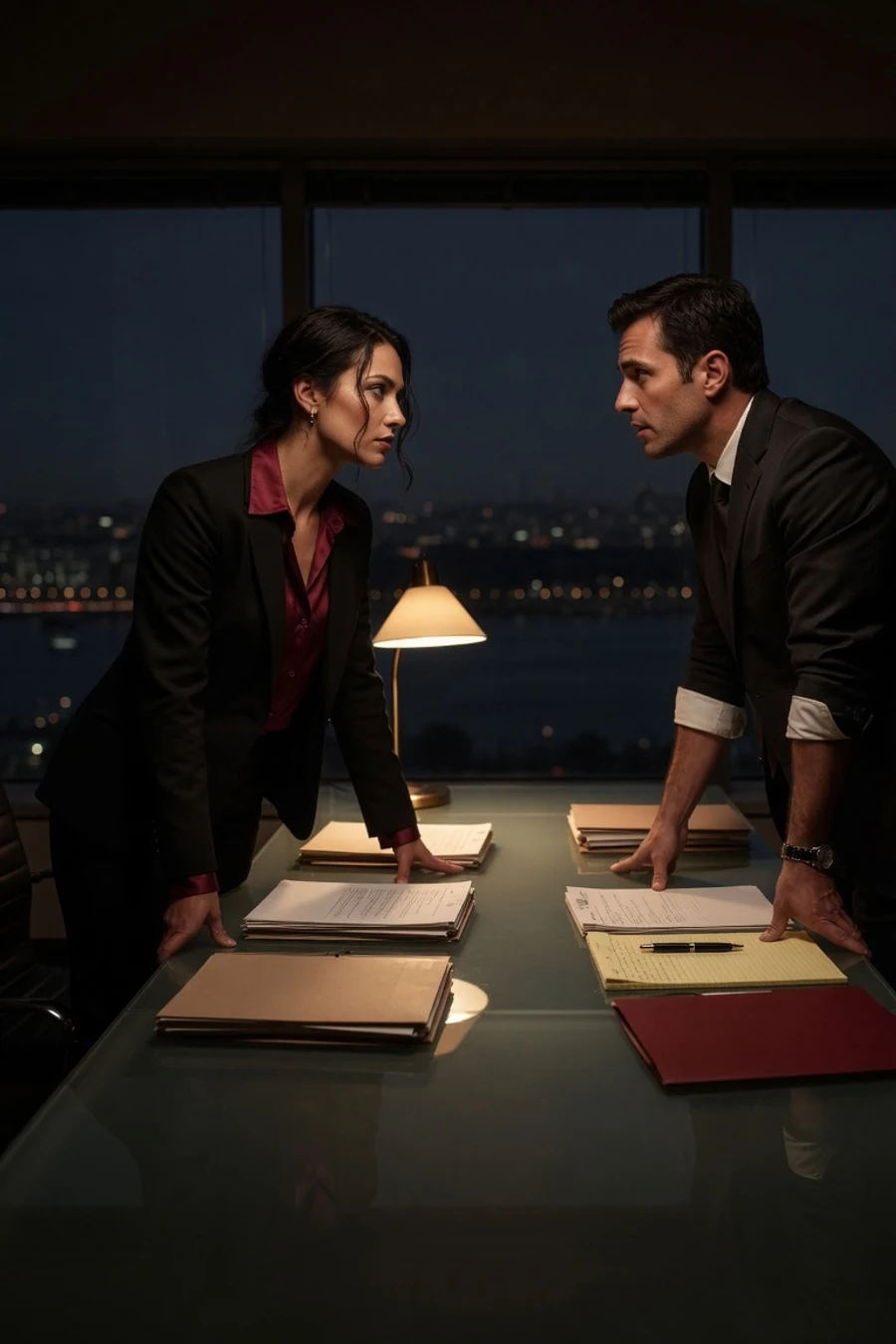
Nora Casey and Adam Reyes have spent five years on opposite sides of a courtroom, keeping a private count of who won and never once letting the other take something they had not earned. Then one brutal case puts them on the same side of the table, alone in a war room past midnight, and the cleanest rivalry of her life becomes the one thing neither of them has any rules for.
Chapter 1: For the Record
Five years, and Adam Reyes still set his pen down before he won a point.
Nora knew the gesture the way she knew the layout of her own apartment in the dark. Across the deposition table he would be listening, leaning back, letting her witness talk, and then his hand would move - unhurried, almost bored - and he would set the pen flat on his legal pad, click the cap on, square it parallel to the edge. And then he would lean in and ask the one question that turned the whole afternoon. The pen going down was the tell. It meant he had found the thread he was going to pull, and he wanted both hands free to pull it.
She had learned to watch his hands instead of his face. His face gave nothing. His hands gave everything, if you'd spent five years studying them, which she had, in the way you study the work of someone you cannot stand and cannot afford to underestimate.
He set the pen down now.
"Mr. Khoury," Adam said, to her witness, "you testified that you left the warehouse at six." A beat. "Earlier you told the insurance investigator it was eight."
Nora was already moving. "Objection. Mischaracterizes the prior statement, which my client clarified on the record, page forty-one." She didn't look at the page. She knew the page. She had built this witness's timeline herself, three nights of it, and she knew where every soft spot was because she had spent those nights reinforcing them.
Adam's mouth did the thing it did. Not a smile. The suggestion of one, withheld, the way a man holds back a card he doesn't need yet. "I'll rephrase," he said, which meant the objection was good and they both knew it, and he set the pen down again, and went somewhere else with it.
This was the texture of her professional life. This had been the texture of it for five years, since the bar association mixer where a too-confident second-year named Reyes had looked at her across a tray of bad wine and told her, with genuine pleasure, that he'd read her brief in the Mendel appeal and found the third argument "almost persuasive." Almost. She had wanted to throw the wine at him. She had wanted, more disturbingly, to keep talking, and they had stood in a corner of that mixer for two hours dismantling each other's reasoning while everyone else networked, and she had driven home furious and awake in a way she had not been awake in months.
He had taken a job at Halloran the following spring. She was at Brandt-Wei. Across the river from each other, on opposite sides of nearly everything, and in five years she had beaten him in court eleven times and he had beaten her ten, and she kept the count, and she was almost certain he kept it too, and that the ten and the eleven were the most honest thing either of them had.
The deposition broke at noon. Mr. Khoury was led off to compose himself. Nora gathered her exhibits, not because she needed to but because keeping her hands busy was a discipline, and Adam, on the other side of the now-empty table, did not leave.
"You over-prepped him," Adam said.
"I prepped him."
"You prepped him until he sounds prepped. Six o'clock, eight o'clock - a man who actually left at six just says six. Your guy recited six." He pulled his coat off the chair back. "It plays fine in here. It won't play to a jury."
"There isn't going to be a jury. You're going to settle, because your client backed a truck into a loading dock and you know it, and you're doing the math on what it costs you to make me go away."
"Am I." He shrugged into the coat. He was annoyingly good at the small choreography of leaving a room, never fumbling, never the man patting his pockets for keys. "What's it cost me?"
"More than you've offered. Considerably."
"Mm." He looked at her then, full on, which he did rarely, because Adam Reyes understood the value of withholding his attention and spent it like a man who'd grown up without money. "You know what I've never figured out about you, Casey?"
He used her last name. She used his. It was a rule neither of them had agreed to. "Enlighten me."
"Whether you actually believe your guy left at six. Or whether you stopped caring about that years ago and now you just - " he searched for it, found it - "build the most beautiful version of whatever you're handed. Whether the truth is even in the room for you anymore."
It landed harder than she let her face show. Because she did believe Khoury. Mostly. And the mostly was the splinter Adam had just pressed, the one she pressed on herself at two in the morning, and she hated that he had found it, and she hated more that he had found it gently, like a doctor locating the exact spot that hurts.
"The truth," she said, "is that your client owes mine four hundred thousand dollars and you'd rather talk about my soul than write the check. It's a tell, Reyes. You only get philosophical when you're losing."
That got her the rest of the smile. The whole thing, for half a second, before he put it away.
"See you at the conference," he said, and left.
She did not, in fact, see him at the conference, because the conference settled the day before it was scheduled, which she found out from a paralegal and not from him, and which annoyed her out of all proportion to its importance. Halloran had folded. Not for the four hundred thousand she'd put on the table - for three-eighty, which meant Adam had clawed back twenty grand on his way out the door, the way he always clawed something back, never letting a defeat be total. She read the settlement memo twice and could not find the seam where he'd done it, and that was the part that kept her at her desk an extra hour. Not the twenty thousand. The fact that she couldn't find the seam.
She thought about texting him. Three-eighty. You found twenty grand under a couch cushion. How. She had his number. They'd traded it years ago for the mechanical purposes of litigation, scheduling, the exchange of exhibits, and over the years a second layer had grown over those texts, a thin private channel that ran underneath the official one. Your expert's deposition runs long, push our call? And then, six months later, with no occasion: Saw your name on the Calloway verdict. The dissent was right and you know it. And his reply, an hour later: The dissent is always right at 11pm. Go home, Casey. Nothing in any of it that a judge could have read as anything. All of it, she understood, something.
She did not text him about the twenty grand. She put her phone face-down on the desk, which was its own kind of statement, made to no one.
What she did instead was open the file on the case she actually cared about, the one with forty families in it, and work until the cleaning crew came through, because the thing nobody understood about Nora Casey - the thing her colleagues mistook for ambition and her opponents mistook for ruthlessness - was that she did the work because the alternative was sitting still inside her own head, and she had never in her life found a way to make sitting still survivable. The work was the thing that held. She built timelines the way other people prayed.
The only person who had ever once said this back to her, in so many words, was the same person who had just folded for three-eighty and clawed back twenty and not texted, and she sat in her lit office and was furious at him, and underneath the fury, in the place she did not examine, she was the most awake she'd been all week. That was the splinter. Not the case. Him. That the only person who saw exactly how good she was, was the one person who would never, ever say so.
She didn't know yet that in nine days a partner at her firm would walk into her office and say a sentence that ruined the count. She didn't know that the cleanest rivalry of her life was about to be taken away from her and replaced with something with no rules at all.
She just gathered her exhibits, and squared them parallel to the edge of the table, and did not notice she had done it.
Chapter 2: Co-Counsel
The sentence was: "We're bringing in Halloran on Vasquez."
Diane Brandt said it the way she said everything, as a fact already concluded, while pulling a binder off Nora's shelf to look at something unrelated. Nora had three seconds to arrange her face before the rest of it came.
Vasquez was the case. The one that made the others look like practice. A wrongful-death suit against a chemical company that had spent a decade poisoning a town's water and a fortune making sure no single plaintiff could afford to prove it. Forty families. A defendant with seven law firms on retainer and the patience of something geological. Nora had fought for eighteen months to be lead on it. It was the case you built a career to be ready for, and the case you could lose so badly it ended you.
"Halloran," Nora repeated. "Co-counsel."
"Their environmental group is the best in the state and we don't have the bandwidth to staff this alone against what Dellinger's going to throw at us. It's not a discussion, it's a number problem. They take the science track, we take the families and the narrative, we share first chair." Diane slid the binder back. "You'll run point with their lead."
"Who's their lead."
Diane was already at the door. "Reyes. You know him, I think. You two have history."
History. Nora sat very still after the door closed. History. As if it were a fact about the past. As if the man had not been, for five years, the precise instrument against which she measured her own edge, the one opponent who never once let her win something she hadn't earned down to the bone. And now he was going to be on her side of the table. Now she was going to have to hand him the soft spots in her own case and trust him not to press them.
She thought she would be angry. She was angry. But underneath the anger was something she had no filing system for, something that felt horribly like the way she'd felt driving home from that mixer five years ago. Awake. All the way awake.
---
They put the two firms in a conference room on the fourteenth floor of Brandt-Wei, a room with a view of the river and a long table that was, by the end of the first week, no longer visible under paper. They called it the war room because that was what you called it. Boxes of deposition transcripts. Foam boards with the timeline of the poisoning. A whiteboard that filled and was wiped and filled again. And the families - Nora kept their photographs on the wall, forty of them, because if you stopped seeing the faces you started writing the brief that lost.
Adam noticed the photographs on the first day. He didn't say anything sentimental about them, which she'd have despised. He just stood in front of the wall for a while with his coffee, reading the names under the faces, and then he said, "Which one do we put on the stand first," and she understood that he had already done the same arithmetic she had, that the families were both the heart of the case and its strategy, and that he was not going to pretend otherwise to seem kind. It was the first time in five years they had looked at the same problem from the same side, and it was unnerving how little adjustment it took.
It did not make them gentle with each other. If anything the proximity sharpened it. They fought about everything. They fought about whether to lead with the science or the suffering. They fought about which expert to put up first and whether Dellinger's motion to exclude was a real threat or a delay tactic. They fought standing up, leaning over opposite ends of the table, and the associates learned to find reasons to be elsewhere when it started.
And the work got better. That was the thing she could not get over. Every argument she handed Adam came back to her stress-tested, the weak joint found and named, and every argument he handed her she did the same to, and what they built between them in that room was stronger than anything she had ever built alone. He made her better. She had spent five years refusing to say it even to herself and now she had to watch it happen in real time, eight, ten, twelve hours a day, in a room that smelled of cold coffee and toner.
The proximity had its own laws, and she learned them the way she learned everything, by getting them wrong first. She learned that Adam took his coffee black and never finished it, that he poured a cup as a kind of timer and abandoned it the second the work caught him, so that by evening the war room held a small archaeology of his half-drunk cups, each one marking the hour an idea had taken him. She learned that he rolled his sleeves up exactly twice - once when he sat down, an inch, ceremonial, and once around hour four, all the way, which meant he'd stopped performing and started actually working, and that she had begun, without deciding to, to wait for the second roll the way you wait for a held breath to release. She learned that he hummed something tuneless and barely audible when he read transcripts and went dead silent when he read one that mattered, and that the silence was worth more than the humming, and that she could tell across the room which kind of page he'd hit by whether the room had a sound in it.
He learned her too. She caught him at it. She had a habit, an old one, of pulling her hair off her neck and pinning it with whatever was nearest - a pen, a binder clip, once, memorably, a highlighter - when a problem went from hard to serious, and on the second week she reached up for a pen that wasn't there and found one set down at her elbow within arm's reach, capped, ready, and Adam was on the other side of the room not looking at her, reading a transcript, humming. He had watched her do it enough times to put the pen where her hand would go. He did not mention it. She did not thank him. She pinned her hair and went back to the problem and felt the small unbearable fact of being known sit in her chest like a swallowed stone.
It did not make them kind. It made them precise with each other, which was a far more dangerous thing. They knew exactly where to cut now. In the second week they had a fight about the expert budget that got loud enough to bring a partner to the door, and Adam said, flatly, in front of the partner, "She's right, I was wrong, we do it her way," and then waited until the partner left to add, quietly, just to her, "but you knew you were right ten minutes before you let me figure it out, and you let me twist, and that's a habit you've got, Casey, letting people arrive somewhere you're already standing, and one day it's going to cost you a jury." And the worst of it was that he was right about that too, and she said so, and he looked genuinely surprised, and she filed the surprise away as a small private win, the first time in five years she'd handed him a concession he hadn't fought for, and she did not understand yet why she'd wanted to.
"You're wrong about Voss," she said, near nine one night, the building gone quiet around them, the cleaning crew's cart squeaking somewhere far off. Voss was their lead toxicologist. Adam wanted to put him up early to set the science. Nora wanted him last, the closing argument in a lab coat.
"I'm not wrong. I'm just not telling you what you decided before I got here." He'd taken his jacket off hours ago. Sleeves to the elbow. He had a way of arguing where he got quieter the more sure he was, and he was very quiet now. "You want Voss last because you want the jury to like the families before they have to do the math. That's a good instinct. It's also a tell - you don't trust the science to carry itself, so you're hiding it behind the heart. Dellinger will smell that. He'll spend the whole trial implying the science is weak because you're treating it like it's weak."
"And your way they get a forty-minute chemistry lecture from a man with no chin before they've met a single human being this killed, and they're checking their phones by the time we get to Mrs. Okafor's daughter."
"So we fix Voss. We don't hide him." He set his coffee down. He set it down the way he set the pen down, and she felt the old recognition go through her, the here it comes, except now it was coming for the same thing she wanted. "We make him human. We spend an hour with him before trial finding the one sentence he can say that a tired person at the end of a long day will remember. And we put him up second. After Mrs. Okafor. So the jury meets the wound, and then meets the man who can prove what made it. You don't choose between the heart and the science. You order them."
She opened her mouth to tell him why he was wrong.
She closed it.
Because he was right. He was completely right, and the rightness of it reorganized three weeks of her own thinking in a single breath, and the worst part, the part that made her furious and made something turn over low in her chest at the same time, was that she could see he knew he was right and was not gloating. He was watching her get there. He wanted her to get there. In five years of beating each other in courtrooms he had never once wanted her to arrive somewhere with him, and now he was standing in a quiet room at nine at night waiting for her to catch up to him, and it was the single most intimate thing anyone had done to her in longer than she wanted to count.
"Fine," she said.
"Say it."
"I just did."
"You said fine. Casey, in five years you've never once told me I was right. I want to hear what it sounds like."
"It sounds like fine. Don't get greedy." But her voice had gone wrong somewhere in the middle of it, lost its edge, and she heard it and so did he, and for a second neither of them said anything at all. The building hummed. The cleaning cart squeaked closer and then away. He was on the other side of the table, sleeves to the elbow, looking at her with the pen set down and both hands free, and she understood, with the clean horror of a diagnosis, what the gesture had always meant and what he had found the thread of, and it was not the case.
She was the first to look away. She made herself busy with the transcript. "We should call it," she said. "We're both tired."
"Yeah," he said, not moving. "We're both tired."
Neither of them moved for a while.
When she finally did look up, to gather her things and go, he was already pulling his jacket on, because he was Adam Reyes and he never once gave her the satisfaction of being the one caught staring. But his coffee was still on the table, untouched since he'd set it down, and she knew Adam, she had spent five years knowing Adam, and Adam Reyes did not leave coffee.
The rest of the story
Finish Opposing Counsel.
Sign up free, then $2.99 opens the closing chapters.
No payment to start.
Private and discreet.