BF Original
Off-Season
Esme is twenty-two, redundant, and counting the half-pints at The Greyhound. The man in the overcoat learns her name from Mrs Pace and starts with eighty pounds in an alley. He keeps writing prices on cream paper. By the fourth Friday she discovers the price was teaching her how to ask.
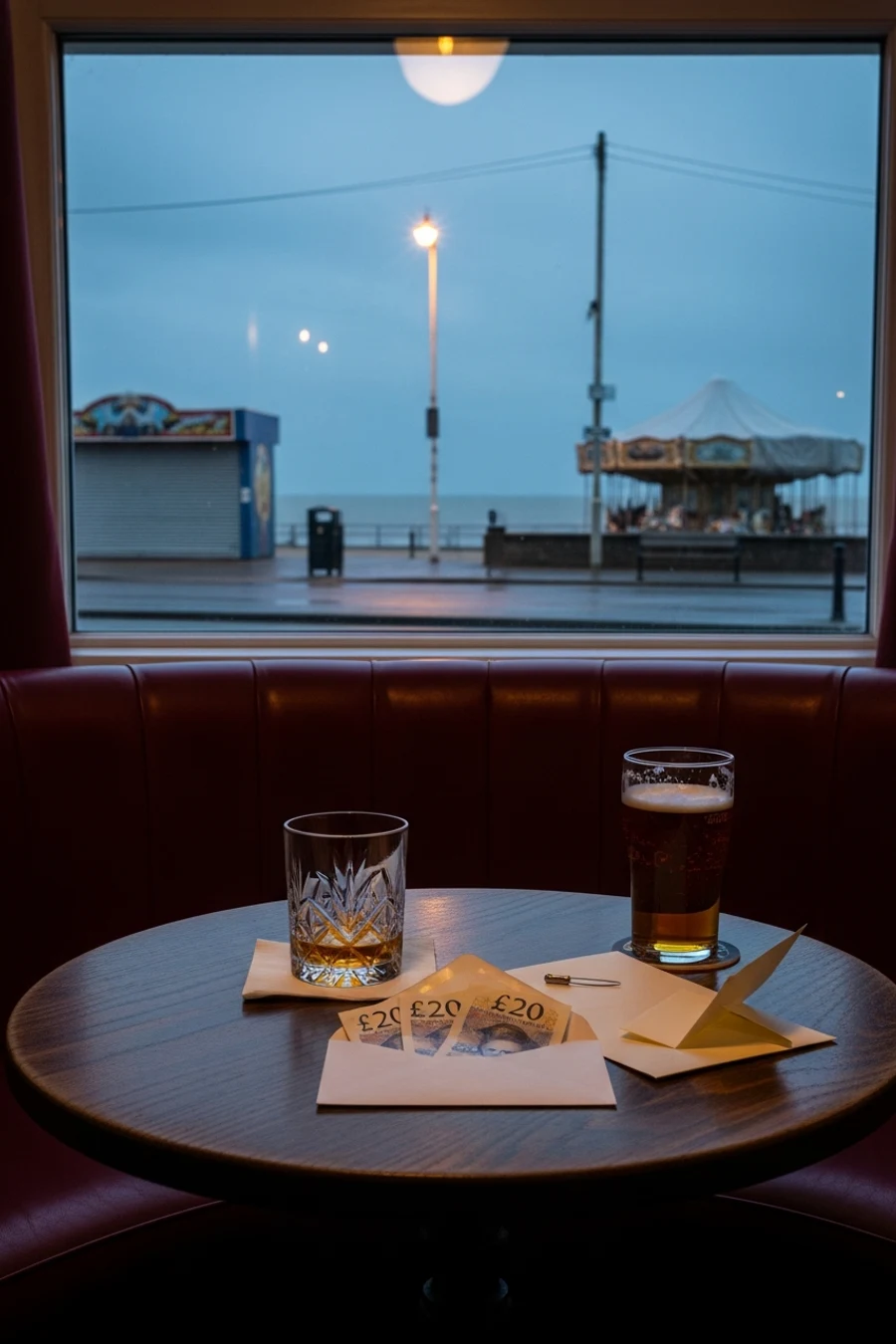
Chapter 1: The Greyhound
The pub is called The Greyhound and there is, in fact, a greyhound painted above the door, in the loose unsentimental way that pub signs are painted on the south coast. The paint has chipped at the dog's left flank for as long as I can remember and nobody has touched it up. I have lived in Wickton all my life and the dog has had the same wound the whole time.
It is the second week of December and the season is over. The amusement arcade on the front has its shutter down to the pavement. The pier cafe has the sign in the window that says CLOSED FOR THE WINTER and a smaller one underneath that says SEE YOU IN MARCH. The carousel is wrapped in a tarp the colour of an old plaster. The town has done what it does every year, which is shrink to its bones.
I shrink with it. I lost my job at the museum on the first of November and the redundancy was three weeks and the bank account has a slope on it now. I am twenty-two. I left sixth form with three A levels in subjects that didn't help and I went to work at the museum gift shop because Mrs Pace was kind to me after my dad died and I needed to be in a room with other quiet people. The museum has not closed forever. It will open in March. There is no job there for me in March either. They told me at a meeting in the library with the trustees and a man from the council, and Mrs Pace looked at the table the whole time and the man from the council told me to think of it as a fresh start.
I go to The Greyhound on Wednesdays because the half of bitter is two pounds thirty and the place is warm and my flat over the chip shop on Church Street is not. I do not drink to be drunk. I do not drink to be social. I drink because the seat by the window is across from a small two-bar electric fire that the landlord turns on at four and turns off at half eight, and because if I sit there for the two and a half hours between those times I have an hour in the flat in the dark before I go to bed and that hour is bearable.
That is the arithmetic. I do not pretend it is anything else.
There are four people in The Greyhound this Wednesday. Old Bill, who has been at the bar end since I was at primary school and was already old then. Two men I don't know, in waxed coats, who have come in off the bus from Halverton and are talking about a boundary fence. And one man, in the snug, alone, in a dark wool overcoat that he has not taken off, with a tumbler of something amber on the table in front of him. He does not look like he has come in off the Halverton bus.
I sit by the fire. I have my book, which is the same book I have been carrying for ten days because I cannot make myself care about anyone in it. I do not open the book. I look at the window. The window faces the front and the streetlamps are on already at four because that is the kind of light it is here in December. The lamps are the old yellow lamps. They make the wet pavement look like the surface of an old painting.
I get up at five for a wee. The Greyhound's ladies is at the back through a door that says THIS WAY in a brass plate. The corridor is narrow and the carpet is the kind with a pattern that has been there since the seventies and is doing the kind of work a carpet does when no one is going to replace it for another ten years.
The man in the overcoat is standing at the corridor's mouth when I come back.
He is not in my way. He is standing against the wall, looking at a framed nothing behind glass, with his tumbler of amber in his hand. He is forty, forty-three. Tall in a way that is not theatrical. Hair that has gone grey at the sides in the way you can tell is not artful. A face you would not be able to describe to a friend ten minutes later because it does not insist. The overcoat is a good coat. The shoes are the kind of shoes that come from one shop in London and not from any shop here.
I have to walk past him to get to my seat. The corridor is narrow.
"I beg your pardon," he says, when I am most of the way past. He does not move from the wall. The voice is quiet. It is a voice that has not been raised in a long time.
I stop. I do not know why I stop. He is not blocking me. He has not touched me.
"You worked at the museum," he says.
It is not a question. I look at him and try to place him. I do not know him. He is not from here.
"I was up there in October," he says. "I was buying a postcard. Of the Roman dog dish."
The Roman dog dish. There is a Roman dog dish in the case at the back of the gift shop. It is the most boring thing on the postcard rack and I sold three of them all year. I sold him one of them.
"Yes," I say.
"It's a fine dish," he says.
I do not know what to say to that. The corridor's quiet has the kind of quality that says nobody is coming behind me out of the loo. The two-bar fire is humming in the bar that I cannot see from here.
"I noticed when I came in just now," he says, in the same quiet voice, "that you were sitting at the window. I thought you might let me buy you the second half of your bitter."
There is a thing that happens to me when a man speaks to me. I become very, very still. It is not a flattering stillness. It is the stillness of an animal that does not know if the door has opened on a friend.
"I don't know you," I say.
"No," he says. He does not move. He looks, for a moment, at the carpet, then at me again. "I'm at the house on Castle Crescent through the winter. Number Twelve. I drink here on Wednesdays. I find it the quietest of the three."
The Castle Crescent houses are the rich houses. They are the houses with the brass numbers and the gravel that gets raked. Number Twelve I do not know specifically. The whole crescent I know by walking past it.
I should go back to my seat. I know I should go back to my seat. I do not want to go back to my seat. The seat is not what is keeping me warm. The arithmetic is what is keeping me warm. The arithmetic is two pounds thirty.
"I'm not a chatty drinker," I say.
"That suits me," he says.
He is not smiling at me. He is looking at me. There is a difference. A man who smiles at a young woman in a corridor of an empty pub on a Wednesday in December is doing one of two things and you know which without having to be told. He is doing neither.
"All right," I say. "Thank you."
He waits a beat. Then he turns away from the wall and walks back to the bar and orders me a half of bitter and a small whisky for himself and pays in cash and brings the half of bitter to my window seat and sets it down on the beermat with care. He does not sit. He stands for a moment with his own glass in his hand and he does not look at the window and he does not look at me. He looks at the dog painted above the door, which we cannot see from here, but which he is looking at as if he can.
"Thank you for letting me," he says, and goes back to the snug.
I sit with the half of bitter in front of me and I do not pick it up for a long minute.
I pick it up. I drink. The bitter is fine. The pub is warm. Outside it has started to rain again, a thin December rain that does not commit to being rain, and the yellow lamps make the rain look like silt in old water.
I think: he did not ask for my name. He did not ask what I am doing now. He bought me a drink and went back to his seat. He did not try to make me earn it.
I think: that is its own kind of asking.
I think: stop.
I drink the bitter. I look at the window. He sits in the snug with his amber and his coat and at half eight, when the landlord switches the fire off, the man in the overcoat stands and puts a five-pound note under his empty tumbler for the bar and walks out without looking at me.
The bell at the door does the small clatter it does. The cold comes in for two seconds. The door shuts.
I sit in the going-cold for another five minutes because I do not want to be back in the flat yet.
I walk home. The chip shop is closed and the metal shutter is half down and the smell of yesterday's fat is in the air the way it always is. I climb the stairs to the door at the side and I let myself in and I sit on the edge of the bed with my coat on for ten minutes before I take it off.
I have not been touched in nine months. Not by a man, not by a doctor, not by a friend in any way that mattered. I do not say this to be pitied. I say it because it is information.
I lie on the bed in my coat and I think about the man in the overcoat. I think about the way he did not move from the wall. I think about the way he looked at me without smiling. I think about the way he said thank you for letting me, which is a small sentence that is supposed to be a thing you say at the end of a transaction and which he said as if it were the transaction itself.
I think: I am twenty-two and I am sitting on a bed in a coat in December and the gas bill is on the kitchen counter and I have been pretending that the redundancy is going to stretch.
I think: he did not ask. He let me know he was there.
I think: I can choose not to go back next Wednesday.
I do not believe me when I think it.
I get up and I take my coat off and I put the kettle on and I sit at the small kitchen table and look at the gas bill and I drink the tea and I go to bed at ten and I lie in the dark for a long time with my hand on my stomach and I do not move it lower.
I will, later. I do.
I think about the man with the half-grey hair, the way he did not move, the way he stood looking at the painted dog. I do not give him a name in my head. He has not asked me for mine and I will not give him one until he does.
I come quietly because the flat over the chip shop has thin walls and old Mrs Carmody on the other side. I bite the side of my hand. I lie still after. I do not sleep for two hours.
I think: the gas bill is sixty-seven pounds. The half of bitter is two pounds thirty.
I think: a small whisky in The Greyhound is four pounds. He left a fiver. He did not wait for the change.
I think: stop counting.
I do not stop counting.
I sleep at last and I dream of the wet pavement and the painted dog and the small brass plate that says THIS WAY.
Chapter 2: The Alley
I do not go back on the Wednesday after. I tell myself I do not go because it is raining hard and the walk is twenty minutes. The walk is fifteen minutes. I do not go because going would mean something.
I go on the Wednesday after that.
I tell myself I am going for the fire. I am going because Bill will be there and the bus from Halverton might be in and the seat by the window is across from the two-bar fire and the half of bitter is two pounds thirty. I tell myself many things on the walk down and none of them are the truth.
I take a little more care with my hair than I have in a fortnight. I notice that I have. I notice that I notice. I do not change what I am wearing because what I am wearing is what I have warm enough to walk down in: the fitted brown skirt my mum bought me for the museum job, tights, low boots, the long jumper, the coat. The skirt is the skirt because the jumper is too long for the jeans to work under the coat. That is what I tell myself.
The Greyhound is the way it was. Bill at the end of the bar. Two new men from the boundary fence, perhaps, in the corner. The fire is on. My seat by the window is empty. I order the half of bitter and the landlord gives me the small nod he gives that is not a smile and not friendliness but is something I have decided to take as a sign that I am known.
I go to my seat. I do not look at the snug. I will not look at the snug.
I look at the window. The lamps are on already. The pavement is wet. I do not look at the snug.
I look at the snug.
He is there. The overcoat. The amber tumbler. The hair grey at the sides. He is not looking at me. He is reading something printed, a newspaper, folded small. He has the small page-turning patience of a man who knows the news will still be there in ten minutes.
I drink my bitter.
At five I go to the loo. I do not need to go to the loo. I go to the loo because if he is going to do anything, he will do it now, and I am tired of waiting on a Wednesday in December and I would like to know.
He is at the wall again on my way back. The same wall. The same tumbler. He does not look at me. He says, "Esme."
I stop. He has my name.
I did not give him my name.
"Mrs Pace," he says, quietly. "I was up at the museum the week before they closed. She introduced you."
I do not remember this. There were a great many people up at the museum in October because half the town wanted to say goodbye and Mrs Pace was very polite to all of them. He could have been any of them. I do not remember him.
"Don't be alarmed," he says. He is still not looking at me. He is looking at the framed nothing. "I have no interest in alarming you."
"What are you interested in," I say. It comes out steadier than I had thought it would.
He waits a moment. Then he turns his head, not the rest of him, and looks at me. His eyes are tired in a way that surprises me. I had expected the eyes of a man who hunts. The eyes are not that.
"I would like to look at you," he says.
I do not move.
"Just look," he says. "I will not touch you. I will not ask you to undress. I would like to stand in the alley behind the pub for five minutes and look at you in your coat. And I will give you eighty pounds for the five minutes."
The number sits in the corridor like a third person.
I am not naive. I have not had a great many men but I have had enough to know what men say in corridors of pubs to twenty-two-year-old girls. They do not say I would like to look at you. They say other things. The way he has said this, in the quietness, without smiling, without taking a step toward me, is not a thing I have heard before.
It would be easier if he were leering. It would be much easier.
The gas bill is sixty-seven pounds.
"Five minutes," I say.
"Yes."
"In the alley."
"Yes."
"With the coat on."
"Yes."
I do not say anything else. I do not say yes. I do not say no. I look at him. He waits. He does not press. He does not say anything else either. He is letting me have the silence.
I think: this is the moment. This is the moment I walk away. This is the moment I say no.
I think: eighty pounds.
I think: he is letting me have the silence because he knows that the silence will do it.
I hate that he knows.
"I have to go back to my drink for ten minutes," I say. "So it doesn't look like."
"Of course," he says. "I will go out in five. Come out when you are ready. The alley is to the left out of the door. It does not run far. Mind the bins."
He does not say thank you. He does not say good. He takes his amber and goes back to the snug and reads his folded paper.
I sit at the window with my hands around my half-empty glass and I do not drink. The two-bar fire is humming. Old Bill at the bar end has a cough that is also a laugh. The men in the corner are not in the corner anymore; one of them is at the bar.
I think: I can sit here and not go out.
I think: I can sit here and not go out and he will not do anything. He will not come back to me. He has made his offer and he will accept that the offer was declined. He will not embarrass me. He will not be back next Wednesday, perhaps, or he will be back and not look at me. He is the kind of man who can lose a thing without a fuss. That is what frightens me about him.
I think: I can stand up.
I stand up. I put on the coat that I have not taken off, button it. I leave the unfinished bitter. I do not look at the snug.
The bell at the door does its small clatter. The cold finds my face.
The alley is to the left as he said. It is the narrow strip between The Greyhound and the chemist's. There is a single bracketed lamp halfway down it that gives a circle of yellow light onto the wet brick. The bins are to the right. I do not look down the alley. I walk down the alley.
He is at the lamp. The overcoat. The empty hands.
He looks at me and he does not smile.
"Hello, Esme," he says.
"Hello," I say.
"You are doing me a kindness," he says.
"I am not."
"All right," he says. He accepts it the way he accepts things. He does not insist on the framing. He looks at me. He says, "May I look at you in the light here?"
I take a step toward the lamp. The bracket above us hums. The yellow falls on me. The brick at my back is cold through the coat. He stands two feet away. He does not move closer.
He looks. He looks for what I think is a long time and then I see him glance at the watch under his cuff and I see that it has been forty seconds.
"Turn round, please," he says.
I think: this is the moment.
I turn round.
I face the brick. The brick is cold against my forehead, just, when I lean. I do not lean. I stand with my hands at my sides. The wool of the coat is heavy on my hips. The skirt is under the coat. The tights are under the skirt. I have made myself thinking only of being warm and I do not know what he is looking at.
He looks for a long time. He does not move.
"Lift the coat at the back, please," he says.
There is a beat where I do nothing. The beat is not a refusal. The beat is the body realising what the words have asked. He had said look at me in my coat. He had not said lift it. He has expanded the terms by an inch. It is the first inch. I notice it.
I lift the coat anyway. I do not turn round. I lift it to my waist. My skirt is the brown fitted skirt. The skirt comes to mid-thigh. The tights are opaque black. I am holding the coat up at the small of my back with two hands clenched in the wool.
He does not move.
"That is enough," he says, after a time. "Thank you. You can let it down."
I let it down. I do not turn round. I face the brick. I do not know what my face is doing. I do not want to turn round and have him see.
"Esme," he says, quietly. "You can turn round."
I turn round. I keep my eyes on his coat collar. The collar is dark wool over a darker wool. He is taking something out of an inside pocket. He has folded the notes into eighths. He holds them out.
"Take it," he says.
I take it. The fold is warm from his coat. The notes are a fifty, a twenty, and a ten.
"Thank you," he says.
"Don't say that."
"I will say it," he says. "It is true."
He puts his hand back in his pocket. He does not step closer. The yellow light from the bracketed lamp is on both of us and on the wet brick and on the bin lid two feet from my hip.
"Will you come again next Wednesday," he says.
I do not answer.
"You can decide on the Wednesday," he says. "I will be in the snug from four. If you sit at the fire and finish your bitter and go home, I will not approach you. If you come down the alley after I have gone out at five, I will be at this lamp. The price next Wednesday is one hundred pounds for ten minutes. The terms are the same. The coat at the back. I do not touch you. I look."
The arithmetic of it stuns me. It is the arithmetic that I am ashamed of, more than anything else that has happened. I have the eighty pounds folded warm in my hand and I am thinking about the next Wednesday's hundred. I am thinking about the gas bill and the council tax.
"What do you want," I say.
He thinks about it. He thinks about it like a man who has been asked an honest question.
"What I want is not a thing you have to give me," he says. "What I want is to look at you. That is small enough that I can pay it openly. Anything beyond it is a different question and we do not have to ask it tonight."
I do not know what to do with that.
"Go on home, Esme," he says. "Take the long way. Don't walk past the front of the pub. There is no need for anyone to know."
I go.
I take the long way. I go up the back of the chemist and across the car park of the closed cafe and around to Church Street the back way. The folded notes are in the inside pocket of my coat, warm against my ribs because I have put my hand on them to feel them for the whole walk.
I let myself in over the chip shop and I climb the stairs and I sit on the edge of the bed with my coat on and I do not move for a long time. I do not weep. I do not laugh. I take the notes out of the pocket and I lay them on the bed and I look at them.
I take my coat off. I take my boots off. I take my tights off and the skirt and the jumper. I look at myself in the small mirror above the basin in the corner.
I am Esme. I am twenty-two. I am five foot four. My hair is brown and reaches past my collarbones. My eyes are grey-green and the left one is a shade darker than the right. My breasts are small and high. My waist is narrow. My hips are not narrow. My arse is round in a way that no boy at sixth form ever did me the kindness of pretending not to notice. It is the part of me that I have spent the most years feeling cornered by, because boys at sixth form on the south coast in December are not subtle, and the thing they noticed was the thing they noticed every time, every break, every walk down the corridor.
I have spent a great deal of my life being eighteen years old in a body that someone older than me was paying attention to.
I look at myself in the mirror.
I think: he saw that. He saw what every boy at sixth form saw and he did not say anything stupid. He looked. He did not touch. He paid me eighty pounds and let me go home the back way.
I think: he is paying me what they would not have paid because they were entitled to it for free.
I think: that is not a true thought. That is the kind of thought a person thinks to make themselves feel a way.
I lie down on the bed. I put my hand on my stomach. I move it lower. I think of the brick and the bracket lamp and the slow turn and the lift of the coat and the long, careful, ungrabbing look. I come quickly and bitterly with the side of my hand at my mouth.
I lie still after. The flat is quiet. The chip shop is closed. Mrs Carmody is asleep on the other side of the wall.
I think: I will not go back next Wednesday.
I think: I am lying.
I get up. I put the eighty pounds in the tin behind the cornflakes where my dad used to keep the housekeeping. I have not put anything in that tin for two years.
I sleep.
Chapter 3: The Snug
I do not go on Wednesday.
I go on the Wednesday after. He is not there. He is not in the snug. There is no overcoat. There is no folded paper. There is no amber tumbler.
The relief is so disproportionate I have to sit at the fire for ten minutes pretending I am reading the book.
The bitter is two pounds thirty. The fire is humming. Old Bill is at the bar end. The town is what it was. I think: I am free of him. I think: he was a passing thing. I think: he must have gone back to London.
The folded eighty pounds is in the tin behind the cornflakes. I have not spent it. I have not touched it. The gas bill is still on the counter. I have paid it out of the redundancy, the way I have paid everything out of the redundancy. The redundancy now will last me, perhaps, four weeks more.
At eight he comes in.
He comes in with the cold on his coat and he goes to the snug without looking at the bar. He orders his small whisky when the landlord comes round. He opens the folded paper.
I sit at the fire. The bitter is finished. The book is open and I have not read a word.
I think: he came late on purpose.
I think: he came late because he understood that if he had come at four I would have walked out.
I think: I am sitting here.
I think: I am still sitting here.
He does not look at me.
At five past nine, when the landlord rings the bell for last orders and Old Bill stands up to leave, I get up. I do not get up for the loo. I take my coat and I go to the snug.
He does not look up.
"May I sit," I say.
"Yes."
I sit. The snug has a small round table and a banquette and two chairs. I sit on the chair opposite him. There is the empty tumbler of his small whisky and the folded paper between us. He puts the paper away into the side of the coat without making a show of it.
"You were late," I say.
"Yes."
"Were you late on purpose."
"Yes."
"Why."
He looks at the empty tumbler. He thinks about it. He has the kind of patience that is not patience because it has nothing in it that is being controlled.
"Because last Wednesday I wanted you to come down the alley too much," he says. "I did not want to want it that much. I did not come at four because I did not trust myself not to look at you at the fire."
I do not know what to do with that.
"You did not approach me last Wednesday," I say. "You said you would not."
"Yes."
"And you would not have."
"No."
"Then it was a discipline you were doing."
He looks at me. "Yes," he says. "That is the word."
I do not say anything for a long time. The pub at last orders has the quality it has, of a room beginning to come to its end. The landlord is wiping the bar with the cloth he keeps tucked under the till. Bill has gone. The men from the boundary fence have gone. We are the only ones in the snug.
"What is your name," I say.
He looks at me. He does not look surprised. He looks at me the way a man looks at a thing he has been waiting for.
"Saul," he says. "Saul Vance. Number Twelve Castle Crescent until the end of February. Then back to London."
"You live in London."
"I have a flat in Marylebone. I have a house on Castle Crescent that was my mother's. I come down for the winters since she died."
"When did she die."
"Three years ago. The house has been a discipline of a different kind."
"Saul Vance," I say. I do not know why I say it out loud. I am tasting the name.
"Esme," he says, quietly. "I owe you the chance not to do anything else. I would like to say what I would like and then for you to decide and for you not to feel that any answer is owed because the eighty pounds happened. The eighty pounds is yours. There is no balance."
"Tell me what you would like."
He looks at me. He looks at his hands. He puts his hands flat on the table.
"I would like to put you in the passenger seat of my car," he says. "I would like to drive you to a quiet road on the down behind Castle Hill. I would like you to bend over the seat with the door open. I would like to look at you the way I looked at you in the alley, only properly, with the coat off and the skirt up. I would not touch you with my hands. I might take a photograph with a phone that does not leave the car. I would pay you four hundred pounds and drive you back to the corner of Church Street."
He stops.
"That is the next thing I would like," he says. "The thing after that I will say if there is a thing after that. I am not making a series of promises. I am telling you what is at the front of my mind tonight because you have asked me for my name."
I do not know what my face is doing. I know what my heart is doing. The thing at the front of his mind is, more or less, the thing at the front of my mind from the last Wednesday onward, except that mine is the thing being looked at and his is the thing looking.
"Four hundred," I say.
"Yes."
"For looking."
"Yes. And the photograph."
"Where does the photograph go."
"On the phone, which lives in the drawer in the bedroom at Number Twelve. The phone is not on any cloud. It is on a SIM that does not have my name on it. I bought it for this. I am telling you this because you have the right to know."
"You bought a phone for looking."
"Yes."
"You have done this before."
He looks at me. He thinks about whether to tell the truth. I see him think about it.
"Yes," he says. "Twice. Both London. Both arranged through other channels. Both women who were doing it as part of other work. Neither knew my name."
"And you are telling me yours."
"Yes."
I do not know why this is undoing me but it is. He has handed me the name on purpose. He has handed me the name because the name is a thing I can take to a friend, to Mrs Pace, to the council man, to a copper, and undo him with. He has handed me a key.
"Why are you telling me your name," I say.
"Because you are not the women in London," he says. "Because you live in this town. Because I will see you at the fire in The Greyhound on the Wednesdays I do not have a thing to look at and on the Wednesdays I do, and I do not want there to be a name I cannot say across that distance."
I think about this for a long time.
"Saul," I say.
"Yes."
"If I say no to the car."
"You sit at the fire on Wednesday and we do not say anything. The eighty pounds is yours. I do not return."
"You do not return."
"I do not return to The Greyhound. I will drink at The Crown. The Crown is a worse pub and I will not enjoy it and you will not see me. The house at Castle Crescent I will still hold. I do not give it up. You are not free of me in the town. You are free of me in this pub."
"And if I say yes."
"Then I will drive you on Friday evening at seven. I will pick you up at the car park behind the closed cafe so that no one on Church Street sees the car. I will bring the four hundred pounds in twenty-pound notes in an envelope that I will give you before we drive anywhere. I will give you the envelope first so you can keep it and walk away from the car if you change your mind. I do not ask for the money back."
"You do not ask for the money back."
"No."
"Saul."
"Yes."
"You have thought about this all week."
"Yes."
"You have thought about the car park and the envelope and the time."
"Yes. I have thought about little else."
I look at him. I look at the grey at his temples and the tired eyes and the hands flat on the table that he has not moved an inch since he put them down. The landlord is washing glasses. The two-bar fire is off. The lamps outside are still on.
"Friday," I say. "Seven. The car park."
"Yes."
"The coat on, until."
"Until you choose."
"I have not chosen yet."
"No. You have only said Friday. That is the beginning of the choosing."
"Saul."
"Yes."
"If you frighten me on Friday I will get out of the car. I do not care where we are. I will get out and walk."
"Yes."
"I will keep the envelope."
"Yes."
"I am not promising you anything else."
"You have not promised me anything," he says, gently. "You have said Friday at seven. I have heard you."
I get up. I put on my coat. He stands. He does not offer me a hand. He does not move toward me.
"Goodnight, Esme."
"Goodnight."
I walk home up Church Street, the front way this time, because I do not have eighty pounds in my pocket tonight and I do not have to hide. The chip shop is open and the lights are bright and the smell is the smell.
I let myself in. I climb the stairs. I sit on the edge of the bed with my coat on for a very long time.
I think: I have agreed to a Friday.
I think: I have agreed to four hundred pounds and a passenger seat and a photograph on a phone in a drawer in a house on Castle Crescent.
I think: he has told me his name.
I think: I will not go.
I think: I will go.
I think: at twenty-two, with the redundancy bleeding out and the museum closed and no flat in this town that I can pay for past the end of February, the thing I am doing is the thing I am doing.
I think: this is what people mean by no choice. It is not no choice. It is the choice between two bad and one of them is the one he can pay for and the other is the one no one will.
I do not put the coat in the cupboard. I lie down in it. I put my hand on my stomach. I move it lower.
This time I come slowly, with the heel of my palm, thinking about an envelope, and the words and the photograph, and the bracket lamp, and the discipline of a man who came in at eight because he did not trust himself at four.
I sleep at last. I dream of nothing.
Chapter 4: The Down
Friday is the slowest day I have ever lived.
I wash my hair in the morning because I cannot think of any other thing to do with the morning. I lie on the bed in the afternoon and listen to the gulls and the rain. I make tea three times. I drink one of them. I do not eat.
At five I get up and I stand at the wardrobe and I look at what I have. I have the brown fitted skirt. I have a black jumper that I have worn for two years. I have the long jumper. I have tights. I have stockings, a single pair, from a Christmas party at the museum two years ago.
I think: he said the coat at the back. He said the skirt up.
I think: it is for him to look at me, not for me to be ready.
I put on the brown skirt. I put on the stockings. I take the stockings off. I put on the tights. I take them off. I put on the stockings.
I think: do not make this a costume.
I take the stockings off and put on the tights. The opaque black tights. The fitted brown skirt. The long jumper. The boots. The coat. I put my hair behind my ears. I do not put on any makeup. I have not worn any makeup in two months. The face is the face. He has seen it in the corridor at the loo with no kindness on it.
I leave the flat at quarter to seven. I take the back way down to the car park behind the closed cafe. The pavement is wet from the afternoon rain. The lamps are on. The cafe has the sign in the window. The car park has three cars. None of them is his.
I stand by the wall of the cafe and I count my breaths the way the woman at the doctor's used to make my dad count his breaths.
A car turns in. A dark estate of a kind I do not know the name of. The headlights come across the cafe wall and find me and then sweep past. The car stops at the back of the car park, away from the streetlamp. The engine cuts.
He gets out. The overcoat. The same shoes. He does not wave. He waits by the bonnet for me to come to him. I come to him.
"Esme."
"Saul."
"Get in," he says, and walks round to the passenger door and opens it. He does not hand me in. He does not touch me. He waits until I am in and then he closes the door with the kind of care that says he has been thinking for three days about not slamming it. He walks round and gets in himself.
The car is warm. The seats are pale leather. There is a faint smell of clean wool. The dashboard is dim. The clock says 18:58.
He reaches into the inside pocket of his coat and brings out a plain white envelope and puts it in my lap.
"It is in twenties," he says. "Twenty of them. Count it if you like. The car will not move until you have it."
I take the envelope. I do not open it. I fold it once and put it inside the inside pocket of my own coat. I do not need to count it. He has not given me a reason to think I would need to.
"Are you ready to drive," he says.
"Yes."
He starts the car. He drives.
He drives carefully. He drives the speed limit. He has the indicator on at the corner. He goes out of the town the way out of the town that goes past the closed petrol station and up the lane that climbs Castle Hill, and at the top of Castle Hill the lane forks, and he takes the right fork that goes along the back of the down. The down is the long high field above the town. In summer the dogs and the kites are up there. In December at seven there is no one.
He drives until we are perhaps a mile out, in a lay-by beside a hedge, with the lights of the town small below us and the sea black behind the lights and no other car on the lane at all.
He cuts the engine. The cabin light comes on and he reaches up and turns it off again.
"It is quiet here," he says. "You can hear a car coming for half a mile. We will not be surprised."
"All right."
He sits with his hands on the wheel. He does not turn to me yet. He says, quietly, "Esme. The price has been paid. If you would like me to drive you back now, I will drive you back now. The envelope is yours. There is no balance."
"I know."
"Tell me what you would like the next thing to be."
I think about this. I had thought it would be him telling me what to do. He is not doing that. He is asking. The asking is harder.
"You said," I say, "in the snug. You said you would like me to bend over the seat with the door open. With the skirt up. With the coat off."
"Yes."
"With you not touching."
"Yes."
"Then that is the next thing."
He looks at the wheel for a long moment. He breathes out, once, the way a man breathes who has been holding it.
"Take your coat off, Esme," he says.
I take my coat off. I fold it on my lap. The car is warm but the coat off is colder than the coat on. The long jumper is heavy and warm. The skirt is the brown skirt. The tights are the black.
He looks at me. He does not move from the driver's seat. He does not reach.
"Take the jumper off," he says.
I lift the jumper over my head. Under the jumper I have a long-sleeved fitted top, a plain black thing, because I had thought he might say take the jumper off and I had thought I would like something he could see.
He looks at me. The bra under the fitted top is plain. I am breathing through my nose. My collarbones are doing the thing they do when I am breathing through my nose.
"Open the door," he says.
I open the passenger door. The cold of the down comes in. The hedge is two feet from the door. The earth at the foot of the hedge is wet and smells of wet earth. The lights of the town below us look very small.
"Stand up," he says.
I stand up. The roof of the car is at the height of my hip. I am between the car and the hedge.
"Lean over the seat, please. Forearms on the seat. Skirt up to the waist."
I do.
I lean. The fitted black top rides up at my back. My forearms are on the pale leather. The leather is cool. The skirt I lift, two-handed, slowly, to my waist, because the way I have been told to do it is slowly. The tights are opaque. He has not asked me to take them off.
He does not move for a long time. The driver's door opens. I hear him get out. I hear him close it. I do not turn round.
He comes round the bonnet. The boots on the gravel are slow. He stops behind me. He is, I think, four feet away. He is not closer.
He looks. He looks for a long time. He does not speak. The hedge is rustling at me with the small evening wind that comes off the sea. The cold of the air is on my back where the top has ridden up.
"Esme."
"Yes."
"I am going to take a photograph in a moment. I want you to know before."
"Yes."
I hear the small unlocking of a phone. I hear no shutter sound because he has turned it off. I hear it twice. Then I hear him put it away.
"Hold there for a moment longer, please," he says. "I am only looking."
I hold. The cold is on the small of my back. The wet earth is in my nose. The fact that I am bent over the passenger seat of a stranger's car in a lay-by on the down with my skirt at my waist and my tights on and a four-hundred-pound envelope in the inside pocket of my coat on the driver's seat is the entire content of my mind.
I am wet. I have been wet for an hour.
I do not know if he can tell through the tights. I do not know if he is trying to tell.
"Stand up, please," he says, quietly. "Skirt down. Coat back on."
I stand up. I let the skirt fall. I turn round. I have not been looking at him. I look at him now. He is standing four feet away with his hands at his sides. His coat is open. His eyes are dark.
I get back in the car. I shut the door. He gets in his side. He shuts his door. He sits with his hands on the wheel. The cabin is warm again at once.
"Did you take a photograph of my face."
"No."
"Did you take the photograph from a distance that included it."
"No. The composition stops at your waist."
"Good."
He breathes out. He puts the key in.
"I am going to drive you back," he says. "I would like to ask you one thing."
"Ask."
"Were you a part of that," he says. "Or were you in the car for the four hundred and somewhere else in yourself."
I look at him. I look at the dim of his profile in the dashboard light.
"I was a part of it," I say.
"Thank you."
"Don't thank me for that."
"All right," he says. "I will not thank you for that."
He starts the car. He drives back. He drives the speed limit. He stops at the corner of Church Street and Marine Drive. He does not pull up at the chip shop because he understands.
"Goodnight, Esme."
"Goodnight, Saul."
I get out. I shut the door with the care he has shown the door. The dark estate pulls away. I walk the half-block down Church Street. The chip shop is open. The fryer is loud. I let myself in over the chip shop.
I sit on the edge of the bed in my coat with the envelope still inside the inside pocket. I do not take the coat off for a long time.
I take the envelope out. I count it. Twenty twenty-pound notes. Four hundred pounds.
I lie back on the bed in the coat with the notes on the duvet in front of me and I look at the ceiling.
I am very wet. I have been wet the whole drive home.
I put my hand under my skirt. I am still in the tights. I come almost at once, almost angrily, with my fingers above the tights and a fist of duvet in the other hand.
I lie still after for a long time.
I think: I have been a part of it.
I think: that is the part that is going to be the difficulty.
I take the coat off. I take the boots off. I take the skirt off. I take the tights off. I take the fitted top off. I take the bra off. I lie naked on the bed in the cold of the flat and I cover my face with my hand and I do not weep but the breath does the thing breath does when the weep is in the room.
I think: he will ask for a Friday next week and the price will not be four hundred and the photograph will not stop at the waist.
I think: I will go. I am not pretending that I will not.
I think: I am twenty-two and I am at the end of a redundancy and I am in a town that has shut its lights and I have agreed, in my own body, to be the looked-at thing for the man with the grey at the temples and the discipline who has bought a phone for the looking and the house from his dead mother for the winters.
I think: this is the choice and it is not the one anyone was supposed to have to make. I am making it anyway.
I get up. I put on the long jumper. I put the four hundred in the tin behind the cornflakes. The tin has four hundred and eighty pounds in it now. The gas bill is sixty-seven. The council tax is one hundred and twelve. The flat is paid until the end of January.
I make tea. I drink it. I look at the gas bill.
I go back to bed. I lie on my side. I think of the lay-by and the hedge and the small wind off the sea and the cold on the small of my back and the long, careful, ungrabbing look from four feet away.
I think: he did not touch me.
I think: next time he will ask. I will say yes.
I sleep.
The rest of the story
Finish Off-Season.
Sign up free, then $2.99 opens the closing chapters.
No payment to start.
Private and discreet.