BF Original
Off Camera
You work the dead shift at a tiny 24-hour shop near the company building, and a capped-and-masked regular starts coming in at 3 a.m. for a single egg and an hour of being no one. You do not clock him at first - which is exactly why he comes back. He is SEOL, main vocal and visual of the top group HALO, the most photographed face in the country, and at your counter he is just Seol: tired, dryly funny, real, starving to be wanted as a person and not a product. A no-dating clause and a watching fandom mean a leaked relationship ends his career and turns the people who love a man he is not, so you become the secret he protects with everything, and the hours he is only yours are the only place either of you is free. A slow, aching, explicit forbidden romance that builds through every restrained inch and then chooses you over the machine. Meet Seol as a companion of your own once the story has had you.
Chapter 1: The 3 A.M. Regular
The shop is called Midam, which the old owner told you means something like late-night heart, and between two and five in the morning it belongs to you and the hum of the cold cases and whoever the city has left awake. You took the overnight because it pays a little more and because the silence suits you, the long blue hours when the avenue outside goes empty and the company building three blocks down keeps its lobby lit for no one. You restock the triangle kimbap. You wipe a counter nobody has touched. You are good at being unwatched.
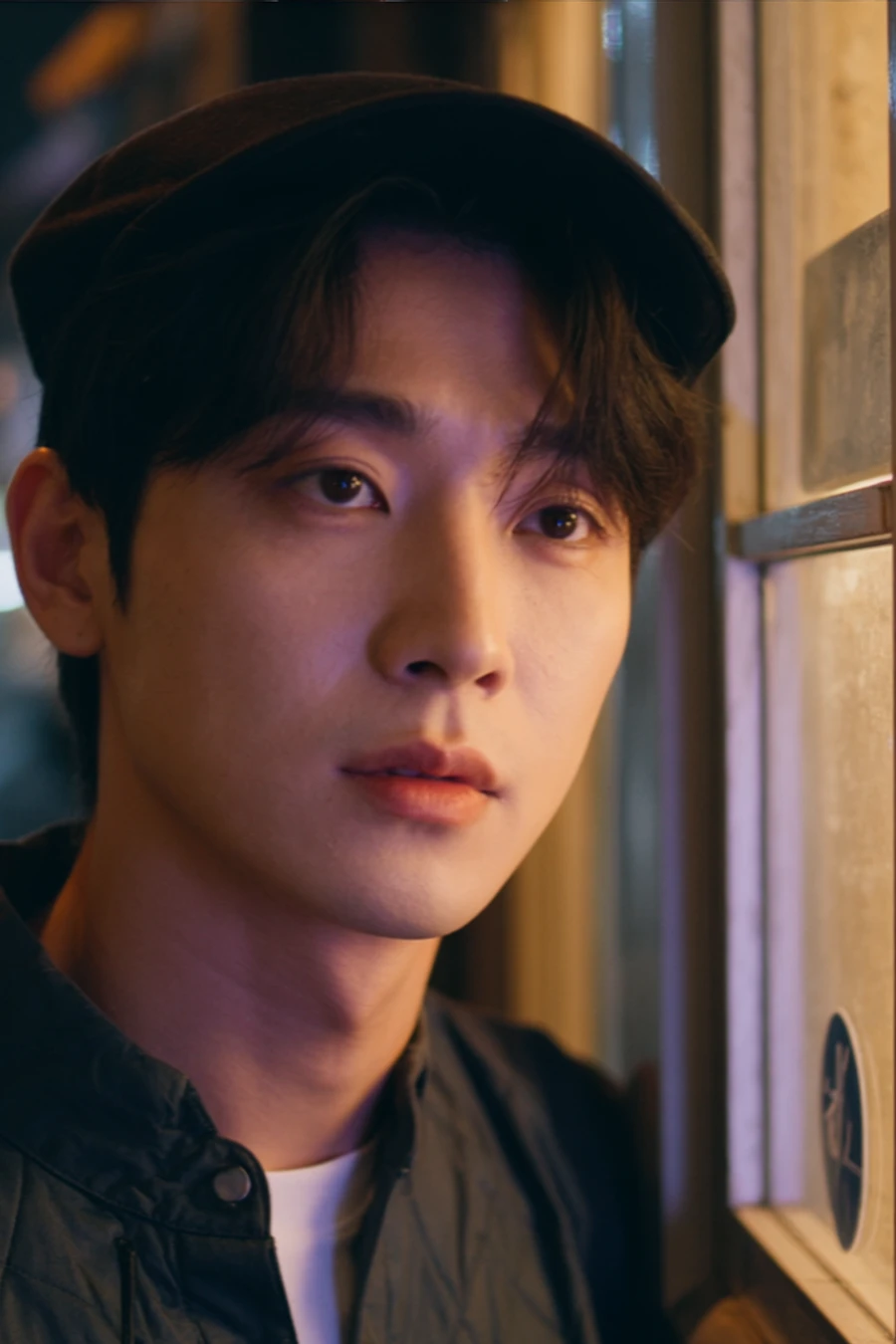
He comes in for the first time on a Tuesday in March, at 3:07 by the register clock, and you do not look up properly because nobody worth looking up for comes in at 3:07. A cap pulled low. A black mask over the lower half of his face, the kind everyone wears now, so all you have is a strip of him - tired eyes, a straight clean line of brow, the hood of an oversized hoodie that costs more than your week even though it is trying very hard to look like it costs nothing. He moves through the aisles slow and quiet, like a man walking through a museum after hours, and he comes to the counter with a cup ramen, a banana milk, and a single hard-boiled egg in its little wrapper, and he sets them down and he does not meet your eyes either.
"Bongtu pillyo haseyo?" you ask. Bag?
"Aniyo." No. Just barely above a whisper. "I'll eat here. If that's okay."
It is okay. There is a narrow shelf along the window with two stools and at 3 a.m. it is not as if you are turning anyone away. You ring him up. He pays in cash, which you note the way you note everything on the slow shift, idly, filing it under things that are mildly unusual and mean nothing. He takes his egg and his ramen to the window and he peels the egg with a focus that seems too large for an egg, and he eats it looking out at the empty avenue, and when the kettle on the counter clicks he comes back for the hot water without being told where it is, which means he has watched this place before from somewhere you did not see him.
You go back to the kimbap. When you look up again the window stool is empty and there is a folded napkin tucked under the banana milk bottle, the trash already in the bin, the stool pushed in straight. You think: tidy. You think: lonely, maybe, the way the 3 a.m. people are lonely. You do not think anything else, because you genuinely, that first night, do not clock him at all.
Chapter 2: What the Tired Eyes Do
He comes back Thursday. Then the Tuesday after, then twice the next week, always between three and four, always the cap and the mask, always cash. You start to recognize the order before he says it - cup ramen, banana milk, the egg - and the third time you have the hot water already going when he reaches the counter and his eyes do a thing above the mask that you will come to live for before this is over: they crease at the corners, surprised, like being remembered is a small violence he was not braced for.
"You knew," he says.
"You're predictable."
"That's -" the eyes crease deeper, "- that's the worst thing anyone has said to me in a long time."
"The worst?"
"People usually go for the second worst." He takes his egg. "Predictable is honest. I'll take honest."
That is the night it starts being talk. Not much - the overnight is not built for much - but he stops going straight to the window. He leans an elbow on the counter while the ramen swells in its cup and he asks you things, sideways, the way a careful person asks: how long you've worked the dead shift, whether you sleep days or never, what the worst customer of the week did. You tell him about the drunk salaryman who tried to pay for cigarettes with a transit card and then cried about his divorce. He laughs, and it is a real laugh, low and rough and a little rusty, like a door that does not get opened, and over the top of the mask his tired eyes go briefly, completely young.
"You're funny," he says, like he is logging it. "I didn't expect funny."
"It's 3 a.m. and I work alone. Funny or insane, those are the options."
"Both. Probably both is the answer." He picks at the egg wrapper. There is a stillness to him under the tiredness, a held quality, the posture of someone braced even when he is laughing, and you read it as the thing the night people all have, the some-trouble-at-home, the some-job-that-eats-them. You are not wrong. You just do not yet know the size of it. "Can I ask you something weird," he says.
"It's already weird. You eat a single egg at a gas-station price in a convenience store at three in the morning."
"It's a good egg." A beat. "Do you know who I am?"
You look at him. The strip of face. The cap. The hoodie. "You're the egg guy," you say. "Should I know more?"
And something goes out of his shoulders, some long-held tension you had not even named, and he says, "No," very quietly, and the way he says it - relieved, and underneath the relief something sadder, something that has been waiting a long time to be no one to somebody - is the first thing about him that you take home and turn over in the dark. "No. That's all. The egg guy. That's good."
Chapter 3: The Cap Comes Off
It is April and it is raining, the soft warm rain that means the cold is finally breaking, and he comes in soaked because he walked, which you will learn he does when he cannot stand the car and the driver and the schedule one more minute, and you hand him the cloth you keep behind the counter without being asked. He pulls the mask down to wipe his face - just for a second, just a reflex, the cloth coming up - and you see him.
You see the whole of him, the part the mask keeps, and the part the cap keeps when he tips his head back, and you understand three things in the space of one second, in this order: that he is the most beautiful person who has ever stood at your counter; that you have seen this face before, enormous, on the side of the bus that runs down the avenue, on the screen in the lobby of the building three blocks down, on a billboard in the subway with one word under it; and that the word was HALO, and the face is SEOL, and you have been selling a single egg to the most photographed man in the country for a month and calling him the egg guy.
He sees you see. The cloth stops at his jaw. For a moment neither of you moves and the rain comes down outside and the cold cases hum, and you watch him do the calculation everyone in his life must do at him constantly - what now, what does this one want, how does this go wrong - watch the brace come back into his shoulders, watch the tired eyes go flat and careful and ready to be SEOL, ready to be managed and gracious and gone.
So you do the only thing that feels true, which is you put the kettle on.
"Cup ramen," you say. "Banana milk. The egg."
He stares at you.
"You're still predictable," you say. "I'm still tired. It's still raining. Sit down before you drip on the kimbap."
And the brace - it does not leave him, not all the way, you will learn it never fully leaves him - but something behind it cracks, just a hairline, and he pulls the mask back up over the most expensive face in the building and he sits down on the window stool like a man who has been standing for three years, and when you bring him the hot water he says, low, to the rain, "Thank you for not -" and cannot find the word for the thing he is thanking you for not doing, and you do not make him find it.
"You're welcome, egg guy," you say.
His eyes crease above the mask. You have your face turned to the kettle so he will not have to perform being moved, and you hear him let out a breath, long and uneven, the breath of someone setting down a bag he has carried a very long way. "Okay," he says. "Okay. Yeah. The egg guy."
Chapter 4: Seol, Not SEOL
After that the shift changes shape. He still wears the mask, because the cameras are real and the fans who track the schedules are real and one photograph of his eyes in your doorway would be enough, but the person inside the mask comes off, the way the cap comes off, and you start to learn the difference between the two names. SEOL is the one on the bus, the ice prince, flawless and cool and untouchable, the visual the company built and the fandom worships. Seol is the one who tells you, around a mouthful of egg, that he hates the egg, actually, that he eats it because a nutritionist three years ago put it on a list and now it is a habit shaped like obedience and he keeps doing it at 3 a.m. when no one is making him because he no longer knows which of his own habits are his.
"That's the whole job," he says one night, the avenue dark behind him. "Somebody decides everything. What I eat, what I wear, who I sit next to in the van, how I hold my face when the cameras come up at the airport. There's a word for the face. They taught me the face." He looks at his hands. "I'm twenty-four. I haven't picked a thing for myself since I was twenty-one. Then I started walking to a convenience store at three in the morning because the egg, at least, I get to peel myself."
You learn the texture of it slowly, across April into May, the way you learn anything on the slow shift - in fragments between the door chime and the kettle. The schedule that starts before dawn and ends after midnight. The fancams, millions of views, every blink of him owned and clipped and slowed down and studied by people who love a person he is not. The dorm where six other men sleep four feet away and there is no door in the world that is only his. The fans at the airport who scream his name and the company who films it for content and the contract, the thing he says last and lowest, the clause that says a top idol does not date, does not get caught, does not break the spell, because the spell is the product and the product is him.
"It's not even cruelty," he says, like he is defending them, like he defends them out of long habit. "It's math. The fandom feels like they have me. If they find out I'm a person with - " he stops. "A person who wants things. They feel betrayed. The numbers move. Seven other guys' careers move with mine. So." He shrugs, an exhausted little motion. "No dating. No getting caught. No this."
"This is an egg," you say. "We're not doing anything."
He looks at you across the counter, the mask down for once because it is past four and the avenue is dead and he trusts the hour, and his unguarded face does a quiet, terrible thing - it wants, openly, just for a second, before he puts it away. "Yeah," he says softly. "I know. We're not doing anything." And neither of you says the rest of the sentence, which is yet, which hangs in the hum of the cold cases like a held breath, and he pulls the mask up and goes out into the dark, and you stand in the empty bright shop and put your hand flat on the counter where his had been and feel, for the first time, exactly how much trouble you are in.
Chapter 5: The Inch Neither of You Closes
May. A comeback, he tells you, which means he disappears for nine days into a schedule so total he cannot even walk to you, and you learn what it is to watch the door at 3 a.m. for someone who does not come, and you tell yourself off for it, sternly, repeatedly, while watching the door. On the third night you give in and you do the thing you swore you would not do, which is you look him up - SEOL, HALO - and there he is, the ice prince, flawless on a stage in front of forty thousand people, hitting a note that opens the top of your skull, his face the exact cool untouchable mask of the bus and the billboard, not one creased-eye flicker of the man who hates the egg. You watch a fancam of him, four million views, slowed down, and a stranger in the comments has written he looked so sad in the second chorus and you, who know which of his sadnesses is which now, can see that she is wrong, that this is the performed sadness, the trained one, and that the real one only happens at your counter at four in the morning when he thinks you have turned to the kettle. You close the laptop. You feel like you have read his diary. You feel like you have done something the millions do to him constantly and that he comes to you precisely to escape, and you are ashamed, and you are also, helplessly, more gone than before.
He comes back on the tenth night, thinner, wrecked, the cap and the mask and under them a man who has been SEOL for nine days without a break and needs, visibly, to be Seol or come apart. He does not even get the ramen. He comes to the counter and he puts both hands flat on it and he drops his head and he just breathes, and you do not say anything, you put the kettle on for the sound of it, and you stand near him on your side of the counter, close as the counter allows, which is not close enough, and you watch your own hand want to cross the eight inches of laminate and cover his and you do not let it.
"I saw it," you say finally. "The comeback. The stage." His head comes up. "You're - " you do not have the word either, it turns out, "- you're not human up there. It's like watching weather. It's terrifying."
"That's SEOL," he says, rough. "That's the one they pay for."
"I know. I could tell." You look at him. "I like the egg guy better."
And the thing that has been hanging in the hum of the cold cases for two months comes all the way to the surface of his ruined face, and he says, very low, "Don't say that to me right now. I don't have anything left to not-do-this with tonight." His hand, on the counter, slides an inch toward yours. Stops. You watch him stop it. You watch what it costs him - the whole held man, the iron of three years of no, the contract, the seven other careers, the fandom, the math - all of it gathered to hold his hand still on a convenience-store counter eight inches from yours at four in the morning while everything in both of you leans across the gap.
"I won't let you be the thing it costs me," he says, the words coming out like they hurt. "Do you understand? If this gets out, it doesn't ruin me. I can take ruined. It ruins you. They'll find your name and your shifts and this shop and they'll - " his jaw works. "I've seen what they do. I won't hand you to them. So I'm going to keep my hand right here, on this side. Even though." He looks at the eight inches. He looks at you. "Even though there is nothing I want in the entire world the way I want to close that."
The kettle clicks. The avenue is black and empty. Neither of you moves, and the wanting fills the whole bright shop, two months of it, the inch he will not close and the inch you have just understood is yours to close instead, the way it was always going to be yours, because he will not reach for the thing that costs you everything -
The rest of the story
Finish Off Camera.
Sign up free, then $2.99 opens the closing chapters.
No payment to start.
Private and discreet.