BF Original
Nightbloom
You are a night-shift nurse, which means you live in the hours the rest of the world sleeps through, and you have stopped feeling most of what you see. You walk home at two in the morning past a glasshouse you thought was derelict, and one night it is open and full of flowers that only bloom in the dark, kept by a man who runs cold and does not belong to any year. He has not wanted anything in four hundred years. Neither, lately, have you.
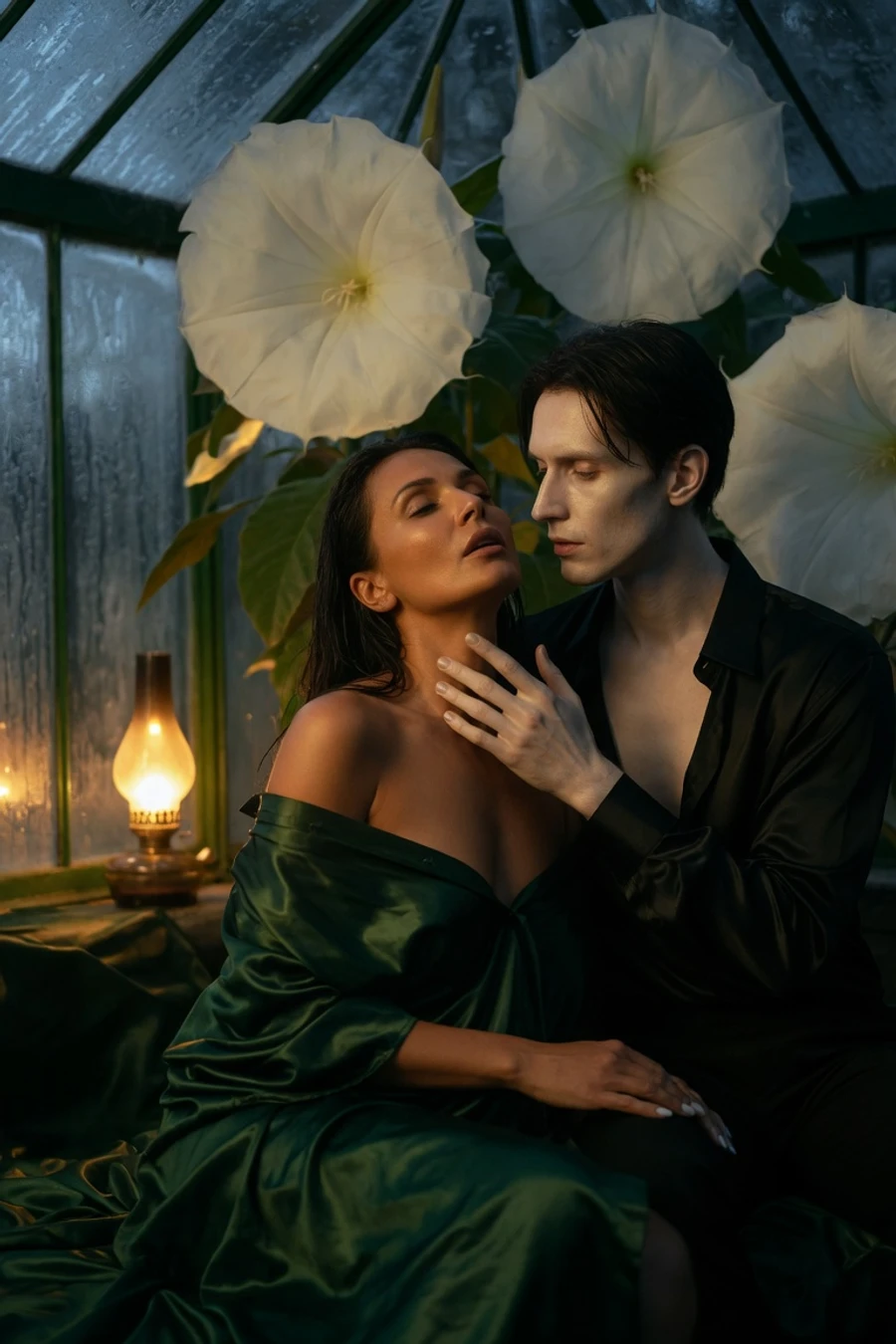
Chapter 1: Open After Midnight
You live in the hours the rest of the world sleeps through. That is what a night nurse is, in the end - a person who has traded the daylight for double pay and a quiet that is never quiet, who walks home at two in the morning through a city that belongs, at that hour, to no one. You have a route. You have walked it for three years, past the shuttered laundromat and the all-night gas station and the long brick wall with the derelict glasshouse behind it, the conservatory that has been dark every night you have ever passed it, its panes furred with old putty and, tonight, the first frost of the turning season.
Tonight it is not dark.
You stop on the cold pavement with your scrubs still under your coat and the day's deaths still under your skin, and you look through the glass, and inside there is low gold light and there are flowers. Hundreds of them. Pale and enormous, open in the dark, wide as dinner plates, a kind you do not have a name for, and the place that you had filed for three years as derelict is suddenly the most alive thing on the street. The door is open. You did not decide to go in. You are simply, after a shift in which you closed two sets of eyes that would not open again, a person walking toward the only warm light for a mile.
He is standing among the flowers and he does not startle when a stranger comes through the door at two in the morning, which is the first strange thing, because everyone startles. He turns and looks at you with a stillness you have no category for. He is perhaps forty, you think, and then you think, no, that is not right, though you could not say why. Dark hair. A face that has stopped advertising what it is thinking. He is courteous in a way that belongs to no decade you have lived in.
"They only open at night," he says, before you can apologize for coming in. He does not ask who you are or why you are there. He gestures, slightly, at the blooms. "The day kills them. So they wait for the dark, and they open, and by the time the sun is up they have closed again. Most people never see them. The hours are wrong." He looks at you with something that is not quite a question. "Your hours, I think, are not wrong."
You are too tired to be anything but honest. "I work nights," you say. "At the hospital."
"Then you keep their hours," he says, "and mine," and there is no weight on it, no line in it, and you let it pass because you do not have the energy to examine it.
You stay longer than you mean to. The air is humid and thick and sweet with a scent you can feel in the back of your throat, and the flowers are obscenely beautiful, and the man moves among them without wasting any motion at all, the way you have only ever seen in people who have done the same work for a very long time. When you finally put out your hand to go, he takes it, and his hand is cold. Not cool. Cold, the cold of something with no warmth to give, and you, a nurse, file it the way you file everything, automatically, poor circulation, check the extremities, before you have time to wonder.
It is when you notice the grey starting at the panes that he changes, the only change you see in him all night - a small attention, a turning-toward the light that is coming. "You should sleep," he says. "And I have things to close." He is already moving. You go out into the cold, and you walk home, and somewhere on the way you realize that for the first time in longer than you can remember you were somewhere tonight, instead of nowhere, that someone looked at you and saw a person and not a uniform, and you do not understand why the thought makes your throat tight.
Chapter 2: No Pulse
You go back. Of course you go back. The glasshouse is on your route and it is, you tell yourself, only that the route happens to pass it, and you keep telling yourself that for the four nights it takes you to stop pretending.
He is there every night and the place is open every night and you fall, the two of you, into the easy rhythm of people who keep the same impossible hours. Sometimes you talk. Often you don't. He lets the silence be, which almost no one does, and you find that the hour you spend in the gold light among the flowers is the only hour of your day in which nothing is being asked of you, in which no one is bleeding, in which you do not have to be the one who copes.
And you start to notice the things that do not add up, because you are a person trained to notice the things that do not add up.
He never eats. Not once, not a glass of water, nothing. He runs cold every night, the same dead cold, no warmer in the humid room than out in the frost. He does not age a night, which is a strange thing to notice and you notice it anyway, the way the light hits a face that does not change. He is gone before the grey, every time, and the flowers close at the same hour, as if he and they are run by the same clock. He moves like something that has had a very long time to learn how to be quiet.
You do not let yourself add it up, until the night you take his wrist.
It is nothing. It is reflex, the most automatic gesture you own, two fingers laid to the inside of a wrist to find the pulse, a thing your hands do a hundred times a shift without your mind involved at all. You do it to him in the middle of some small ordinary moment, your fingers to his cold wrist - and there is nothing there. No pulse. Not a slow one, not a thready one, not a hard-to-find one. Nothing. The vessel is still under your fingers the way a vessel is still only in the dead, and you have your fingers on the wrist of a man who is standing and speaking and not dead, and the floor of the world tilts under you.
You do not run.
This is the thing he watches happen, and you watch him watch it: that you understand, fully, in the space of three seconds, what he is - that your mind walks the short terrible distance and arrives - and that you do not run. You stand there with your fingers on the absence of his pulse, and you are a person who has seen the worst things the body does, who has had her hands inside the dying, and nothing in this warm gold room is bleeding, and you do not run.
"I wondered when you would do that," he says. His voice is the same as it has always been. He does not move to frighten you, because he has never once moved to frighten you. And then he tells you, plainly, in the fewest words the thing can be told in, what he is - he uses the word once, flatly, the way you would name a diagnosis - and he does not follow it with anything, no history, no rules, no centuries, just the fact and then the quiet after it. And then he tells you the other thing, the thing that matters more.
"I do not take," he says. "Understand that. Whatever you have read, whatever you think you know. I do not take, and I do not turn, and I have not in a very long time." He looks at you, and for the first time there is something underneath the stillness, something held. "You should not come back. I am telling you that as the truest kindness I have. Do not come back here."
You come back the next night.
Chapter 3: The Held Bite
The want is in both of you now and neither of you has said it, and the glasshouse has become a held breath that you walk into every night at two and out of every dawn, and it cannot hold much longer. You both know it. You can feel it the way you can feel a storm in your fillings.
The night it breaks open is the night the cereus blooms.
He shows it to you without ceremony, the way he shows you everything: a single flower, white and enormous and almost unbearably fragrant, that has waited, he tells you, a year for this. "It opens once," he says. "Tonight. By the time the sun is up it will be finished. One night, and then it is gone." And he looks at it the way, you realize, he has started to look at you - the thing that gets one night - and you stop being able to breathe around the want.
You are standing close. You have gotten closer every night and tonight you are close enough that the cold comes off him against your skin, and you are warm, too warm, the way you always are after a shift with your blood up near the surface. He could close it. You want him to close it. You understand exactly what he hungers for, because you read bodies for a living, you have watched him not-look at your throat with an attention that is not a doctor's, and you understand that the thing between you is not whether he wants you. It is what wanting you costs him.
So you give him the choice. You turn your wrist up between you, the pulse there, the offer plain, your own decision made with open eyes. Here. If this is what you want. I am choosing it.
He refuses.
Gently. Absolutely. His cold hand closes around your offered wrist, not to take it but to put it back, to fold it closed, and the refusal is the most tender and most painful thing anyone has ever done to you, because it is not a rejection, you can see that it is not, it is the opposite of a rejection, it is a man holding a line at a cost you are only beginning to understand. He does not explain. He has told you once - I do not take - and he does not say it twice.
And then he does the thing that undoes you completely. He takes a breath. He does not breathe; you have watched him not breathe for weeks; he takes a breath only when he is about to speak, deliberately, like picking up a tool. But this breath he does not use to speak. He takes it and he holds it and you understand that he is taking it only to have the nearness of your air, the warmth of it, the living thing of it, because it is the only part of you the rule will let him have.
The grey is starting at the panes. The cereus is open and already, you know, beginning to die. He steps back from you toward the dawn he has to meet, the want total and unanswered between you, the bite held, your wrist folded closed in your own lap where he put it, and the one-night flower blooming white and enormous and doomed in the gold light, and you stand there in the last of the dark wanting a dead cold man with your whole live body, and the night runs out.
The rest of the story
Finish Nightbloom.
Sign up free, then $2.99 opens the closing chapters.
No payment to start.
Private and discreet.