BF Original
Lee
Arran is thirty-eight and eighteen months past the stroke that took half of his right side and most of the words he was sure of. The local joiner has been coming up on Tuesdays and Fridays for three months. The work is twenty minutes. The tea is forty-five.
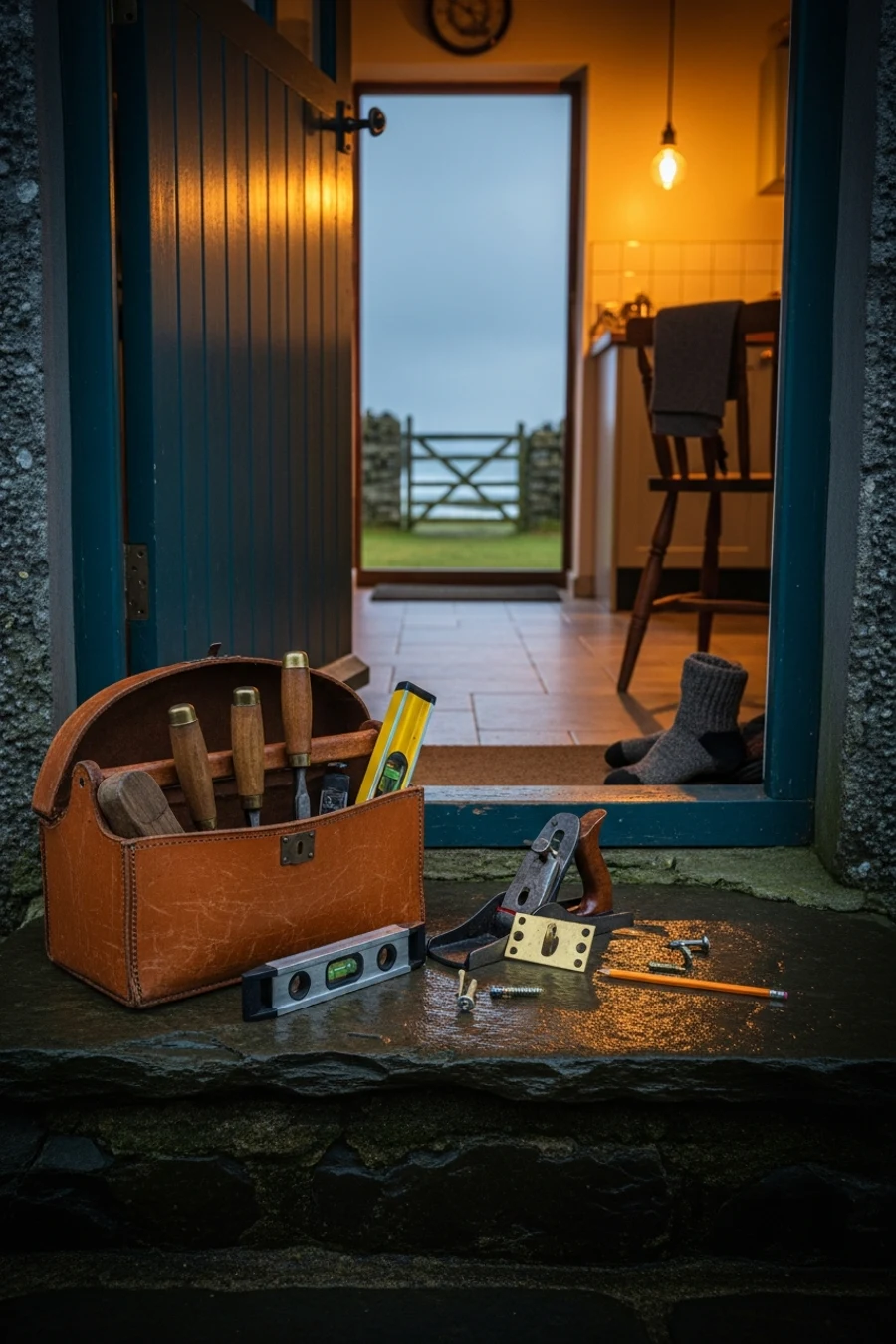
Chapter 1: Tuesday
I hear the van before I see it.
It comes up the single-track road at twenty past two and the engine is the engine of an early-2000s Hilux that has had its timing chain done twice and is on the third clutch, and the wing mirror on the passenger side has been rattling at about seventy hertz since the Tuesday before last when it caught a fence post in a side-wind. I can hear the rattle from inside the kitchen with the wind at the western window at a force three. That is the level of sound my ears still have. The right side of my body has gone unreliable and some of the words I used to be sure of have gone but the ear is the ear.
He pulls up beside the kitchen wall. He cuts the engine. The wing mirror gives one last rattle on the down-stroke. He gets out. He comes round the bonnet with his cap off.
He is in his work clothes, which are a navy wool jumper over a paint-spattered cotton shirt and the kind of trousers I have never owned. His hair is grey at the temples and brown elsewhere. He has a face you would not pick out of a room but that you would notice in a kitchen.
He comes in through the back door. He has not knocked since the second week.
"Arran."
"Niall."
"What's the kettle on for."
"Tea."
He looks at the kettle. It is sitting on the cold ring with the lid not quite straight. He turns the gas on under it. He straightens the lid.
"Sit down."
I sit. There is a chair at the kitchen table with the arms low enough that I can get into and out of it without making it a project. Niall set the chair up in week two, when he had understood the geometry of my right hand. The chair did not exist in the cottage before. He brought it from his own workshop and said it was a spare. It was not a spare.
He makes the tea. He puts the tea in front of me. He puts a packet of biscuits from the Co-op in Tarbert between us.
"Calum rang me last night," he says.
"He cancelled."
"He cancelled. He said he tried you at six and didn't get through. The reception in your bedroom is rubbish."
"I know."
"His wee girl is sick. End of the month if she's better."
"All right."
He drinks his tea. I drink mine. The wind at the western window goes up a fraction; the kettle on the gas ring gives a small different ping as the pressure shifts.
"What needs doing this week."
I have a list. I have a list because I forgot a thing a fortnight ago and Niall came back the following Tuesday and asked me what needed doing and I said the wrong thing first and then forgot the right thing and the right thing was the boiler thermostat, which was reading fifteen when the room was at twelve. I have a list since.
"The thermostat is reading low again. And there is a - a -"
The word goes.
The word I want is the small metal plate you screw into the door jamb. I can see it. I know what shape it is. The word has gone. It is gone the way a track goes when the file has corrupted and the silence sits where the audio should sit.
Niall starts to say it. He gets the first sound out. Strike pl-
I lift my left hand off the table.
"Don't."
He stops mid-syllable.
"I'm sorry," he says.
"Wait."
He waits. He drinks his tea. He looks at the table.
It comes after about twenty seconds. The shape arrives first and the word arrives behind it.
"Strike plate," I say. "The strike plate on the kitchen door. It is bent. The latch does not seat."
"Right."
"And the thermostat."
"You said the thermostat."
"Yes."
"All right."
He drinks his tea. He sets the cup down. He does not look at me. He looks at the strike plate on the door six feet from him.
"Arran."
"Yes."
"I will not do that again."
"All right."
"I know it is hard to give a word back."
"It is."
"I will not."
"Thank you."
He picks up his tea. The kettle on the gas ring has gone off the boil because we did not use the water from it. The wind at the western window is steady. The Atlantic at the headland is at the back of the room, the way it is in the cottage in February, three rooms deep.
"Calum rang me about something else."
I look at him.
"A man on Skye is putting together a Gaelic radio archive. Old reels from the Western Isles Council, 1970s and 1980s. They need someone to remaster the audio. Piece work. Hamish Maclennan. He runs the project out of Portree."
"Calum said this to you."
"He did."
"Calum did not say this to me."
"I think he thought you would say no to him."
"I might say no to you."
"You might. I am telling you the man exists. The reels would come to you on a hard drive. You would not have to travel."
The wind at the western window comes up a touch. I drink my tea.
"All right."
"All right yes."
"All right I will think about it."
"Good."
He gets up. He picks up the cups. He runs the water over them and turns the tap off without washing them properly, because the washing-up is one of the things my right hand can manage and he has learned to leave me the things I can manage. He picks up his cap from the dresser.
"I moved your wood last Tuesday. To the lee side. You won't have to fight the wind to get to it."
"I had not noticed."
"You will when you go to it next."
"All right."
"I'll do the strike plate now."
"All right."
He goes out the back door. I hear his boots on the slate at the step. I hear him at the boot of the Hilux. He has his toolbox open by the sound of the lid - the catch on it is a soft single click. He brings the toolbox round to the kitchen door from outside. He starts on the strike plate. He hums.
The tune is something I have been trying to place since the third week. It is not Gaelic. It is not from the radio. It is older. I have decided I will not ask him what it is until I have placed it.
He finishes the strike plate in seven minutes. He comes back in. He puts the toolbox on the table.
"Two new screws."
"Thank you."
"Friday."
"All right."
He goes. The Hilux turns at the gate. The engine note shifts as it pulls onto the camber of the road and the wing mirror rattles once on the cambered side. The van goes down the single-track road and the third bend takes it out of sound before it takes it out of sight.
I sit at the kitchen table.
I get up at three. I get up using the chair arms. I cross to the dresser. I take the small notebook I have been keeping since week one. I open it. I write, in my left hand:
Hamish Maclennan. Portree. Gaelic radio archive. Hard drive comes to me.
I do not put the notebook back. I leave it on the kitchen table.
I put more peat on the fire. I sit in the chair by the front window. The light is going off the headland the way it goes in February at quarter past four, in one long slow band of pewter, and the sea behind it is the colour of cold metal.
I think about what Niall said about the wood.
I had not noticed the wood. I will notice it the next time I go for it, which is tomorrow. He has been moving things on the lee side of the house for me for three months. I had not put a word to what he had been doing. The word is there now.
The wind at the western window holds at force three. The kettle on the cold ring gives the small ticking sound of cooling metal.
Chapter 2: The Wind
The storm comes through on the Saturday. Force eight in the gusts at the headland. I have been here long enough to read the warning when the small yellow flag goes up at Scarista Bay in the morning and the gulls go off the cliff face below the village. I bring the washing in on the Friday afternoon. I fold it on the dining-room table with my left hand and with the heel of my right palm pressing the fold flat. I put it in the airing cupboard. I am proud of this because three months ago I could not have done it. Niall set up the cupboard so the rail is at my chest, not at my head.
I forget one shirt.
The shirt is the long-sleeved cotton I do not wear at the moment because the right cuff catches on my right thumb and the left hand cannot do the right cuff. I have not worn it since November when Calum did the buttons for me one morning and I made a small decision in the bathroom afterwards that I would not ask him to do the buttons again.
It is on the inside line of the front porch where I cannot see it from the kitchen. I do not go into the front porch on the Friday afternoon because I am at the kitchen table thinking about Hamish Maclennan.
The wind comes up at half past nine on the Saturday morning. By eleven the western window is loud. By twelve the wind has caught the porch door, which I have not latched properly because the bolt does not work with my right hand and I had not thought to ask Niall to do the bolt. The door swings inward. The wind comes through. The shirt comes off the line. It catches on the wire fence at the third post down from the gate.
I see it from the kitchen.
The wind goes up. By three it is rolling along the western window at a frequency you can feel in the chest. By four it is making the casement give a regular tonk against the frame at every gust. The shirt twists against the wire at the third post. The cotton sleeves crack like small flags.
The Hilux comes up at six. No headlights. I do not hear the engine because the engine note is in the wind. I hear him at the gate. I hear his boots on the gravel. I hear him stop. I hear him at the fence at the third post.
It takes him about thirty seconds at the wire because Niall has the kind of hands that untangle wet cotton without forcing it. He comes round to the back door with the shirt folded over his forearm. He is wet through. His hair is flat against his head. His boots are full of water.
"Niall."
"Arran."
"I forgot the shirt."
"I saw."
"I forgot the porch bolt."
"I saw that as well."
He stands in the back door. The shirt is dripping onto the slate. The wind at the western window is loud and the eastern window is at the lee side and is quiet. Behind him the road is a white-grey blur of wind and rain.
"I'm going to put the kettle on."
"You should go home first."
"It's six miles."
"I know."
"It's six miles and the road is going to be down at the cut by Northton in an hour."
"You came up in this."
"I came up because Calum rang me at five. He had been trying you at the cottage and the reception was rubbish. He wanted to know whether the strike plate had held. I told him I would come up and look."
"You did not come up to look at the strike plate."
"I came up to look at the strike plate."
"Niall."
"Yes."
"You came up to look at the strike plate."
"Yes."
"All right."
He puts the shirt in the sink. He takes his coat off. He takes the wool jumper off because it is sodden through and stands in his cotton shirt, which is also wet but less. He stands at the sink with his back to me. He puts his hands under the cold tap. He waits for the kettle.
"You are going to need to stay tonight," he says, with his back to me.
"Yes."
"The road is going to be down at Northton by seven."
"Yes."
"I have a spare set of clothes in the van. I keep them for jobs that go wet."
"All right."
"I am telling you because I do not want to walk through your kitchen in my underclothes without telling you first."
"All right."
He turns. He looks at me. His eyes are tired. His face is wet. The wool jumper is in the sink.
"Arran."
"Yes."
"I came round the back way. The lee side of the road. The single track was funnelling the wind from the headland and the wing mirror was already loose."
"All right."
"That is why I am dry from the waist down and wet from the waist up. I had to do the last half mile on foot."
"You walked half a mile in this."
"I did."
"All right."
He goes to the bathroom with his bag. He shuts the door. I hear the water. I hear him change. He comes out in dark green corduroy trousers and a heavy grey cotton shirt with the sleeves rolled up. He hangs the wet things over the bath rail. He comes back into the kitchen.
I have made the tea with my left hand. He sits at the table.
"There is soup. The lentil one. Calum's wife froze it in November. It is enough for two."
"That would be very good."
I heat the soup on the wood-burner because the gas is funny in a storm. He sits at the table and watches the western window. We eat the soup slowly because we are warm and because neither of us has anywhere else to be.
He eats hungrily. He has not eaten today. He gets through the first bowl in about three minutes and pulls the bread to him with one hand. He stops himself halfway through tearing it. He looks at me.
"Sorry. Long morning."
"Have the bread."
"Thanks."
"Calum told me about your stroke at three weeks in," he says, halfway through the second bowl. "I had not known until then. He told me because I had asked him about whether I should keep coming up. I had thought maybe you wanted me to stop. He said no, please keep coming, and he told me about the stroke and about Margaret leaving."
"He should not have told you about Margaret."
"He did. If you want me to forget the telling I will. I will not lie about it."
"All right."
He has the second bowl. The casement is at the wrong pitch in the wind - a small constant pressure that you can hear, just below speech. I had not had a name for the sound before tonight. The bedding strip is gone. It is a thing I would have noticed before the stroke. It is a thing I notice now.
"Arran."
"Yes."
"There is a thing I would say if you wanted me to say it."
"Say it."
He puts his spoon down. He thinks for a moment. He looks at his bowl, then at me.
"I have liked coming up here on Tuesdays and Fridays."
"Yes."
"I do not stay for the tea because of the tea."
"I know."
"All right."
I look at him.
"Niall."
"Yes."
"I have not been touched by anyone except a doctor in fifteen months."
He looks at me.
"All right," he says, very quietly.
"I am not asking you to do anything. I am telling you because I have not said it out loud."
"All right."
He puts both his hands flat on the table. He thinks for a long minute. The wind at the western window is at force seven.
"I am not going anywhere. I am going to be in your spare room tonight. I am going to be back Tuesday whether the road is up or whether I have to come round through Stornoway. You can decide between now and then whether you want me to come up Tuesday and ask you something or whether you want me to come up Tuesday and just fix the casement."
"All right."
"Either is a real answer."
He eats. The wind goes up.
We sit at the table for a long time after the soup is finished. The wood-burner does its work. He has not moved his hands.
At ten he stands. He clears the bowls. He runs water on them and leaves them in the sink because he understands by now what I will do and what I will not.
"Bed."
"Bed."
He goes to the spare room. I hear him at the airing cupboard. I hear the bed.
I go to mine. I lie on top of the duvet, in my clothes, because if I get into the bed properly I will not get back out in the night and I might need to.
The casement is at its wrong pitch. The wind is at force seven. Niall is in the next room.
I do not sleep until two. When I sleep I sleep without dreams. The wind drops at five.
I wake at seven. The wood-burner is still going because Niall got up in the night and put more peat on. He does not know that I know he did it.
I get up at eight. I cross to the kitchen. Niall is at the kettle in his wet clothes from yesterday.
"The road is down at Northton."
"All right."
"It will be up by Tuesday."
"All right."
"Arran."
"Yes."
He turns. He looks at me. He has not slept much either.
"Good morning."
"Good morning."
He puts the tea in front of me. He sits opposite.
"Tuesday."
"Yes."
"I want you to come up Tuesday and ask me the thing."
He looks at me. He nods, once.
"All right."
He drinks his tea. The wind has gone completely. The cottage is still. The Atlantic at the headland is loud but the wind at the western window is gone.
"I am going to make breakfast. Then I am going to walk to the road at Northton to see how down it is."
"All right."
"I will not ask you the thing this morning."
"I know."
"I am telling you because you have made me want to."
I look at him.
"All right."
He stands. He turns to the cooker.
He makes the breakfast.
Chapter 3: Margaret
The letter comes on the Friday.
The post comes up the single-track road at half past eleven, when there is post. There is post on Tuesdays and Fridays, which is the same as Niall, and which is one of the small coincidences I have stopped trying to read meaning into.
The letter is from Margaret. The handwriting is hers and I would know it anywhere. The envelope is the cream one from the stationer's on Byres Road in Glasgow that we used to walk past on the way to the café on the corner. She has my name in her own hand: Arran Greer, Tigh Tarwine, Scarista Bay, Isle of Harris, HS3 4QS.
The postcode is right.
Margaret writing the right postcode is the first odd thing about the letter. She is the kind of person who writes a postcode the way she writes a sentence in her own essay, which is to say carefully, with each character considered. She has my address right because she has it. But she has written the postcode and not got it wrong, which means she had checked it, which means she had not trusted her own memory of it, which means she had thought about getting it wrong, which means she had thought about getting it right.
I take the letter into the kitchen.
I do not open it for an hour.
I open it. The letter is two pages, handwritten, in the way Margaret writes letters, which is the same way she wrote me letters when we were twenty-six and she was on her Erasmus in Lyon. She writes the way she has always written.
The letter says, in the order she says it:
That she has been meaning to write since November.
That she is sorry it has taken her until February.
That she has met someone. That his name is Tom. That he is a lecturer at the school of art.
That she does not know how to write what comes next and so will write it plainly: she does not know how to set the dates of the thing in her own head. She thinks she met Tom in October. She thinks the first conversation was in October. She knows there had been conversations before October at openings. She does not know how to put one date on it. She is writing this because she does not want me to find out from someone else and she does not want to lie about the part she is not sure of.
That she is sorry for the part she is not sure of.
That she wants to ask me about the Hyndland flat. The flat is in my name. The mortgage is paid down. She has not been in it since March. She is asking whether I want to sell it or whether I want to take it back over. She does not have a preference. She would like to know by July if I can decide by July.
That she has been seeing a grief counsellor since the summer. That the counsellor is a woman called Anwen at a practice in the West End. That Anwen has been very good. That she is writing to tell me not as a recommendation but as a fact about her year. That she does not know if I would want to know. That she is telling me anyway.
That she signs off:
I had loved you. I had loved you for a long time. I do not know how to use a different tense in this paragraph. I do not know what I would call what I have now. I do not want to say the wrong word so I will not say a word at all.
Take your time about the flat.
Margaret.
She signs it Margaret and not Maggie, which is what I had called her and what I have not called her since the morning she left. She has written Cal in the third paragraph. Calum is Cal to nobody now except, in his childhood, our mother, who is dead. Margaret has not called him Cal before in the eleven years I had been married to her. She must have heard our mother say it once, in a recording or a story, and filed it as the family name for him.
That is the third odd thing about the letter.
I sit at the kitchen table.
I do not move for a long time.
The light at the western window is the wet steel of a still February day with low cloud.
I had wanted, for fourteen months, for the letter to come and to settle the question I had been carrying, which was the question of whether the new thing had started before she left. The letter has come. It does not settle the question. It tells me she does not know herself. It tells me she has been honest about not knowing. The honesty is the thing I cannot fault and the thing that hurts the most. If she had been certain in either direction I could have done something with the certainty. The not-knowing is the thing I am going to have to hold.
I read the letter again.
I think about I had loved you.
It is the past perfect. It is the tense of a thing that ended before another thing began. The grammar makes a claim that the prose around it explicitly denies. She has set the grammar down in one paragraph and then in the next paragraph said I do not know how to put one date on it. The two sentences are mutually undermining. She has put them in the letter knowing this. The not-knowing is in the past perfect too.
I do not weep.
I think about Anwen at the practice in the West End. I think about Margaret going to see her in the summer. I think about Margaret deciding in the summer that she would write to me in November and then deciding in November that she would write to me in February. I do not know what moved the date. I am not going to know.
I think about Cal.
I fold the letter. I put it in the drawer of the kitchen dresser, the one with the napkins I do not use.
Niall will be here in twenty minutes.
I make the tea. I make it with my left hand. I put two cups on the table.
The Hilux comes up the road at twenty to four. I hear the wing mirror rattle on the camber at the gate.
He comes round the back of the cottage. He takes his cap off. He comes in.
"Arran."
"Niall."
"Tea's on."
"Tea's on."
He sits opposite. He sees my hands on the table. He does not say anything. He picks up his tea.
We drink. He waits.
"Niall."
"Yes."
"Margaret wrote me a letter today."
"Right."
"She has met someone."
He puts the tea down. He looks at his hands. Then at me.
"How are you."
"I do not know."
"All right."
"I had been holding a question for fourteen months. The question was whether the new thing had started before she left. The letter says she does not know herself. The letter is honest. I had not been expecting honesty."
"All right."
He thinks. He drinks his tea.
"You can ring me about it on Sunday if you need to," he says.
"All right."
"I am going to look at the casement first."
"It is at the wrong pitch."
"I know. I have heard it for a fortnight."
He gets up. He goes to the kitchen window. He looks at the casement. He runs his thumb down the inside of the frame. He turns back to the table.
"The bedding strip is gone. I will bed it on Sunday with the kit I have at home. I will need it dry for that and it will not be dry tomorrow."
"All right."
He sits back down.
"Niall."
"Yes."
"I am going to ask you the thing now."
He looks at me.
"All right."
"I am asking now and not later because I do not want to ask it after the letter and not because of the letter. I want to ask it because I had decided on Sunday morning. I am not changing my mind because of the letter. I would have asked you tonight even without it."
"All right."
"I want you to stay tonight."
"In the spare room or not in the spare room."
"Not in the spare room."
"All right."
"I am not asking for anything in particular tonight. I am asking you to stay."
"All right."
"I have not done this in eight years."
"All right."
"I am telling you that because I do not want it to come up later."
"All right. Thank you for telling me."
"Niall."
"Yes."
He puts his hand across the table. Palm up. He does not move it closer. He waits.
I put my left hand in his.
He closes his fingers slowly. His hand is warm and the calluses are where you would expect on the hand of a man who does what he does, and the skin at the side of his thumb is rough from the wire on Saturday.
I do not weep.
I do, for about thirty seconds. He does not move. He does not let go. He sits with his hand round my hand and lets me do the thing.
I stop. I take my hand back. I wipe my face with the back of my left wrist. I drink the rest of my tea.
He drinks the rest of his.
"Stay for dinner."
"Yes."
"There is the lamb shoulder Calum's wife sent up last month. I have not done it. It takes three hours in the oven. We will not eat until eight."
"That is all right."
I get up using the chair arms. He is at the table and I have decided I do not need to look away while I do it. I cross to the larder. I get the lamb. I get the potatoes. I get the rosemary from the windowsill.
He sits. He does not get up to help. He has been here long enough to know which jobs are mine.
I do the lamb. He watches the kitchen window. The light goes off the western water. The headland goes to silhouette. The wood-burner hums.
I put the lamb in the oven at one hundred and fifty. I sit opposite him.
I put my left hand on the table.
He puts his on top of it.
We do not say anything for a long time. The oven hums. The casement is at the wrong pitch. The Atlantic at the headland is loud and the kitchen is quiet.
I do not move my hand. He does not move his.
Chapter 4: Dinner
The lamb comes out at eight. I do it the way Calum's wife showed me before everything, which is with the potatoes underneath catching the fat, the rosemary roughly torn, one onion quartered through the root. It comes out brown on the outside and pulling apart on the inside.
I bring it to the table on the board. Niall has set the board under the table for me without my asking because the board is heavy and the right hand will not carry it. I do the lifting from the oven, which I can do, and the slicing, which I can do because the board is at the lowered counter and I have a knife with a tall handle that Niall brought in week two without commenting on it.
We eat at the table by the front window. The light is gone off the headland. Niall has put a candle on the table that he brought from his van. The candle is in a small brass holder he also brought. He keeps candles in his van in winter for the same reason a sensible man on Harris keeps a wool blanket in his van in winter.
We eat the lamb slowly. We drink a bottle of the red I had brought with me from Glasgow and had been keeping for a thing I did not know I was keeping it for.
"David," I say, halfway through the first glass.
"Yes."
"You told me his name on Saturday and I did not ask you."
"You were not in a place to."
"I am now."
"All right."
He takes his time. He picks up his glass. He drinks. He sets it down. He puts both hands round the bowl.
"David was a year older than me. He was from Stornoway. He came to Tarbert to teach at the secondary school. He taught geography and ran the football team. He was the kind of teacher the boys in his class remember when they are forty. He drank his tea too strong. He had been quietly out since he was twenty-four. He and I lived in his flat above the chemist because we could not afford anything else and because it was warm. He died at thirty-five. Pancreatic. It was eleven months from the first scan to the funeral. I have been alone since the funeral, which was eight years ago in March."
I look at him.
"You did not date again."
"I did not."
"Was that a decision."
"It was at first. Then it became the shape of my life. I did not think about it after the third year. I made the workshop. I made things. I went to my sister's at Christmas. I went to my mother's at Easter. I did not think there would be anyone else."
"And now you think there might be someone else."
"Yes."
"All right."
He drinks. I drink. The candle does its work.
"Niall."
"Yes."
"I was bisexual before."
"All right."
"I had relationships with men in my twenties. There was one in particular in Edinburgh, when I was doing my MA. His name was Greig. We were together for a year and a half. I was twenty-five when it ended. I have not been with a man since. I was not closeted in the marriage. Margaret knew. Calum knows. My mother is dead and I do not know if she knew, but she might have. I am not someone who is coming out tonight. I am someone who has not been with a man in eight years and has not been with anyone in fifteen months and who had decided he would not be again."
"That is a lot of decisions."
"Yes."
"You can change a decision."
"I am."
He looks at me.
"All right."
We drink. The candle is at its second inch. Niall has had two helpings of the potatoes and is making a show of not having a third.
"Have the third."
"Are you sure."
"They will not keep."
"Then I will have the third."
He eats slowly. He eats the way he does everything, which is with both hands close to the plate and the focus of a man who has eaten a lot of meals alone and has learned to make them last.
I watch him eat.
I have not watched a man eat a meal in eight years. I had forgotten that I liked watching a man eat a meal.
He looks up. He sees me watching. He does not look away.
"Arran."
"Yes."
"I am going to put my hand on the side of your face in a moment. I am telling you because I want you to be able to say no without having to do it from inside it."
"All right."
He puts his hand on the side of my face.
He puts the right hand on the right side, which is the side where the right corner of my mouth does not always go up when the left does. He has chosen the side on purpose. He keeps it there. His thumb is at the corner of my jaw. His fingers are at my temple, near the small silver scar of the endarterectomy. He has chosen that hand. He does not say anything.
I close my eyes for a second. I open them.
"Niall."
"Yes."
"I am going to do the dishes after dinner. Then we are going to bed. I am asking you to come to bed with me. It is not the spare room."
"All right."
We finish the lamb. He washes up. I dry. The candle is at its third inch. The wood-burner is at its slow place.
We go up.
Chapter 5: The Bed
The bedroom is at the back of the cottage. It has a small Velux above the bed and a long low window facing east, which looks out onto the slope of grass that goes down to the dry-stone wall and the road. The bed is the bed I have been sleeping in for three months. It is bigger than a London bed because Calum's father-in-law was a tall man and bought a tall bed.
I take Niall's hand on the stairs. I take it because I want to take it, and because my right hand needs the banister and my left hand wants to be his. We go up slowly.
At the door I stop.
"Niall."
"Yes."
"I am going to take my own shirt off."
"All right."
"It is going to take me a while because of the buttons and the right hand."
"All right."
"I am telling you because I do not want you to think you are meant to help me."
"I will not help unless you ask."
"All right."
"Arran."
"Yes."
"You can also ask."
"I know."
We go in. I put the small lamp on the dresser on. He puts his cap on the dresser. He takes his boots off at the threshold.
I sit on the bed. I take my socks off. I take my trousers off. I am in my shirt and my underclothes. The shirt is the long-sleeved cotton I forgot in the wind on Saturday, the one Niall took off the wire.
He sits on the chair across the room. He does not move closer. He watches.
I take the shirt off slowly. I do the buttons from the top down. The buttons are small and the right hand does not grip them properly, so I do them with the left while the right holds the cloth flat. One at a time. It takes about four minutes.
He does not move. He does not look away.
I get the last button. I do the cuff button on the left, which I can do. The cuff button on the right is impossible with the left hand alone. I slip the shirt off the right shoulder first, easing the cuff over the thumb. Then the left.
I take the undershirt off with the left hand. I draw it up and over my head and off the right shoulder.
I am bare from the waist up.
The right pectoral is a fraction smaller than the left because the muscle has wasted in the time I have not used it. The right shoulder sits about a half inch lower. The right deltoid is slim where the left is not. The small scar from the endarterectomy runs from behind my ear down into the side of my neck about two inches, and is silver now, eighteen months on.
I am terrified of this.
I have not let anyone see this except a doctor.
Niall stands. He crosses the room. He sits down beside me on the bed, leaving the width of his hand between us.
He looks. He looks at the right shoulder. He looks at the pectoral. He looks at the scar. He looks at the place where the right hand sits in my lap at a fraction of an angle the left does not. He takes his time.
"All right."
He bends. He kisses the side of my mouth that I cannot always control.
That is the only kiss. He sits back.
"Arran."
"Yes."
"I am going to take my own shirt off now."
"All right."
He takes it off, not slowly, not fast. He has the body of a man who has worked with his hands for thirty years and spent the last eight on Harris. He is not gym-built. He is functional. A faint dark coil of hair on his chest. The muscle of his forearms is the muscle of a craftsman. A small scar on his left side below the rib that I will ask about another time. Forty-seven. He looks it. I like that he looks it.
He sits beside me.
I put my left hand on his chest. He puts his over mine.
"Niall."
"Yes."
"I want to lie down with you."
"All right."
"I am going to need the left side. I cannot hold weight on the right yet."
"All right. I'll take the right."
"You will take the lee side."
He looks at me.
"All right," he says.
We lie down. He takes the right side. He puts his arm under my pillow. His other hand is on my stomach, flat.
He kisses me. He is patient. His mouth is warm and unhurried.
He kisses my neck. He kisses my chest. He kisses the inside of my left wrist where the artery sits close to the skin.
He stops. He sits up on his elbow.
"Arran."
"Yes."
"Tell me if there are things you do not want. Tell me about your body the way you would tell me about the strike plate. I do not want to guess and I do not want to assume."
I think.
"I can be hard. The stroke did not affect it. I have not been hard with another person in fifteen months. I do not know what will happen. I want to be touched."
"All right."
"I want you to use your mouth on me."
"All right."
"I do not know about anything else tonight."
"That is all right. We do not have to know about anything else tonight."
He puts his hand between my legs, on top of my underclothes. He pulls the cloth down slowly. He pulls it off. He folds it on the floor.
He bends his head.
His mouth is patient. He is paying attention to me and not to himself.
I close my eyes.
I keep them closed because the heat is too much and the looking is too much. My left hand goes into his hair. His hair is short at the back and slightly thicker at the crown and my fingers go through it.
He pauses every minute or so and looks up at me to see what my face is doing. He does it the way you steady a piece of work to see if the glue has set.
I come quietly. It is not the way it used to be. It is the body of a man who has had a stroke and who has not been touched in a long time and who is overwhelmed and who is forty pounds lighter than he was. He stays with me. He puts the side of his face on my stomach.
I open my eyes.
I cannot speak for a minute. I put my left hand in his hair.
"Come up here."
He comes up. He lies beside me. He pulls the duvet up. He kisses the side of my mouth.
"Niall."
"Yes."
He puts his head against mine.
I weep for a long minute. Quietly, the way you weep when you have been holding a thing and finally put it down. He puts his hand on my back, between the shoulder blades.
I stop.
"You have not - you did not come."
"I am all right."
"You did not."
"I will. Not tonight."
"I want -"
"I know. Tomorrow. We will be here tomorrow."
"All right."
"Sleep."
"You will stay."
"I will."
He puts the lamp out. The room goes dark. The Velux has a square of cloud-grey sky in it. He puts his arm across me and his hand on my hip and he does not move it.
I sleep almost at once. I sleep through to seven. I have not slept like that in eighteen months.
The rest of the story
Finish Lee.
Sign up free, then $2.99 opens the closing chapters.
No payment to start.
Private and discreet.