BF Original
Late Harvest
You came to a small island in the off-season to be no one for a month - a woman of forty-five who decided, across a long marriage that wore through, that the part of her life where she was looked at was over. He came with the rented house: Theo, the caretaker, late twenties, rooted, certain, who looked at you the way no one has in years and would not be talked out of it. The late figs are the sweet ones. The only foolish thing is believing it is too late.
Chapter 1: To Be No One
The marriage ended the way a long thing wears through rather than breaks, quietly, over years, until one day you looked up and there was simply nothing left where the marriage had been, and somewhere in the long erosion of it you had agreed, without ever once saying so out loud, that the part of your life in which you were looked at was finished. You are forty-five. You have decided you are at peace with this. You have been at peace with a great many things lately, which is its own kind of warning sign, if you are honest, which you are working on being.
You came to the island to be no one for a month. That is the whole of the plan. You rented an old stone house with a blue door on a small island in a southern sea, in the off-season, after the tourists have gone and the place is given back to the few hundred people who actually live on it, and you intend to spend a month finding out what is left of you when no one is watching. The light here goes long and gold in the late afternoons. The figs are ripening on the trees above the road, latest and sweetest, and the warm spell is holding past when it should, an island summer that does not yet know it is over.
What you did not plan for is Theo.
He comes with the house. This is explained to you on the first afternoon, in careful English, by the woman who hands you the key: that the caretaker tends the olive terraces and brings the fish up from the harbour and fixes whatever the old stone breaks, and that his name is Theo, and that he is around. He is around. You meet him that first evening as the gold light is going, a man in his late twenties, brown from the terraces, work-strong, salt in his hair, and he is unhurried in the particular way of someone who has never once in his life been told to be somewhere else.
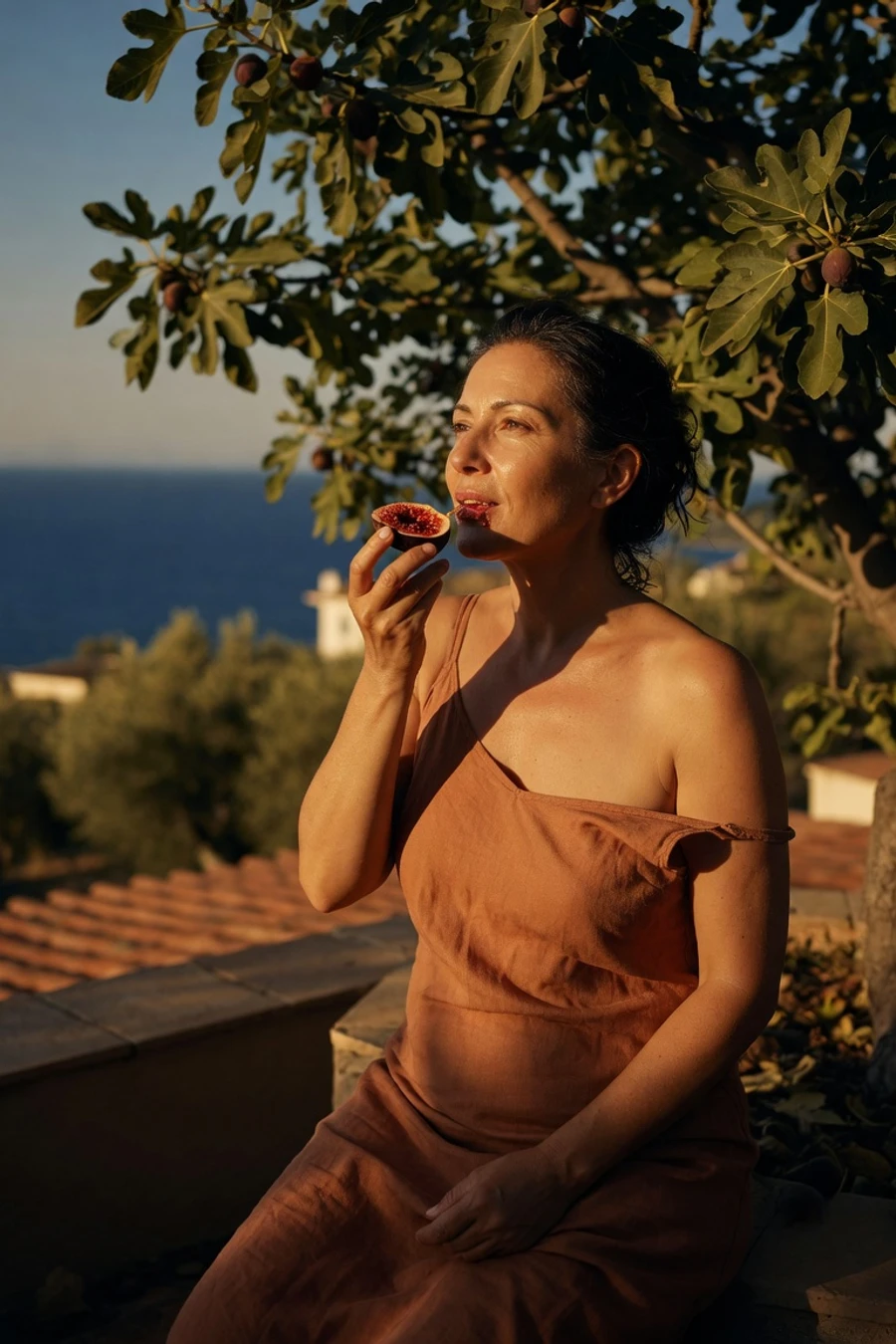
He brings you a fig.
He splits it with his thumb and holds it out, warm from the tree, and he watches you eat it, and it is the first thing you have tasted in longer than you can remember as if it were actually for you, the sweetness of it almost obscene, and you are so startled by your own pleasure in it that you say something clever and small and dismissive, some little joke about the kind young man being kind to the tourist, the reflex of a woman who gets to the self-deprecation before anyone else can.
He does not laugh with you. He looks at you, directly, the way a man looks at a woman he has already decided he wants, with no hurry in it and no apology for it either, and he does not take the joke, and he does not look away when you catch him. You finish the fig with your face going warm. You tell yourself you imagined the way he looked at you. You lie awake in the stone house that night telling yourself that, and you do not believe it, and you hate that you do not believe it, because believing it would mean you are exactly the kind of fool you came here to stop being.
Chapter 2: He Will Not Take It Back
The thing about Theo, you discover over the first days of your month, is that he will not be talked out of it.
You are very good at being talked out of. You have spent twenty years becoming the kind of woman who makes herself small and calls it grace, who gets the disclaimer in first, who waves her own desirability away before anyone has the chance to confirm or deny it. It is a reflex now, a thing your own hand does, a little gesture that brushes the compliment aside. And Theo simply will not let it land. He keeps seeing you, all through the long gold days, undeflected by every clever thing you say to make yourself less.
You hand him the easy out, once, because you cannot help it. He has been fixing the shutter that the wind took and you bring him water and you say something light about how he does not have to be kind to the tourist, and he sets the shutter down and looks at you and says, plainly, "You keep saying that like it is true." And that is all. He goes back to the shutter. And you stand there in the gold light with your heart doing something it has not done in years.
You take the one good linen dress out of your bag that evening, the one you almost did not pack, packed for a version of yourself you had stopped being, and you hold it up, and you put it back. And then you take it out again. And you put it back again, and you hate that you care, you hate that there is a part of you, a part you thought you had buried decently years ago, that wants to be looked at and is sitting up now, blinking, hungry.
It is the old woman who says the thing that breaks it open. She keeps the church candles and a sharp eye and misses nothing on the road below her terrace, and she sees you and Theo on the road one afternoon, and instead of the judgment you brace for, the disapproval of a young man and an old fool, she says, in her dry blunt way, that she buried a husband decades ago and not the wanting along with him, and that the late figs are the sweet ones, and that the only foolish thing in the whole arrangement is your believing it is too late. And she goes back up her terrace, and leaves you standing on the road, and after that you cannot pretend anymore. Not that he means it. Not that you do.
Chapter 3: The Warm Spell
The warm spell holds past when it has any right to, the last heat of the year refusing to know it is over, and the night it finally breaks open between you is the night you wear the good linen dress.
You wear it for yourself first. That is the thing you make yourself understand as you put it on in the gold evening light, that you are not putting it on for Theo, you are putting it on for the woman in the mirror who you have not looked at properly in years, and then you walk out into the warm dark and Theo sees you in it and the way he looks at you nearly puts you on the ground, because it is not careful and it is not kind, it is hunger, plain and unhurried and absolutely certain, the look of a man who has decided and is only waiting for you to catch up.
And your appetite comes back all at once. That is the only way you can describe it, later, to yourself: that years of calling its absence contentment end in a single evening, that the whole starved buried wanting of you stands up at once and you are dizzy with it, a forty-five-year-old woman shaking with want in a borrowed dress on a borrowed island, terrified, because wanting is the door back to being a fool, and you have spent so long being careful.
The boat home is already drawn on the calendar in your kitchen. You are aware of it the whole time, the date, the way the month is finite, the way this is finite, and the awareness makes it worse and makes it better, the want sharpened on the ending built into it. Theo does not hurry you. He stands close in the warm dark with the harvest supper finished and the sea going dark below, and he says the plain true thing - that he has wanted you since the first fig, that he is not a boy and this is not a phase, that he will not pretend he wants less than he wants - and he holds your eye while he says it, and the want crests in you so high you cannot breathe through it.
You are at the very edge of it. At the edge of letting yourself be a woman who is wanted, of reaching back, of taking the thing the careful version of you has refused for twenty years. His hand is warm at the side of your face. The warm spell holds one more night. And you stand there on the brink of your own reawakened appetite, terrified and starving and alive, the boat date burning on the calendar and the want total and the whole question of whether you are allowed this hanging in the warm dark between you.
The rest of the story
Finish Late Harvest.
Sign up free, then $2.99 opens the closing chapters.
No payment to start.
Private and discreet.