BF Original
Keycard
The building has forty-one floors and your matte black card lights only three of them. The man it is named for owns the floors you cannot reach. Damien Voss says perhaps forty words across a whole day and watches the lobby empty like it is the most awake thing in the room. He fixes the stairwell light on your floor and will not admit it. He tells you not to take the stairs because the card reader reports to him, and lets you hear, underneath it, the thing he will not say. Then, on an ordinary Tuesday, he hands you a card heavier than a card should be - one floor above the ones you can reach, his, the door with no number. A dark, controlled, intense slow-burn about a man who guards every door in your life and will not walk through the one he wants uninvited.
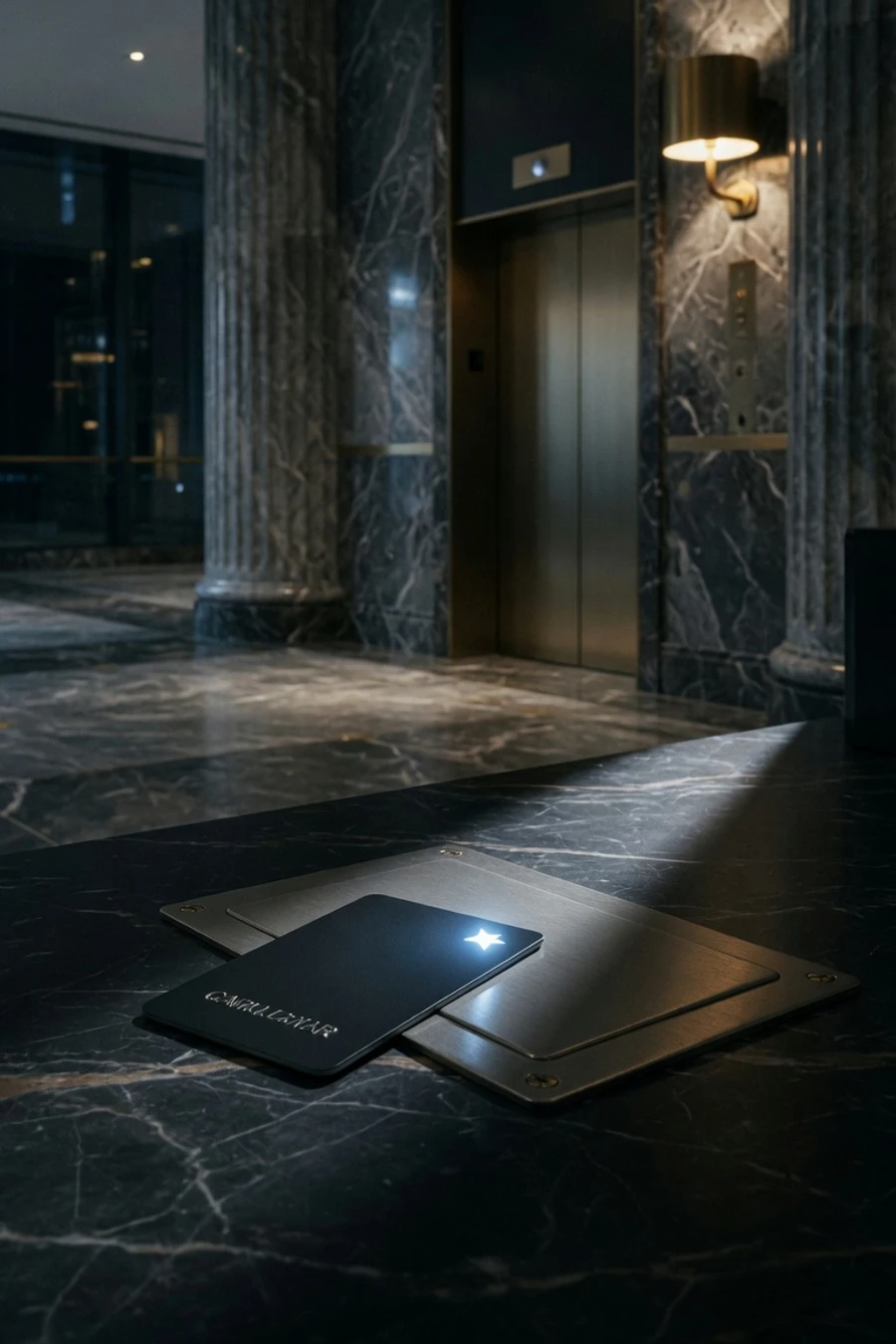
Chapter 1: The Lobby
The building has forty-one floors and you are allowed onto three of them.
You learned this your first week, the way you learn the rules of any new place - by walking into them. Your keycard, the matte black one they hand you with your photograph already on it, lights the turnstile green for the lobby, the fourth floor where you work, and the parking level. Press it anywhere else and a small red light tells you, without unkindness, that you do not belong there. The building is owned by Voss Holdings. The man it is named for owns the floors you cannot reach.
You see him for the first time in the lobby, which is the one room in the building everyone is allowed into and therefore the one room that tells you nothing. It is six in the evening and the day shift is draining out through the turnstiles, and he is standing near the private elevator at the back, the one with no call button, the one that has its own card reader and its own quiet, and he is not waiting for it. He is watching the lobby empty. A dark suit cut close enough that you can see he was built before he was dressed. Knuckles you would not want to be on the wrong end of. He is doing nothing at all and he is the most awake thing in the room.
His eyes move across the lobby the way a hand moves across a page in the dark, reading it, and they pass over you and do not stop and then - a half-second later, a beat too late to be nothing - they come back. He looks at you for exactly as long as it takes to decide you are not a threat, which is a way of being looked at that you have never experienced and that goes straight through the front of you to somewhere behind your sternum. Then he releases you. He turns. He presses his own card to the reader on the private elevator and the doors open for him the way they will never open for you, and he steps in, and as the doors close he is still facing out, still watching the room, and his eyes find you one more time across the closing gap.
The doors meet. The little light goes from green to nothing. You stand in the lobby that is open to everyone, holding the card that opens almost nothing, and you understand that you have just watched a door close that you are going to spend a long time thinking about.
Chapter 2: The Fourth Floor
You find out who he is the way you find out everything in a building like this, which is sideways, from someone who tells you not to ask.
His name is Damien. He is not security the way the men at the desk are security; he is the reason there are men at the desk. Voss Holdings had a credible threat last winter - a deal that went wrong in a country with looser rules about how a deal goes wrong - and Damien is what they brought in after, the wall they built around the thing worth protecting. He decides who gets a card and what color it is. He decides which floors a card wakes up. Somewhere in a room you will never see, there is a list with your name on it and a short row of permissions, and he is the one who wrote the row.
You start noticing him the way you notice weather. He is in the lobby at the start of your day and the end of it, not always, but more than chance would explain. He does not speak to you. He speaks to almost no one; you gather he says perhaps forty words across a whole day, and spends them like a man who was raised poor in some currency you cannot name. But the fourth floor, your floor, which had a flickering light in the stairwell and a fire door that did not quite latch, has a stairwell light that works now, and a fire door that latches, and you cannot prove he did it and you know that he did it.
On a late evening - everyone gone, you alone with a deadline and the hum of the floor - the elevator opens and it is him, and he was not coming to your floor, you can tell, his card would have taken him higher; he came to your floor on purpose and is pretending he did not. He crosses to the window where you stand stretching the ache out of your neck and he stops a careful distance away, professional distance, the distance the briefing would approve of, and he looks at the dark city instead of at you.
"You stay too late," he says. Four words. The first he has ever given you.
"There's a lot to do."
"There is always a lot to do." A pause, and the pause is not empty; the pause is where the rest of the sentence lives in a man who has trained himself not to say it. "I will be in the lobby until you leave. Do not take the stairs. The card reader on the side door reports to me and it has been reporting that you take the stairs."
He does not say because I worry. He does not say because I have noticed which nights you are anxious from the way you breathe at the elevator. He says the thing about the card reader, and lets you hear, underneath it, the thing he will not say, and then he is gone back down to the lobby to stand in the open room and wait for the small electronic confirmation that you have left the building safe.
Chapter 3: The Partition
The first time you ride higher than your card allows, it is in a car, not an elevator.
There is an event - a thing the company throws, a floor of the building you have never seen lit up and opened for one night, glasses and a string quartet and the careful theater of people pretending the doors between them do not exist. You go because you were told to. You leave early because the air up there is thin with people deciding your worth in glances, and the valet has gone home, and it is raining the particular rain a city saves for nights you wore the wrong shoes.
The black car pulls up without your calling it. The window comes down an exact two inches. "Get in," Damien says, and it is not a command the way a stranger's would be a command; it is the shortest possible version of I am not going to let you stand in the rain while I decide whether it is appropriate to offer.
Inside, the car is warm and quiet and there is a partition between the front and the back, raised, so that the driver is a shape and a pair of careful eyes in a mirror and nothing you say can reach him. You have never been in a space like this - a room that moves, sealed, where for the length of a city the ordinary rules about who is allowed near whom are suspended because there are simply no other people to enforce them. He sits beside you, not across, and the discipline it costs him to keep the professional inch of space comes off him like heat off a stone.
"You were uncomfortable up there," he says. Not a question. He noticed your breathing again. He always notices your breathing.
"I don't belong on that floor."
He is quiet for a block. The rain runs sideways on the glass. "Neither do I," he says finally, which is the most personal thing he has ever handed you, and you understand it is a gift, and you understand it cost him, and you turn your head and find that he is already looking at you, that he has been looking at you, that the careful inch between you on the seat is the last rule he is still keeping and that he is keeping it with his whole considerable strength. The partition is up. The driver cannot see. There is no briefing for this. There is only the warm sealed dark and a man who has guarded every door in your life for three weeks looking at you like the only door he wants is one he will not let himself walk through uninvited.
The car stops outside your building. He does not move. "Go up," he says, low. "I will watch the card reader." And you go, on legs that do not feel like yours, and you do not sleep.
Chapter 4: The Floor Without a Number
He gives you the card himself. That is how you know what it means.
It is a Tuesday and the building is between shifts and he finds you in the lobby and he does not waste the walk over with words; he simply holds it out. It is not matte black like yours. It is a deeper thing, almost no color at all, heavy in a way a card should not be heavy. "This wakes the private elevator," he says. "And one floor above the ones you can reach. Mine." A beat. "There is no number on the door. I will be there."
You should ask why. You should ask what it means that the man who decides who is allowed where has just decided that you are allowed where he is. You do not ask, because his face, which has been a wall for three weeks, is not a wall right now; it is a man who has made a decision he is not sure he has the right to make and has made it anyway, and you do not interrogate a thing like that. You take the card. Your fingers brush his and he goes very still, the particular stillness of a man holding something at arm's length with everything he has, and he draws his hand back slowly, as though the slowness is the only governance he has left.
You go up that night. The private elevator does not hum like yours; it is silent, and silence in a building is a kind of wealth. The doors open on a floor with no number on the door, unlocked, and you push it open into low light and the city forty floors down and him, jacket off for the first time you have ever seen, tie loosened the way the briefing said no one is supposed to see it, standing in the middle of the only room in the building he does not have to guard, because there is no one in it he did not let in.
"You came," he says, and it is not relief and it is not triumph; it is something with no armor on it at all. He crosses to you. He stops the professional inch away out of three weeks of habit and you watch him notice the inch, watch him look at it like the last locked door in a building he owns. His hand comes up - the scarred knuckles, the hand that has decided who is allowed where since the day you met him - and he does not touch you yet; he holds it a breath from your jaw, asking, the way he has asked nothing else, out loud, in his whole spare vocabulary.
"Tell me to," he says, rough, almost gone. "I do not move on anyone who has not told me to. Tell me, or tell me to leave, and I will stand in the lobby for the rest of my life and never say a word about this again."
The city is far below. The door has no number. You are, for the first time, exactly where you are not supposed to be, with the one man who decided you could be, and he is waiting - disciplined, undefended, his whole life built into the holding of this single inch - for you to say the word that opens the last door.
The rest of the story
Finish Keycard.
Sign up free, then $2.99 opens the closing chapters.
No payment to start.
Private and discreet.