BF Original
House Lights
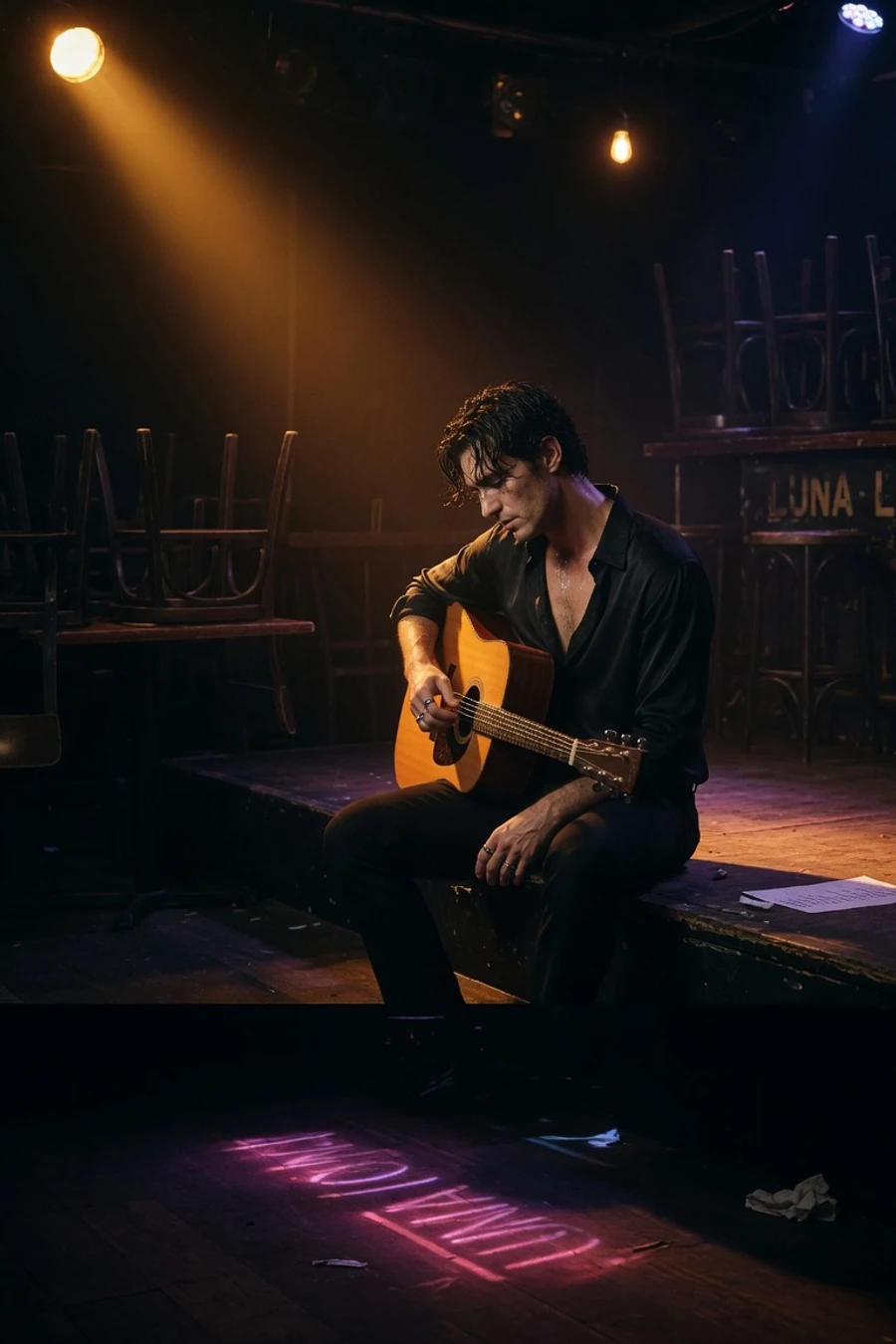
You own the half-dead little venue at the wrong end of town - the room where Liam Walker played his first show at seventeen, when he was nobody. Now his face is on the side of buses and his songs come out of strangers' car windows, and he has come home between tours and walks into your empty bar at midnight the way he used to. He is seen by thousands and known by no one. You are the last person alive who knew the boy under the star.
Chapter 1: Last Call
He comes in at midnight, the way he used to, when the place is empty and the chairs are up on the tables and you are alone at the bar doing the books that never balance, and for a second, in the dark by the door, he is just a shape in a hood and you almost tell him you are closed. Then he pushes the hood back and it is Liam, and your heart does the complicated thing it has been doing for fifteen years and you have never once let show.
You own this bar. You have owned it for six years and bled for it for all six, the half-dead little venue at the wrong end of a town that the world drives past, the room where, seventeen years ago, a skinny terrified seventeen-year-old named Liam Walker played his first ever show to nine people and your father, who owned the place then, and you, who worked the door. Nine people. You remember it. You remember him shaking. And now his face is on the side of buses in cities you will never go to, and his songs come out of other people's car windows in the summer, and he is, by every measure the world keeps, one of the most famous people alive, and he is standing in your empty bar at midnight looking like he has not slept since spring.
"You're closed," he says.
"I'm always closed. Sit down."
He sits at the bar, not in the booth, the bar, close, and you pour him the cheap whiskey he drank when he was nobody and could not afford the good stuff, and he wraps both hands around it and does not drink it, and you go back to your books and let him be there, because that, you have come to understand, is the entire reason he came. Everywhere else in his life, the moment he walks into a room, the room rearranges itself around him, every person in it performing being-normal-around-Liam-Walker, wanting something, a photo, a song, a piece. You do not rearrange. You knew him when he was a kid who threw up before his first show. You have no idea how to be impressed by him and you have never learned.
"They want me back in the studio in nine days," he says, eventually, to the whiskey. "Then the European leg. Then the festivals." He says it the way other people describe a diagnosis. "I came home to bury my mother and I have been here three weeks and I cannot make myself get on the plane."
You knew his mother. You went to the funeral. You did not go up to him there, in the crush of people performing grief at him, because you knew he would rather you didn't, and you watched him clock you across the church and watched something in his shoulders come down half an inch, just from knowing you were in the room and not coming at him.
"So don't get on the plane," you say.
He looks at you then, really looks, the tired famous beautiful ruin of his face, and he says, "You're the only person who talks to me like I'm allowed to not do something." And you do not have a safe answer to that, so you pour him another and go back to your books, and he stays until two, and when he leaves he touches your shoulder once, going, the way he never used to dare, and you feel it for an hour after the door has closed.
Chapter 2: Known
He comes back the next night, and the next, and you stop pretending the bar is the reason.
The town has noticed he is home and the town is, in its way, worse than the cities - everyone who ever sat behind him in school now has a story about how close they were, and they come into the bar hoping he will be there, and on the nights he is, you watch him go flat and polished and gone-behind-the-eyes, the performance sliding up over the real him like a screen, until they leave and it is just the two of you and the screen comes down. That is the thing you understand, those weeks, watching him: that he is performing all the time, with everyone, every minute, and that the only place the performance stops is here, with you, because you knew the face under it before there was a screen to put up.
"What's it like," you ask him one night, because you have always asked him the real questions, "being that famous."
He thinks about it. He does not give you the answer he gives interviewers. "It's like being seen by millions of people," he says, "and known by none of them. They know the songs. They know the face. They'd die for the version of me on the records. But there's nobody in any of those rooms who knew me before, who'd recognize me if I stopped." He turns the glass. "You're the last person alive who knew me when I was nobody. When I stop being famous, and I will, that's how it goes, you'll be the only one who can tell me I was ever real."
You should not do what the wanting in you wants to do, which is reach across the bar and put your hand on his face. You have wanted to do it for fifteen years, since before he was anyone, back when wanting Liam Walker was just a dumb crush on a boy who was going to leave. He left. He became this. And the crush did not die, it just learned to be quiet, and now he is here at your bar every night looking at you like you are the only solid ground in a life made entirely of stages, and the wanting is not quiet anymore.
He is leaving in five days. You make yourself remember that. He is leaving in five days, back to the unreal enormous life, and whatever this is, it cannot be more than a man coming home to feel real for a few weeks before he goes back to being a god to strangers, and you are not going to be the fool who forgot that.
You keep your hands on your side of the bar. He keeps his on his. And the five days start counting down between you like a held breath.
Chapter 3: The Stage
The night it breaks open, the bar is empty and the rain has kept even the hopefuls home, and it is just the two of you and the house lights and the little stage at the back where it all started.
He wanders up onto it without meaning to, the way he does, a man who has spent his life on stages, and he stands where he stood at seventeen, and he looks out at the empty room, and he says, "Nine people. And your dad. And you on the door in that terrible jacket." And you laugh, because you remember the jacket, and you come out from behind the bar and up to the edge of the stage, and he crouches down at the lip of it so your faces are level, and the laughing stops.
You are close. You have been getting closer every night for three weeks and tonight there is nothing between you but six inches of bar-light and fifteen years of a thing neither of you has ever said. He looks at your mouth. You watch him look. He is famous and exhausted and grieving and home, and he is, in this lit empty room where he became himself, just Liam, the kid who shook before his first show, and the want comes up in you so hard it takes the floor out.
"I need you to know I'm not -" you start, because you have to say it, because you cannot be the fool, "I'm not a place you come to feel real before you go back. I won't be that. I've got a life. I've got this dump. I'm not going to be the thing you do between tours."
"I know," he says. "That's not -" He stops. His hand comes up to the side of your face, finally, the touch you have wanted for fifteen years, his thumb at your cheekbone, and he is shaking very slightly, the way he shook before his first show. "Do you have any idea," he says, low, "how long I've been coming home to this room. It was never the room." His forehead comes down against yours. The house lights are warm and bare overhead. Five days. The rain on the dark windows. His mouth an inch from your mouth and the whole loud unreal world held off outside the door, and you on the edge of the only stage that ever mattered, about to do the thing you have not let yourself do in fifteen years.
The rest of the story
Finish House Lights.
Sign up free, then $2.99 opens the closing chapters.
No payment to start.
Private and discreet.