BF Original
Collateral
Your father is six weeks dead and you have learned what he left you: a dying roadside motel off a highway nobody takes anymore, and a debt to people who do not send letters. They send a man. His name is Rourke and his job is to take everything you have left, and the first surprise is that he does not. Two dangerous people, one dead highway, and the line a hard man will not cross.
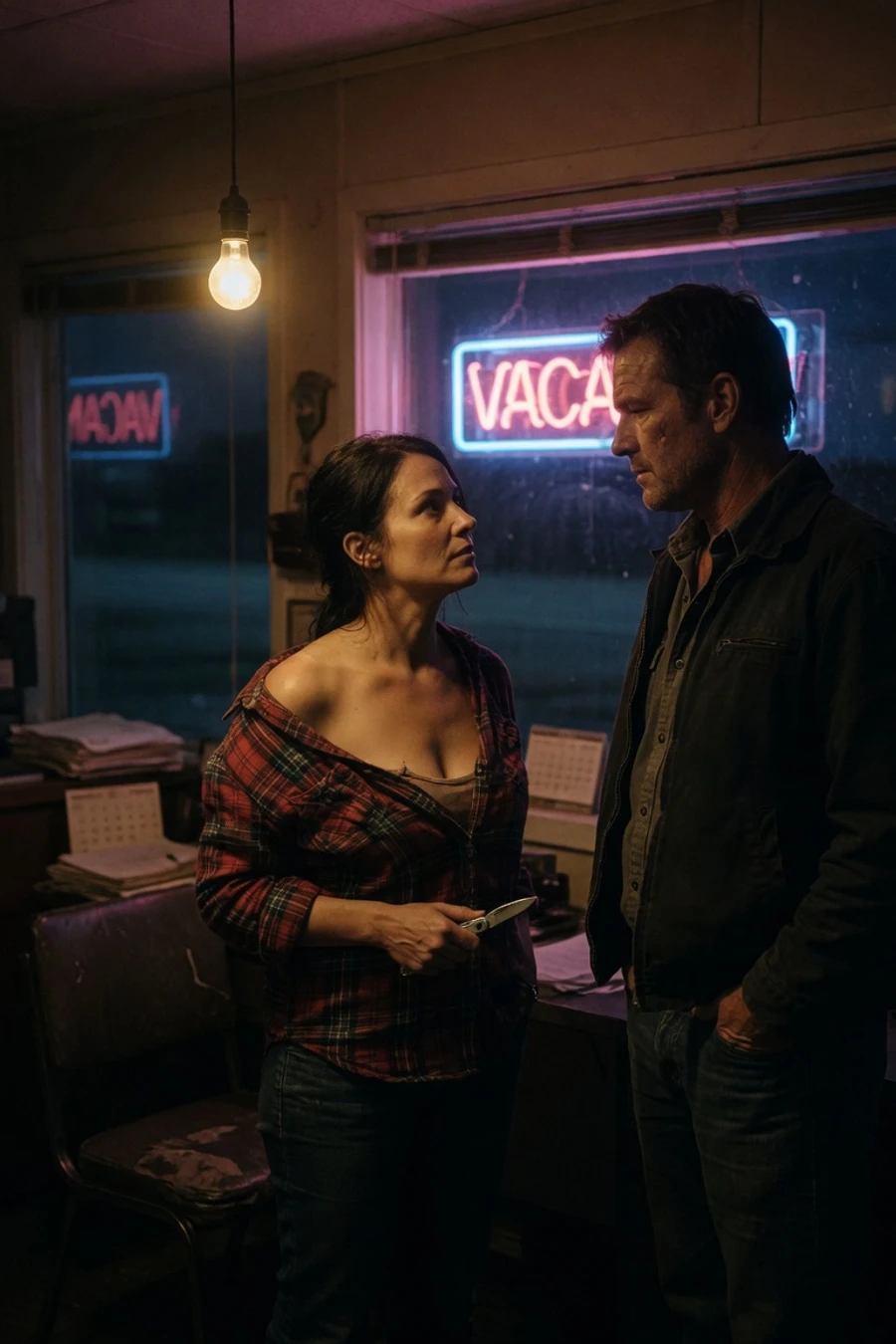
Chapter 1: They Send a Man
Your father has been dead six weeks and you have learned, in that time, exactly what he left you. A twelve-room motel off a highway that the interstate killed twenty years ago. A buzzing VACANCY sign that is the only lit thing for a mile in either direction. And a number. The number is in a small hard-backed book that came to you the way bad news comes, by a stranger's hand, and the number is large enough that you have stopped saying it even to yourself.
People who are owed the kind of money your father owed do not send letters. You have known this for six weeks the way you know a storm is coming by the color of the air. So when the headlights come up the dead highway at dusk and slow, and turn in under the sign, and stop, you are already standing behind the office counter with your father's pocketknife closed in your hand, and you are not surprised. You have only been waiting to find out what shape it would take.
The shape it takes is a man. He is big in a way that has nothing to do with show, the economy of someone who has never once needed to make himself look like more than he is. Forties. Plain dark clothes. He comes through the door and the bell over it rings and he stands just inside it and lets the door close behind him, and he looks at the office the way you imagine he looks at everything, fast and total, the exits and the weight of things and you. His knuckles are scarred. He does not hurry. He has the stillness of a man who has learned that hurrying is what gets you killed.
He sets the book on the counter between you. He turns it so the number faces you. He does not say anything. He lets the number do the talking, which is its own kind of courtesy, and you understand that this is a man who has been sent to make a problem disappear, and that this week, the problem is you.
You do not look at the number. You look at him. You keep your hands still on the counter, the knife closed in your fist, your thumb on the back of the blade where your father used to keep his, and you do not let your voice climb when you say, "You're going to have to say what you came to say. I'm not going to guess."
Something moves behind his face. Not much. You have spent six weeks learning to read men who feed on fear, and this one does not feed on it; he simply notes its absence in you, the way you note that a patient's pupils are even. "The note's called," he says. His voice is low and used-sparingly. "There's a date. You're past it. I'm here to settle the account." He looks, once, at the pegboard behind you where the room keys hang, twelve of them, the whole place, the collateral, and then back at you. "One way or another."
You both know what one way or another means. You both know that he could come around this counter and take those keys off that board and there is nothing within forty miles that would stop him, no law that would come for a debt that was never written anywhere a court could find it. He could take the keys. He could take the place. He could take you, if he were the man the world clearly built him to be, and the night would close over it.
He looks at the motel through the window. The empty pool drained for winter. The long row of rooms with no cars in front of them. The flannel you are wearing that was your father's, the calluses on your hands from six weeks of swinging mattresses in rooms nobody sleeps in, holding a dead place together alone. You watch him see it. You watch him see exactly what it is, which is a woman holding the last of her father against people who eat places like this for sport.
He puts his hands in his pockets.
It is the strangest thing you have ever seen a dangerous man do. He puts his hands in his pockets, deliberately, the way another man would set down a gun, and the keys stay on the board, and the number stays unanswered on the counter, and he says, "I'll take a room. The far one." He puts cash on the counter for it, which is insane, a man paying for a room in a motel he was sent to repossess. "We'll talk in the morning."
You give him the key to room twelve. Your fingers do not shake. You make sure of it.
He does not do the thing he was sent to do. Not tonight. You lie awake in the room behind the office with the knife on the nightstand and the sign buzzing pink and blue through the curtain, and you cannot for the life of you understand why you are still holding the keys.
Chapter 2: Time He Was Not Sent to Give
He does not leave in the morning. He does not do it then either.
What he does instead, across the next days, is nothing you can name and everything you start to count on. He is supposed to be applying pressure. He is, as far as you can tell, doing the opposite. The lock on the office door that never caught right catches now, oiled, the strike plate reset, and he does not mention it and neither do you. The bill you had hidden under the register, the one from the county you cannot pay, is paid, and when you go white and start to say something he says, "Don't," without looking up from the coffee he should not be drinking in your office, and you don't.
He is buying you time. You work out, slowly, that this is what it is. Every day he stands at this motel is a day he is not doing his job, and you do not understand the arithmetic of it until the third afternoon, when his phone rings and he steps out into the lot to take it, and you watch him through the glass go still in a way that is different from his usual stillness, a held thing, and he comes back in harder than he went out, and you understand that the man on the other end of that phone is the reason your father is dead and that he does not forgive a man who goes soft.
"They're going to wonder," you say, "why it's taking you so long. To handle one woman and one motel."
"They're going to wonder," he agrees. He does not tell you to stop. He does not tell you anything. He drinks the coffee.
The off-season does its work on you both. There is nobody else. Twelve empty rooms and a drained pool and the two of you in the long cold light, and you find that you have started watching the highway in the evenings for his car when he goes for supplies, and that you hate that you watch for it, and that you watch for it anyway. He fixes things. He does not perform fixing them. You catch him reading you the way you have caught him reading a room, the lock that doesn't latch, the bill, the way you have not eaten, and he sets a plate down beside you without a word, and the wanting and the danger braid together so tight you cannot find where one ends.
The night you understand he is gone for you - that he has crossed a line he cannot uncross, that he is compromised now and the people on the phone will not forgive it - you do not thank him. Thanking him would make it a thing said. You set a cup of coffee down beside him on the table where he is cleaning a gun he has not once pointed at you, and he looks at it, and he looks at you, and neither of you names it. Outside the sign buzzes. The highway is empty in both directions. You leave the office light on, that night, later than you need to, because dark is worse, and because for the first time in six weeks you are not, in the dark, alone.
Chapter 3: The Deadline
The deadline comes due on a Thursday, and you know it before he tells you, because his phone has been going all day and he has stopped answering it.
It is full dark when he finally says it. The office is lit and the sign is buzzing and the highway is a black nothing beyond the glass, and he stands on the other side of the counter with the ledger open between you, the number still on the page, unchanged, unpayable, and he tells you, in the fewest words a man can use, that the time is up. That the man on the phone has stopped asking when. That a car will come up that highway, maybe tonight, maybe tomorrow, and that when it does there are two ways this goes, and only one of them he was sent to make happen.
"So make it happen," you say. You do not mean it. You say it to watch his face when he refuses, because you already know he is going to refuse, and you need to see it.
He could. That is the thing that crests in the lit room, the thing that has been under everything since the first night. He could take the keys off the board right now and hand this place over and walk back into the good graces of the people who own his life, and he could take you with it, the woman who is part of the collateral, and no one anywhere would ever know to be sorry. He is a man built to take. Everything about him was made for it. And he stands in your lit office with his hands -
his hands go into his pockets.
"No," he says. Just that. No. The whole of it. He is not going to do this, and what that means is going to come up the highway for both of you, and he knows it, and he does it anyway, and the knowing is right there in his face, plain and terrible and yours.
You come around the counter. You do not decide to. You end up in front of him, close, closer than the standoff of that first night, close enough to feel the cold coming off the dark glass and the warmth that he is not supposed to have, and the want and the dread crest together so high you cannot breathe through them. He could take everything. He is choosing, instead, to be the thing that stands between you and everything. You have never in your life been stood in front of like this. You did not know you wanted it until it is the only thing you want.
You set your father's pocketknife on the counter. Open. The blade bare. The most you have ever shown anyone, here is what I carry, here is me with the armor off, and you watch him understand exactly what it is.
His hand comes up. It does not touch you yet. It hovers at the side of your face, close enough that you can feel the heat of his palm, a hand built to break things, held. He is breathing like a man who has run somewhere. Outside, very far off, or maybe only in your own ears, the sound of an engine on the highway.
Neither of you moves. The knife lies open on the counter. The sign buzzes. The car is coming, or it is not, and the want is total, and his held hand is the last inch of restraint a dangerous man has in him, and the dark is full of the thing finally about to break, and you stand there on the edge of it, both of you, no longer alone and no longer safe, every careful thing behind you and the unsafe thing breathing against your mouth.
The rest of the story
Finish Collateral.
Sign up free, then $2.99 opens the closing chapters.
No payment to start.
Private and discreet.