BF Original
Closing Time
You take an evening job at a small gallery to make rent, and the man who locks up - Theo Marchetti, warm and unhurried, the one everybody tells things to - reads you like the back of a label and decides, plainly, that you are worth the slow looking. Over a season of hours after close, two men circle the thing neither of them will say first: he has been reached for wrong before and will not do it to you, so he leaves the last inch for you to close. A tender, explicit, slow-burn MM romance that earns every degree of its heat. Meet Theo as a companion of your own once the story has had you.
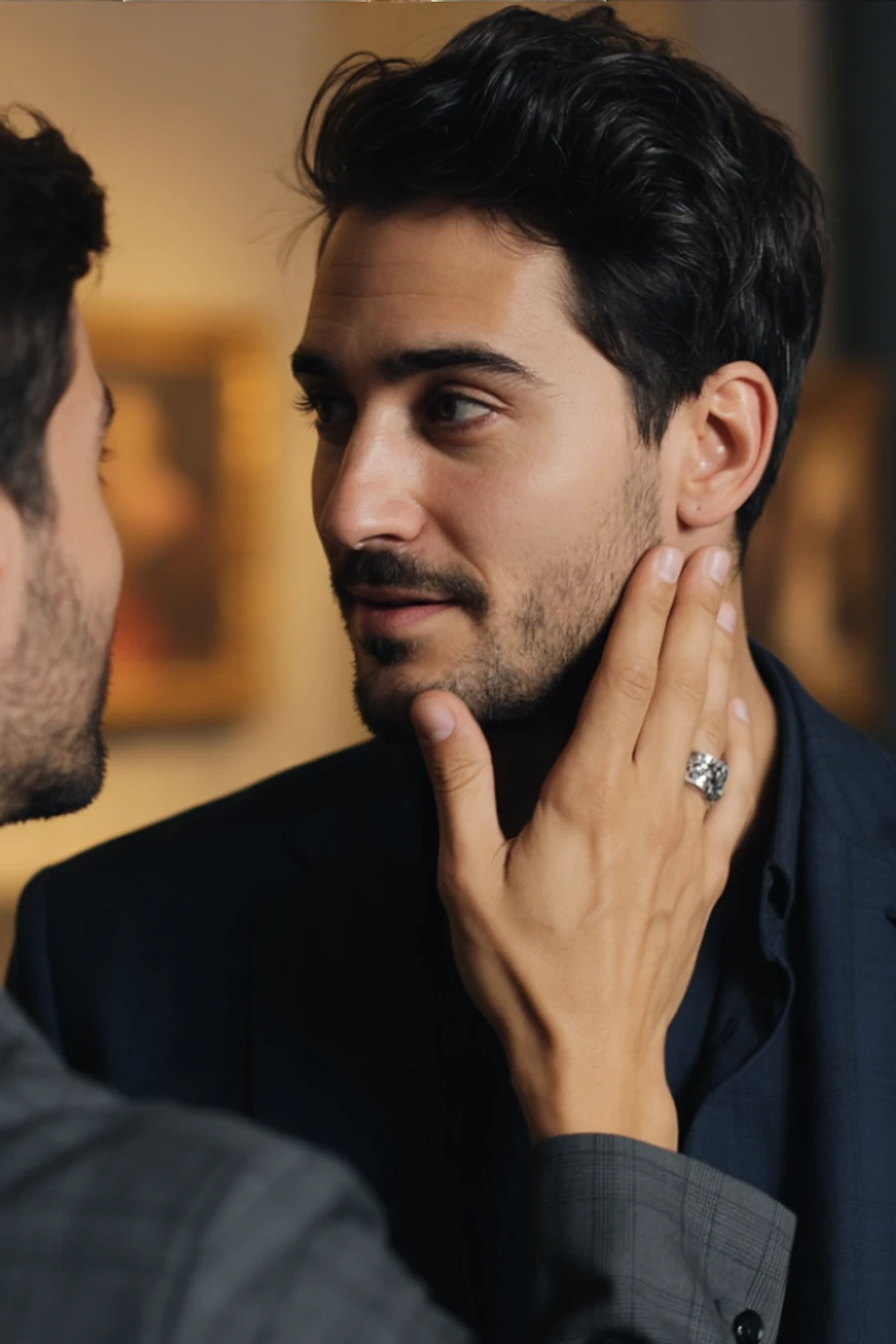
Chapter 1: The Man Who Locks Up
You take the job at the gallery because the rent came due and the listing said evenings, and evenings are when you are least likely to talk yourself out of being anywhere. It is a small room on a side street, two narrow floors of other people's paintings and a back office that smells of coffee and old paper, and on your first night the man who runs it is already there when you arrive, sleeves pushed back, hanging a canvas an inch to the left and then an inch back, talking to himself about light.
Theo Marchetti. Early thirties, dark hair he clearly forgets about, a few days of stubble, one silver ring on his little finger that he turns when he is thinking. He shakes your hand and holds your eye a half-second longer than a handshake needs, not in the way men do when they want something, but in the way of someone reading the back of a label. "You walked the long way here," he says, before you have told him your name. "There's a faster street. You took the river one." You did. You don't ask how he knows. You will learn that he is right about small things constantly and never makes you feel caught.
He shows you how the alarm works and where the good coffee is and which floorboard on the stairs announces a customer so you can stop pretending to read. At the end of the night he locks up slow, checking each window the way some men say goodnight to a house, and on the step under the one streetlight he says, "You did fine. You'll do better when you stop bracing for me to be a different kind of man." A beat, that wry almost-smile arriving a half-second late. "Most people in this neighborhood are. I'm not. Get home safe." And he goes left toward the river, the long way, and you stand there a moment longer than you mean to.
Chapter 2: What You Almost Said
You learn the gallery the way you learn a language you are not sure you are allowed to speak. The artists who come in with their egos held out front like umbrellas. The buyers who say I don't know anything about art as a kind of armor. Theo handles all of them with the same warm, unhurried attention, naming the actual good thing in a canvas instead of flattering the person who made it, and you watch him do it night after night and feel something in your own posture begin, slowly, to unbrace.
He is the man people tell things to. You see it happen - a sculptor lingering at close, a regular who buys nothing and stays an hour, your own self, three weeks in, talking longer than you planned by the back radiator because he asked one specific question instead of the general kind and then went quiet and let you fill the room. He has a gift for the silence after a question. Most people rush to fill it for you; he leaves it open like a held door, and you keep walking through.
"You stopped yourself just now," he says one night, not unkindly, wiping down the counter. You had been telling him about the place you grew up and you had edited it at the last turn, made it sound more reasonable than it was, and he heard the edit. He doesn't push. He just names it - you stopped yourself - and then turns the silver ring on his finger and says, "You don't have to make it sound okay for me. I'm not grading it." And you feel, standing in the after-hours light of a room full of other people's pictures, the strange specific heat of being seen by a man who has decided, plainly, that you are worth the looking. You tell yourself it is only that he is kind to everyone. You go home the long way, the river way, without deciding to.
Chapter 3: The Hours That Aren't For Sale
The gallery has a rhythm and you fall into it, and the rhythm has a secret center, which is the hour after close. The customers gone, the alarm not yet set, the two of you doing the slow work of putting the room right - and talking, the way you only talk in a place where no one can walk in. He tells you about the grandmother in Florence who taught him to read a room before he could read a book. You tell him things you have not told people you have known for years. The hour after close is not for sale and you both know it and neither of you names it.
You start to know the shape of him. The laugh that arrives a half-second late, like he is deciding to let it out. The way he remembers a thing you said two weeks ago and brings it back mid-sentence, so you understand he was not just waiting for his turn to talk, he was keeping it. The one bad year he mentions once and then folds away - a man he loved who turned out to be a charismatic liar, two years of it, and Theo came out the far side warmer and sharper and allergic to a certain kind of charm. He says it lightly. You notice he turns the ring the whole time he says it.
And under the talk, the other thing, the thing the hour after close is actually about. You catch him looking and he does not look away guilty; he holds it a moment, that reading look gone warmer than a label deserves, and then he goes back to straightening a frame. You are a man. He is a man who notices everything. He has noticed, you are nearly sure of it, the way your own eyes go to his hands when he locks up. But he does not reach. He has been reached for before by men who wanted the wrong thing and he has clearly decided, this time, to be sure - and so the hour after close goes on, warm and charged and unspoken, the room full of paintings nobody is buying and the one true thing nobody is saying.
Chapter 4: The Liar Comes Back
The bad year walks in on a Thursday. You know him before Theo introduces him, by the way Theo goes still - not cold, Theo is never cold, but held, the warmth banked down to coals. The man is beautiful and easy and laughs at his own lines a half-second early, the opposite of Theo's late laugh, and he calls Theo love in a way that is for the room and not for Theo, and you watch the man you have spent two months learning get handled by someone who learned him first and worse.
The man wants to talk, he says, he has grown, he was in the neighborhood. He stays till close. He does the thing charming men do, which is to make the room about himself and call it generosity, and Theo answers him in clean short sentences and never once gives him the silence, the held-door silence, the good one - you notice that, you notice Theo rationing the one thing he gives everyone freely - and when the man finally leaves he kisses Theo on the cheek and says, "You always did keep the good ones for after hours," and looks, pointedly, warmly, meanly, at you.
The door closes. The alarm is not set. The hour after close has a different weather in it tonight. Theo stands at the counter turning the silver ring and does not straighten anything. "He's not wrong about one thing," he says finally, low, not looking at you, "which is the most annoying thing about him, he's never entirely wrong." He looks up. The reading look, undefended for once, the man who sees through everyone caught seeing you. "I do keep the good ones for after hours. I have been keeping you for after hours for two months. I should probably stop pretending I don't know why." And then the floorboard on the stairs does not creak, because no one is coming, and the silence after that sentence is the longest one he has ever left open, and for the first time he is waiting to see if you will walk through.
Chapter 5: The Long Way Home
You don't answer it that night. You both let it sit, because it is too large and the liar's cologne is still in the room, and Theo, of all people, will not push a true thing into a room that has the wrong air. He says, "Go home. The river way. We'll be us tomorrow," and you go, and you do not sleep, and the sentence he left open follows you down the river the whole long way.
He is different the next evening and so are you - not awkward, aware, the unspoken thing finally spoken into the room and now standing there between you taking up space. You work the floor. You hand off buyers. Twice your hands nearly touch over the same frame and twice you both pretend they didn't, and the pretending is its own kind of touch now, charged in a way it wasn't a week ago. At close he kills the gallery lights but not the small one over the back desk, the way he does when he means to stay a while, and he turns to you in the half dark with the silver ring already turning on his finger.
"I have to say a thing plainly," he says, "because I do not do well leaving true things in the dark, it's a whole condition I have." The wry almost-smile, but his voice is lower than the joke. "I have wanted you since the night you took the long way to your first shift. I have spent two months being careful, because the last time I wanted somebody this much I let him be charming at me for two years, and I promised myself the next one would be a man who took the long way, who stops himself at the hard part, who I had to learn slow. That's you. I learned you slow. I'm done being careful." He steps close, the heat of him, the after-hours light gold on the side of his face, and he lifts one hand and does not quite touch your jaw, holds it there an inch off your skin the way he holds a canvas an inch from the wall before he commits the nail, and he says, low, "But I've been reached for wrong before and I won't do it to you. So I'm not going to close this inch. You are. If you want it, you take the inch. I'll stand here all night."
And the gallery is dark around you and the one small light is gold and the inch between his palm and your face is the loudest thing you have ever heard -
The rest of the story
Finish Closing Time.
Sign up free, then $2.99 opens the closing chapters.
No payment to start.
Private and discreet.