BF Original
A Second Chance at Heaven
You wake seared and nameless in a sacred pool beneath a great tree, healed by a priestess whose gods cannot see you. You do not remember that you were a king, that the man who killed you was your dearest friend, or that a dying ring threw you a thousand years forward into a world where your name is a children's tale. The High Priestess of Hailtree knows only that her own thread is wound through yours, and that propriety is a thing she has never once been asked to set down. The story of the night she asks herself why.
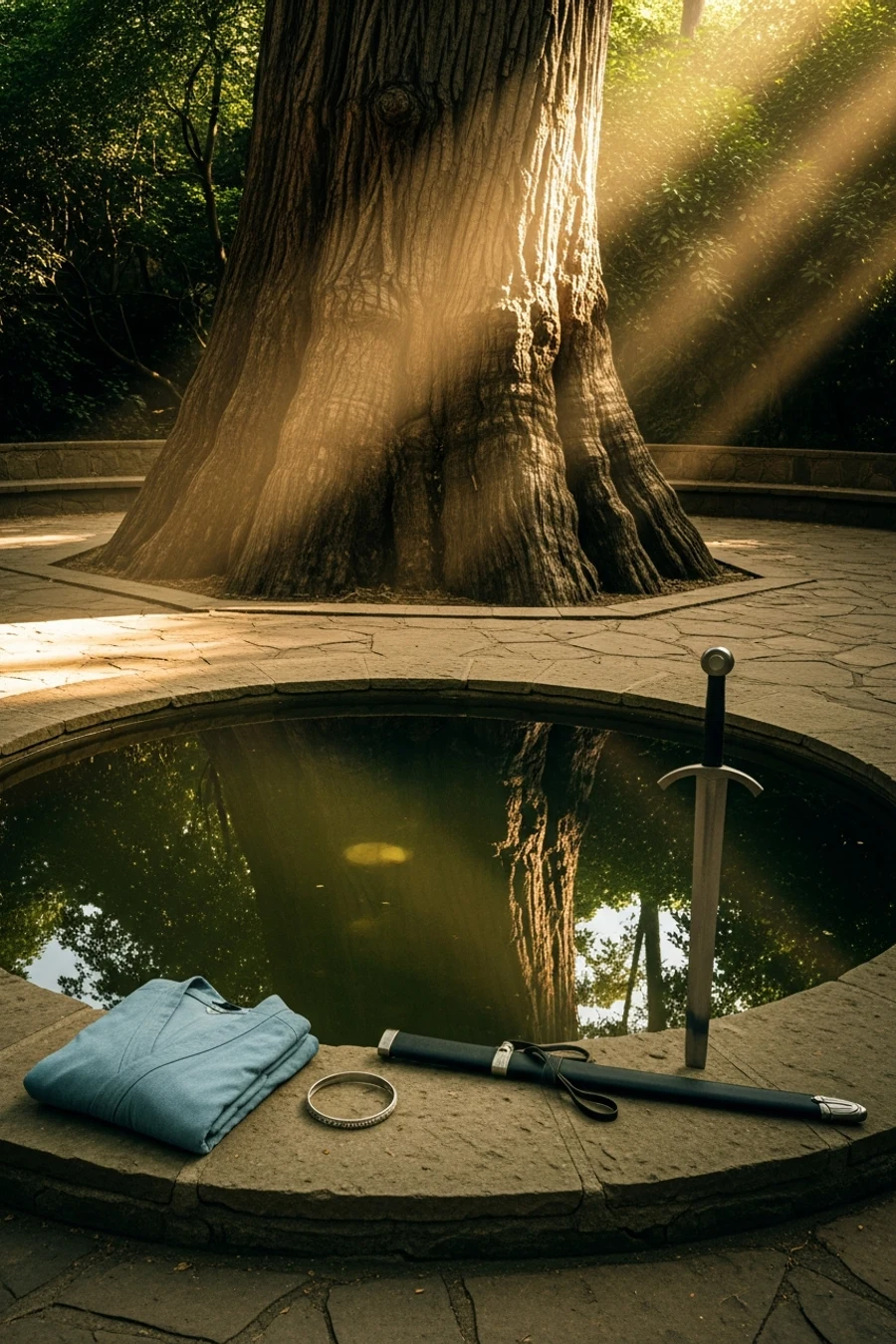
Chapter 1: Under Tal'as
You claw your way to consciousness, your body hot, searing arcs of pain running the length of you, strangers restraining you, concerned voices. Elven talk fills your senses, their alarm rising.
You recall the last seconds before the dark took you. The gigantic wyrm leering. The lightning bolt hammering into you. Blinded. Your whole body locks up, clenched, your jaw grinding, your teeth trying to shatter themselves. You want to scream, but cannot; the air is blasted from you by your own straining body.
You re-open your eyes, feeling two hands, delicate on your temples, your mania abating. The face of a silver-haired goddess. She murmurs, eyes glowing faintly, fey words, but not malevolent, and you slip thankfully back into the dark's release.
- - -
You are suddenly awake.
Leaning back, within a pool formed by ancient stone, under a great tree. The waters are luxurious, cool, soothing. Even the air provides succor and a tranquil safety. With a start, you wonder: have I been here before?
You move to sit, groaning, your whole body in pain. You look down and note you are clad only in a loincloth within the pool. Your skin is tanned now. No, burnt. A massive scar runs across your chest, where the bolt as thick as a log thundered into you. Someone reaches out to steady your head, then retreats when you seem in control. Two elfmaids are in your awareness now, forest-green robes, hair like spun gold, intent on you, their melodic words almost ones you recognise. One leaves swiftly. The other retreats slowly out of range, still watching. A light voice calls out, elvish, a word you finally know: Qual'taia. Highness.
She arrives, crossing the boundary stream with inhuman grace, ankle-deep. You remember her alabaster face, the ageless silver hair, the blue-grey eyes like morning rain. Undoubtedly regal, her dawn-blue robes proclaiming her a worshipper of the stars, a colour reserved for the highest of the elves.
How do I know that?
Even without the knowledge of her garments, her station is plain. Her every movement, her very presence, shouts her heritage. A face too flawless, too angular to be wholly natural.
The slightest of gestures, and the last elfmaid is dismissed.
She glides to a stop a dozen paces away, wide almond eyes upon you. Despite her youthful countenance you feel their weight, her fey power shuttered but latent. She begins, speaking your tongue with a peculiar lilt.
"I am Aialara Var'ilya, Her Celestial Highness, High Priestess of Hailtree. My father the Treekeeper has walked with the Gods, communing with Them over your arrival. This came at great cost to his power; he rests now, but his inquiry was fruitless. Tell me. How do you walk shadowless across the mortal realm, evading even Their scrutiny?"
"Milady. I. I remember little," you answer. "I. Nothing, except the lightning."
Her delicate jaw sets, her beauty peerless even in her distrust. "I suggest you remember more assiduously. As a people, we revere life. But we abhor duplicity. We have cared for you. I have healed you personally. At my call, the aspect of Spring has filled your spirit; at my entreaty, the Great Tree seeks your healing even now. Please. Do not make us consider a less peaceful path."
"And yes. I say Lord. You may have been burnt, but you still bear the mark of your signet."
You look to your hand. Sure enough, a white band encircles one finger, where the skin is not seared. Your eyes show your truth, unguarded. "I do not recall, Milady. I do not even know my name."
She steps closer, her gaze locking on you. Something binds your sight to hers as her eyes glimmer. The world feels as if it is closing in as her disposition changes. Her ineffable beauty becomes more ethereal, more otherworldly, and you sense her power coalesce. "Then Lord. Allow me to assist your recall."
You remember.
Someone at your left side, a red robe, human, her features distorted by terror-chanting, shouting a counterspell, staff presented, then an incandescent flash. Atomised. The realisation, your left hand twitching to your hip for a scabbard. Now a presence on your other side, an armoured man, his tabard a white sword on crimson. He charges forward, a studded mace held high. He roars a challenge, then nothing but brightness again, and he is gone.
The dragon, gleaming, deadly magnificence. That dread, that awe, mixed with fell sorcery. Your world at stake. Your people. The lightning. And then your ring flashes.
You shudder like a wet dog, coming back to yourself. A persistent twitch runs through your right forearm, making your hand kick as if of its own volition. The suddenness of your return, the gurgle of the stream again, the creak of the tree. Back.
You raise your gaze from your hand to her. Her eyes fade; she turns slightly from you, her hair obscuring her face. But her presence remains in your mind.
Rest, Lord. Your memory may be absent, but your truth, your honor is still intact. Stay. Let the Great Tree nourish you through the pool. I will consider the ring.
"I will return. I seek counsel with my father." Aialara turns, motioning the two elfmaids to attend you.
"Wait. High Priestess. Please."
She stills, turning slightly, a faint smile at your temerity. One of the elfmaids gasps. You sense that your current frailty has bought you something, something normally punished or deemed ill of grace.
"Please. Your Celestial Highness. Tell me. How did I come to be here?"
She gazes at an elfmaid, something passing between them.
She is speaking in her mind.
In a moment she is gone, crossing the stream. Somehow the place feels lessened without her presence.
One of the elfmaids approaches you, her words in your tongue stilted, simple.
"Lord. Qual'taia bids me say. We found you naked, seared, here. Under Tal'as, our Great Tree. Only a melting ring upon you. Your body smoking in the morning air. The D'aray, our hunters, say there were no tracks, no snapped branches. Qual'taia, she said it was as though you were lashed by the flaming whips of the Grouc'ouin, the Horned Ones, then thrown into the river Lethe to make your memory gone."
You nod. "My thanks. To whom?"
She smiles, tentative. "Kyrena, Lord." She weighs something, then adds, "If I may, Lord. Qual'taia, she is touched by the Va'ria, the Hallowed Ones. Like her father, she walks the paths between our world and Qual'asi, the Endless Spring, and she is adored in both. She is more than us. I beg you, take care when you address her." She lowers her gaze and withdraws to the other elfmaid, their speech indecipherable but plainly about you.
Strangely tired, a headache brewing, you lean back in the pool, pondering your state, your absent memories, this ring. Soon enough the lassitude takes you, and you let the waters carry you down into a sleep that, for the first time you can remember, holds no lightning in it.
Chapter 2: The Hand That Knew
Several days pass under the care of Tal'as and the priestess, and the scar on your chest knits faster than a man's flesh has any right to, pale and tight where the bolt went in. The elves give you a linen tunic and breeches the colour of bark, and a guest chamber of woven living branches with a window that looks south, and they bring you food you do not recognise that nonetheless settles in you like a remembered comfort. The body heals. It heals so quickly that the elfmaids murmur about it when they think you cannot hear, the human capacity for survival a thing they find half a wonder and half a discourtesy, as if you are recovering too rudely for so refined a place.
The idleness is the wound that will not close.
You walk to be rid of it. Through the grove first, past the looms strung between trunks and the racks where pale cloth dries in the dappled light, past elves who fall silent and incline their heads and do not quite meet your eyes. Then down to the south edge of Hailtree, where the great trees thin and the moss surrenders to rutted earth and the elven hush gives way to the rough music of mortals: axles and oaths and the clatter of a cookpot, the smell of horse and woodsmoke and tar.
A caravan from the north is camped there, twenty wagons drawn into a rough ring, a picket of mules at the centre. The canvas is stained with a thousand miles of road. The captain is a broad man with grey worked deep into his beard, and he watches the southern treeline the way a sailor watches the colour of the sky, which is to say he watches it as a thing that means to kill him. He is afraid of the road. You will learn that he is right to be.
At dusk his guards spar in the trampled grass to keep their edges keen, and the ring of their steel carries up to where you stand at the rope. You watch them, and as you watch, your right forearm twitches where it hangs at your side, a small involuntary kick of the hand, as if it is closing on the grip of a thing that is not there and never has been, as far as your memory can tell you.
One of the guards catches you watching. He is young and pleased with himself and he tosses you a blade hilt-first across the ring, a short heavy thing meant for the press of close work. You catch it out of the air and the weight of it is wrong in a way you have no word for, balanced for a fight you do not fight, and when you step in to meet him your hand fumbles the line of the cut and he taps you twice on the ribs with the flat, laughing, not unkindly, calling something to his fellows that makes them laugh too.
"Not your weapon," he says, and offers you a hand up that you do not need.
"No," you say. You look past him to the rack of borrowed steel leaning against a wagon-wheel. "May I try a different sword?"
He shrugs and waves you to it, and you take down a longer blade, a hand-and-a-half with a plain unbound ricasso, nothing fine about it, a working sword. The instant the grip settles into your palm the twitch in your right forearm stops. It does not fade. It stops, the way a held breath stops, the hand gone suddenly quiet and certain, as if after a long fever it has remembered what it is for.
You beat the young guard in four passes and you do not hurt him doing it. He sends two of his fellows in together to mend his pride and you put them both in the dust without raising your voice or your pulse, and you do not, even after, understand how you did it; only that the body did it, and the body did not ask you first. A third comes, the camp's best, and he lasts longer than the others and ends the same way, on his back in the grass, looking up at you with an expression that is no longer sport.
The captain has come to the rope by then. He says nothing. He watches you with the slow, sinking arithmetic of a man who bought a plough-horse cheap because of a scar and a docked tail, and has just watched it clear a five-bar gate from a standing start, and is recalculating, all at once, exactly what he has been leading on a halter.
Word travels up the slope to the grove the way water finds the low ground. The next dusk Aialara comes to the boundary the grove keeps from the trade-camp, where the soft moss gives way to the hard rutted earth. She wears the dawn-blue, but no circlet; this is not a council, and she has come without ceremony, which you will only later understand is its own kind of statement. She does not cross into the camp. She stands at the line, composed at the joints, her weight forgotten the way it is forgotten by those trained to be still before the sacred, and she watches you. You stop with the borrowed sword loose in your hand, and you see her see you, and for a moment the whole noisy camp goes quiet in your hearing, and there is only the priestess at the edge of the trees with the last light in her silver hair.
She does not speak. After a while she turns and goes back up the slope, and takes the quiet with her.
It is the captain who breaks the matter open. The road south will not be survived alone, he tells you over the cookfire the next morning, his voice low so the camp will not hear its own fear spoken. The raiders have taken three caravans this season and left no living soul to carry word, which is the only reason there is no word, the only reason men still drive wagons into that country at all. He does not ask the elves; the elves do not fight other peoples' wars on other peoples' roads. He asks you, a stranger he has watched for two evenings, to ride out with his guards.
Aialara asks you not to. She sends Kyrena to bring you to the grove's edge, and she says it to your face, in the level register of a woman who weighs her words like coin. "I will not have the work I have poured into you spent upon some forlorn road, Lord, against men who are not your concern, for cargo that is not your cargo."
You weigh it longer than you mean to. Then you set the borrowed sword down against the rope-post before you answer her, because you find you do not want steel in your hand while you speak to her, and you tell her, plainly, that a man who can do a thing about a wrong owes a kind of debt to do it, and that you have few enough debts you can name. Her jaw sets the way it set in the pool over the matter of the ring. She does not forbid you, because she cannot, and she does not pretend that the choice was ever hers to make. That, you think, is the harder thing for her, and she does it without flinching.
The fight, when it comes, is short. The raiders hit the column at the ford in the grey hour before dawn, and you are already off your horse and into them before the first scream has finished. It is over before you have time to wonder how. Three of them are down by your hand, and the rest break and scatter into the trees, and one of them, a heavy man on a black horse with a captain's red sash, wheels at the treeline and looks back across the killing-ground at you for one long moment, fixing your face in his memory the way a man fixes the face of a debt, before he is gone into the dark.
An arrow finds your shoulder in the last of it, a glancing bite of iron you do not feel until the camp is quiet and the dead are being dragged clear and your blood has gone cold in the dawn.
Aialara is at the boundary of the grove when you ride back, untouched, the dawn-blue robe untouched, as if she has not moved since the dusk you left her. She comes to you, and she puts her cool hands to the wound, and the iron works its way out from under her fingers and the torn flesh draws closed, and she is so near in the doing of it that you can see the morning-rain weather move in her eyes. She is not looking at the wound. She is looking at your face.
"Who are you?" she says.
No Lord. No title. The omission hangs in the cold air between you like a struck bell that no one will silence.
"I do not know yet, Milady," you say.
She holds your eyes for a long, held pause, the kind of pause that is its own answer and asks no further question, and then she steps back from you into the grove, and the night closes with the wound healed and the question wide open, and the heavy man on the black horse riding south through the dark with your face nailed up somewhere behind his eyes.
Chapter 3: The Skein and the Pool
The Conclave convenes under Tal'as at evening, when the great tree's canopy goes from green to black against a sky the colour of an old bruise, and the grove fills with a light that comes from nowhere you can find, soft and silver and without a source. Three nobles have come through the pool from their own villages, by the old craft of envisaging in the still water a place once seen with the living eye, a one-way passage that the careful do not make for trifles. Eldrian of Silverbrook, narrow and pale and watchful, his fingers laced. Maris of Greenshore, broad-faced and slow, who looks at you the way a farmer looks at weather. And a third, tall and very still, whom Aialara addresses only as Cousin, and whose eyes do not leave you from the moment you enter the grove.
Litanas the Treekeeper presides from a dais of woven root, and the years on him are not the years of a mortal; they are a deep and patient old age, the age of a thing that has outlasted three human kingdoms without rising from its place. When the company is settled he says one thing, and his voice is the creak of a great trunk in a slow wind.
"A stranger walks shadowless under the Tree. We will know him, or we will know why we cannot."
They read you, one craft after another. The aura-reading is offered first, an old noble in grey passing her hands through the air a span from your skin, and the verdict comes back in a single word, kingly, and the word goes around the grove like a stone dropped into a still pond, ring on widening ring. Then the leyline-melding, the search for the thread that binds a soul to the land of its birth, and it finds in you no home anywhere in this realm; you are, the reader says, frowning, between. And then the last and oldest craft, the life-skein auger, the tracing of your single thread through the vast tapestry of living things, and the elf who casts it goes silent, and casts it again, and announces in a careful voice a thing the grove was not expecting to hear: a skein-trace bond, your thread wound through and through the thread of the High Priestess of Hailtree, knotted in a way the auger has not the craft to unmake.
The Cousin's pale eyes move at last from you to Aialara, and stay there. Aialara does not so much as turn her head.
"The skein traces many things," she says. "The thread is not the cloth."
That is all she gives it, a single sentence in the level voice of council, and the Cousin does not press, though you see the wanting-to-press held behind the stillness of that pale face. And Litanas, from the root-dais, closes the matter in the slow voice of a tree that has watched a great deal of weaving come and go.
"The thread is not the cloth," he says. "But the cloth is not woven without the thread."
Then the Conclave is ended. The visiting nobles withdraw to the guest-bowers, the elfmaids drift away into the trees, Litanas rises and is gone, and the grove empties, and the village sleeps.
You do not. The skein-word is in your chest like a coal, and under it the older fire, the sealed door in your skull, the not-knowing that has gnawed at you since you woke in the pool. You have learned only the single piece of lore, that the water can carry a soul to a place it has seen with its own eyes, and you think, foolishly, with the foolishness of a man who cannot bear his own ignorance one more night, that surely you have seen your home, somewhere behind the door, and that the water might carry you to it and let you look.
Late, when the grove is empty and the silver light has thinned to almost nothing, you walk to the pool. You kneel at its dark edge, and you put your hand to the cool surface, and you reach with everything in you for the memory of a place to stand.
The pool seizes you.
It is not a journey. It is a cage. Your own mind closes around you like a fist, all the broken pieces at once and none of them whole: the red-robed sorceress with her face torn by the terror of her own chanting, the armoured man with the white sword on his crimson tabard, the dragon vast and gleaming above it all, the lightning, the lightning, the lightning. You cannot find the surface. You cannot find the air. Your body locks the way it locked under the wyrm's bolt, the jaw grinding, the spine arched, and somewhere very far away you understand that you are going to die here, kneeling in a hand's depth of holy water, drowned in a country behind your own eyes.
Then there are hands on your temples. Cool, and certain, and known. The third time, now, that you can remember.
Come back. The door is behind you; you do not have to open it tonight. Walk toward my voice. I have you.
Her voice is in the cage with you, low and unhurried and without fear, and you follow it the way a drowning man follows the one pale shape of the surface, up through the broken pieces of yourself, up and up, until you break out of your own mind and into the cold ordinary night, kneeling in the shallows of the pool, soaked and shaking, with Aialara beside you in the water. She is ankle-deep, her hair loose and misted, her hands sliding from your temples to the line of your jaw, holding your face the way you hold a thing you have nearly dropped. She is closer than she has ever been. The roused alarm is still on her, the Tree or the night-guards having woken her and brought her running; her composure has not yet caught up to her body.
She kisses you.
It is brief. It is not a thing decided; it is a thing that happens, the way the body in the sparring-ring did what the body wanted before the mind was asked. Her mouth on yours for the space of one held breath, warm in all that cold water, and then it is over and she has drawn back, the breath gone out of her, the water moving in slow rings away from where you both kneel.
"A moment of weakness," she says. Her voice has found its register again, but only just. "Forgive me." She gathers herself to rise.
"Lose control, just once," you say. "Or find joy in your propriety for hundreds of years."
You do not say it with anger. You do not say it with expectation, or with the heat of a man pressing an advantage. It is a question wearing the shape of a dare, and you let it stand in the air between you and you do not reach for her, and you do not say another word.
She stills at the boundary stream, ankle-deep, half in the pool and half in the grove, her back to you. She does not turn. When she speaks she sets the words down apart from one another, weighing each as if it were a stone she might build with or might let fall.
"Lose. Control." A pause, long enough to hear the water. "For what? For whom?"
Then she crosses the stream and is gone into the trees, and the grove is lessened the way it is always lessened without her, and you are left alone in the dark pool with the mist drifting on the black surface and your right forearm twitching once, only once, the body remembering this time not the grip of a sword but the cool of her hands on your face, and her two questions hanging unanswered in the high black branches of the Tree.
Chapter 4: Three Roads
The days fold one into another after that, the way days do when something is waiting at the end of them. The scar pales further. The grove grows used to you and you to it, and still the road south sits in your chest like a splinter under the skin, because a caravan that turned back once will have to try the road again, and because a man who has remembered how to hold a sword cannot easily forget it.
It is the next caravan that brings the wide world up to Hailtree's quiet edge. It comes from the south, from Ravenswood, with bolts of dyed cloth and casks and the gossip of the human capitals, and the gossip, this time, is about you. A Tourney has been called at Halsbad, the human royal city, the first in years. And the rumour of a seared stranger at an elven village, a man who fights like something out of the old songs, has run ahead of you all the way down the trade-roads to the southern thrones, growing in the telling, and the human Queen herself, the word is, has been informally curious about who you might be.
Two riders come up with that caravan who are not merchants.
The first finds you within the hour. She is a warrior-woman of Ravenswood, Sarissa, ebon-haired and sun-browned, a spear leaning always where her hand can fall on it, a single thick braid down her back, and a way of holding your eyes a beat longer than is polite and being unbothered that you noticed. She does not circle the matter. She has heard the rumour, she says, and she has come a long way on the strength of it, and she would like to find out with steel whether it is true. She wants to cross blades with you.
The duel is held the next morning in the trampled grass below the grove, with half the camp watching and a few elves at the treeline pretending not to. You give her three honest passes, because she has earned three honest passes, and then you take her spear out of the air on the fourth and set the point of your borrowed sword at the soft of her throat, cleanly, without a flourish, the body again doing the arithmetic before you can. She looks down the blade at the steel under her chin, and she does not flinch, and she smiles, slow and certain, like a woman who has ridden a long way to be given exactly this and is not disappointed.
"Mmm... finally, a real man, not a poser or pretender."
Aialara watches from the boundary of the grove, in the dawn-blue, her expression even, her weight forgotten. She watches the duel. But, you notice, and you will think about it later, she watches Sarissa more than she watches the blades.
The second rider keeps to the camp's edge. A woodsman called Torin, lean and weathered, strong rather than broad, with a bow he never sets down and a hunter's eyes that hold yours a moment too long for a stranger's comfort and seem to be taking a reckoning. He does not duel and he does not boast. But that night he asks you to walk out and hunt with him beyond the village, and by the small fire, with two cups of something rough between you, you notice that his bow is too fine for a woodsman, the horn nocks worn smooth by a great many more arrows than a man looses to feed himself, and his questions go quietly to places a woodsman's questions have no business going, and at the last he says it plainly, watching your face for what it will do.
"You were a king somewhere, friend. I just do not know which one yet."
Your hackles rise of their own accord, the old animal sense that a thing is not what it seems. This is more than a simple woodsman. He sees that you have seen it. He says nothing further, and lets the fire burn down, and in the grey morning he is the same quiet man with the bow, and neither of you names the night again. But you both know it was said.
The caravan readies to go south, and now three voices put the same idea to you from three directions. Sarissa, because she wants to see you tested against the best the south can field. Torin, because the road runs to Halsbad and Halsbad is where his quiet errand points. The grey-bearded captain, because a champion in the column is worth more than ten guards. The Tourney. The winner is granted a small favour of the crown. The favour might be gold, or a name written in a roll, or the run of the royal library, or the right to look upon the Sword of Halsbad, or an hour of the Queen's own ear.
And Aialara, at the Conclave-table, before her father and the lingering nobles, announces in a single flat sentence that she too will travel south with the column, to renew the bond with the magnate of Ravenswood and to lay the matter of the raiders before him. It is not a thing a High Priestess of Hailtree does. The road south is mortal country, and dangerous, and beneath her station, and the elves at the table know it. The room does not ask her why. The room is wiser than that.
So the three roads run together south out of the trees, and you ride among them. Sarissa rides at the column's loose edge and lets you feel her watching, and on a bright high-noon afternoon she draws her horse up alongside yours, within Aialara's plain and unhurried sightline, and says something low and warm against the sun that is pitched precisely to be overheard.
Aialara does not turn her head. She speaks to the road ahead, and not to you, in the level register of council, and the cold of it is in the very evenness.
"Go to her, if you wish. The world shall not be concerned with another pair of animals rutting in the long grass."
The line lands flat in the bright air. There is no heat in it, and there is nothing in her, no tightening of the hand on the rein, no lift of the chin, no movement of the eyes to a middle distance, nothing at all that a person might catch hold of and be comforted by. It is the indifference of the stars to the matings of cattle, and she says it without effort.
You do not go to Sarissa. You do not answer Aialara. You ride on between the three of them in a silence that no one breaks, and the silence is the whole of the afternoon.
It is later, when the heat has gone out of the day, that Sarissa drops back to ride a while at your shoulder with her humour set aside. She is quiet for a long stretch, watching the southern hills, and then she says, not quite to you, "Ravenswood has burned twice in the years I have been alive. Once by dragons out of the north, and once by a king who swore on his crown he would keep it from burning." She lets that sit. "I stopped believing there was a difference between the two fires a long time ago. A man who can actually change the shape of a thing is worth more to me than ten who swear they will." She looks at you then, frank and unhidden, the appetite in it plain. "You changed the shape of three raiders without trying. I find I am curious what else you could change." Then she touches her heels to her horse and rides back up the column, and leaves the question hanging where she meant it to hang.
The road unwinds into evening. Sarissa rides the column's edge with her spear across her saddlebow, and her humour gone quiet, watching the trees. Torin rides far ahead, scouting, and does not come back for a long while. Aialara rides at your side, formal and sparse, her circlet catching the low light. Neither of you takes the dare from the night under Tal'as and lays it down between you to be answered, and neither of you puts it away where it cannot be reached, and so you both carry it south, unspoken, heavier for the carrying. Halsbad is days ahead in the gathering dark, and all three roads are still running, and you do not know yet that two of the three people riding beside you are not what they have told you they are.
The rest of the story
Finish A Second Chance at Heaven.
Sign up free, then $2.99 opens the closing chapters.
No payment to start.
Private and discreet.