BF Original
A Quiet Arrangement
Della's husband left her a debt she never knew existed, and the only person who can make it disappear is the man the city's powerful call when a problem is the wrong shape for the law. He makes the threat vanish. The only price is that she lets him close. He is lethal to everyone in the world, and unbearably gentle with her, and she is about to learn what it costs to be the one exception a dangerous man allows himself.
Chapter 1: The Man You Call
The envelope came on a Tuesday, which felt like an insult. Bad news should at least have the decency to arrive on a Monday, when you are braced for it, or on a Friday, when you can drink it under the rug for two days. Tuesdays were for getting on with things. Della had been getting on with things for fourteen months, and the city had decided she had gotten on long enough.
She read the letter twice at her own kitchen table, in the apartment that still smelled faintly of the lemon oil Mark used to rub into the cabinets, because some habits outlive the man who taught them to your hands. The figure at the bottom of the page did not change between the first reading and the second. It sat there, eight digits and a decimal, the kind of number that does not belong to a person who buys her coffee one cup at a time.
Mark had left her a wedding ring, a record collection alphabetized with a precision he never once applied to their joint account, and a debt she had not known existed until the man who held it decided he wanted to be paid. She had assumed the debt died with him. Debts, it turned out, were more loyal than husbands. They followed you home.
She did not cry. She had done her crying in the first month, in the shower mostly, where the sound of the water gave grief somewhere to go. What she felt now was colder and more useful. She felt the specific, narrow fear of a woman who has counted her options and found there is exactly one she has not tried, and that it frightens her more than the debt does.
Her sister had said the name once, at a dinner two years ago, the way you mention weather you do not expect to live in. If you ever have a problem that isn't the kind you take to a lawyer, you call Vega. Joelle had laughed when she said it. Everyone at the table had laughed. It was the laugh people use to put distance between themselves and a thing they are afraid is true.
Della had not thought about that dinner in two years. She thought about it now, lying awake, the figure on the page burned onto the inside of her eyelids. She thought about the way the laughter had gone around the table and then stopped at the one woman who had not laughed, a friend of Joelle's whose husband did something with property, and how that woman had looked into her wine and said nothing, and how Della had understood, even then, that the silence meant the name was real. That somewhere in the city there was a man you called when the problem was the wrong shape for the law. She had filed it away the way you file the location of a fire exit, hoping never to need it, knowing where it was.
She had needed a great many things in fourteen months. She had needed her husband to not be dead, which no one could give her. She had needed the apartment to stop smelling of him, which time had refused to do. She had needed money, and sleep, and for the phone to stop ringing with men who said her late husband's name like a question they already knew the answer to. None of those needs had had a fire exit. This one did.
Della did not have a lawyer's kind of problem anymore. She had the other kind.
It took her three days to find the number, and she found it the way you find such things, through a friend of a friend who stopped smiling when she explained what she wanted, who wrote ten digits on the back of a receipt and slid it across the bar without meeting her eyes, who said only, "Be exactly on time. He notices."
So she was exactly on time.
The restaurant was the kind that does not put its name on the door. You either knew where it was or you had no business there, and Della stood on the sidewalk for a full minute feeling like the second kind of person before she made herself go in. It was a narrow door between a shuttered tailor and a bank, the kind of door you would walk past a thousand times and never see, and she had walked past it, she realized, standing there. She had passed this door for years and never once wondered what was behind it. That was the whole point of it. It was a door for people who already knew.
She had dressed carefully and was now certain she had dressed wrong. She did not know the dress code for asking a man to make a problem disappear. She had landed on the dark blue dress she wore to her own job, the one that said competent woman who will not waste your time, and standing on the cold sidewalk she felt it was both too much and not enough, an outfit for a meeting that had no protocol. She made herself stop thinking about the dress. She made herself open the door.
Inside it was dim and low and quiet, white cloths and old wood, brass lamps turned down to the color of weak tea, the hush of a place where money goes to be discreet. The carpet ate the sound of her heels. A few couples and a few solitary men sat in the booths, and none of them looked up, and the not-looking was practiced, she understood, a courtesy the room extended to itself. A man at the host stand looked at her and seemed to know her name before she gave it.
"He's at the back," he said.
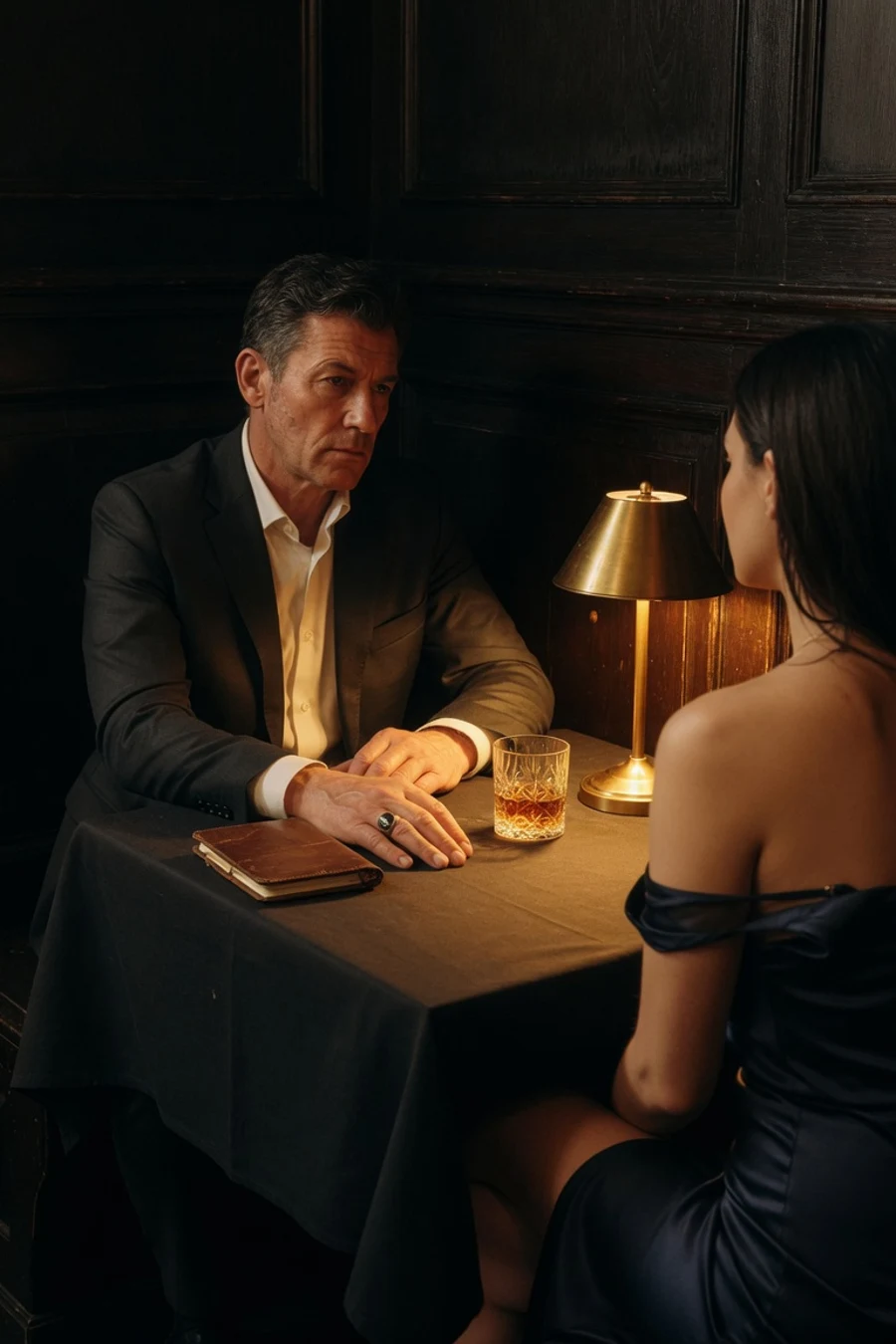
The back was a corner booth, and the man in it did not look up when she approached, which she would later understand was not rudeness but a kind of courtesy, the way a person gives you a moment to arrive at yourself before they look at you directly. He was finishing a line in a small leather notebook. He capped the pen. Then he looked up, and Della understood several things at once.
He was not what she had built in her head. She had built something theatrical, a man performing his own danger. Vega did none of that. He was perhaps fifty, dark hair going gray at the temples in a way he had clearly made no effort to hide, a face that had been handsome and had aged into something more interesting than handsome. He wore a charcoal suit with no tie, the collar open one button, and he sat the way very still water sits, with the whole weight of itself underneath. The room was loud with other people's conversations and his corner was not. That was the first thing she noticed about the danger. It was quiet. It arranged the air around it.
"Della," he said. Not a question. He gestured to the seat across from him, an open hand, unhurried. "Sit. You're cold."
She had not realized she was cold until he said it. The walk over, the nerves. She sat.
"You want something to drink. Something warm." He had already lifted two fingers a fraction off the table, and a man was moving toward them before she had decided. "Tea," Vega said, when the man arrived. "The one with the honey. And whatever she normally takes at the end of a long day." He looked at her. "What do you take?"
"Whiskey," she said. "Neat. The cheap kind, usually."
Something at the corner of his mouth moved. Not a smile. The place a smile starts. "Not tonight," he said to the man. "The good kind." And the man went.
She had come here braced for a transaction with a monster. She had not braced for this, the small warm machinery of being attended to, the way he had read the cold off her skin and the long day off her face before she said a word. It unsettled her more than menace would have. Menace she knew how to stand against. This she had no posture for.
She studied him while he was not, for the moment, studying her. The notebook was small and worn, the leather gone soft at the corners, a thing he had carried a long time. His hands were still on the table, large and clean and unhurried, no rings, and there was a thin white scar across two knuckles of the right one, old, faded, the kind of mark a man stops noticing on himself. He did not fidget. She had not met a man in years who did not fidget, who did not reach for his phone or turn his glass or do something with the surplus of himself. Vega had no surplus. He was the exact size of the space he occupied and not one inch more, and the effect was that everything around him seemed slightly too loud, slightly too much, the other diners overspending on motion while he banked his.
"Tell me the problem," he said. "Not the feeling about the problem. The problem."
It was, she would think later, the most useful sentence anyone had said to her in fourteen months. Everyone wanted the feeling. Her sister wanted the feeling so she could comfort it. Her friends wanted the feeling so they could agree it was terrible. The bank wanted the absence of feeling, the cold numbers, and gave her nothing back. No one had simply asked her to lay the problem on the table, the actual shape of it, and let her be a person reporting a fact instead of a widow performing her distress.
So she told him. The debt, the man who held it, the number with eight digits, the way it had arrived on a Tuesday. She told it flatly, because she had learned that flat was the only way she could say it without her voice doing something she did not want it to do in front of a stranger. He listened the way she imagined he did everything, completely, without performing his listening. He did not nod to show he was following. He did not make the small encouraging sounds people make. He simply received it, all of it, his eyes on her face, and when she finished he was quiet for a moment that should have been uncomfortable and was not.
"Voss," he said finally. The name of the man who held the debt. He said it the way you say the name of a stain.
"You know him."
"I know him." The tea arrived, and the whiskey. He waited until she had her hands around the cup, until the warmth had reached her, before he went on, and she noticed that too, that he had paced his own words to her comfort. "Your husband borrowed from a man who lends so he can own. The money is not the point for Voss. The money was always going to come back to him double, or it was going to come back as you. He has been waiting fourteen months for you to be afraid enough to come to the table thinking you have nothing to offer but yourself."
Della's hands tightened on the cup. "And do I? Have nothing to offer but myself."
Vega looked at her for a long moment. When he spoke, his voice did not change, but something underneath it did, some floor that had not been there a sentence ago.
"You are never going to be at Voss's table," he said. "That part is finished. You came to the right man. I am going to make this go away, and you are not going to think about Voss again."
It was not a boast. That was the thing that frightened her and steadied her in the same breath. Men boasted. Men in bars and men in board rooms, men inflating themselves to fill the space they wished they took up. This was not that. This was a man stating the weather. It is going to rain. The debt is going to vanish. Equal certainty. Equal calm.
"Why," she said. "Why would you."
And here, for the first time, he was not instant. He turned the small notebook a quarter turn on the table, an old habit she would come to recognize, the way some men touch their wedding rings. Then he looked at her, and the look was direct in a way that no one had looked at her in fourteen months, no pity in it, no managing of her grief, just a man seeing a woman.
"Because I would like to be the reason you sleep through the night," he said. "That's all. That's the whole arrangement. I take this off you. And you let me close enough to know whether it worked."
She should have laughed. She had come prepared to be propositioned, prepared to refuse, prepared for the ugliness of a powerful man's price. This was not ugly. That was what made it dangerous. He had asked for nothing she could put in a box and hold up and say there, that's the catch. He had asked to be let near. He had asked to know whether she was sleeping.
"That's not a price," she said.
"No," he agreed. "It isn't."
"Then what do you get."
He drank, set the glass down, and the small sound of it against the wood was the only sound at their table. "I spend my life," he said, "making sure dangerous things happen to people who have earned them. It is good work. I am good at it. It is not gentle work." He paused. "I would like, somewhere, to be gentle. I have decided it will be with you. You can say no. You should probably say no."
She did not say no. She would think about that for a long time afterward, lying awake in the apartment that still smelled of lemon oil, the fact that she had not said no, and what it meant that the not-saying had felt less like a decision and more like setting down something she had been carrying so long she had forgotten it had weight.
"How long do I have to decide," she said.
"You don't decide tonight," he said. "Tonight you finish your drink. Voss is mine starting tomorrow whether you ever see me again or not. That part isn't conditional. I don't trade safety for a yes. That would make me Voss."
And there it was, the line, drawn so quietly she almost missed it. The thing he would not do. He would make the threat go away and ask for nothing she could be made to regret. The asking, if there was asking, came after, on the far side of a door he had already locked against her fear.
She finished her drink. It was, in fact, very good whiskey.
When she stood to leave he stood too, and he walked her to the door, not touching her, a half step behind and to the side, and she realized he had positioned himself between her and the room, between her and the dim faces in the dim booths, and that he had done it without making it a thing she was supposed to notice. At the door he did not offer his hand. He looked at her one more time in that direct, unmanaging way.
"Sleep," he said. "It's handled."
She walked home through a city that felt, for the first time in fourteen months, like it was not actively trying to take something from her. The streets were the same streets. The cold was the same cold. But she walked through them differently, and it took her three blocks to understand why, and when she understood it she stopped on the corner under a dead traffic light and stood there in the dark with the understanding. She was not afraid. That was the difference. She had been afraid for fourteen months, a low constant hum of it under everything, so steady she had stopped hearing it as fear and started hearing it as the sound of being alive, and it was gone, and the silence where it had been was enormous. A man had looked at her across a booth and said it's handled and the fear had simply lifted off her like a coat someone takes from your shoulders at the door.
She did not understand yet that this was what he did, that he had reorganized her whole night around a single instruction, that what she had walked into had turned all of its terrible attention outward, away from her, like a lamp turned to face the dark.
She slept through the night. She had not done that since the funeral.
In the morning there was a text from a number she did not have saved. It said only: Voss has reconsidered. You owe nothing. - V.
She read it four times. Then she put the phone face down on the table that still smelled of lemon oil, and she sat very still, and she tried to locate the feeling, and the feeling, when she found it, was not relief.
It was that she wanted to see him again.
Chapter 2: How a Room Reorganizes
He did not text again for nine days. She counted them. She told herself she was not counting them and she counted them.
It would have been easier if he had pushed. A man who pushed she could have refused, could have built a wall against, could have told her sister about over wine in a voice that made it a story with a villain in it. Vega did not push. He had made her problem disappear and then he had disappeared too, and the silence was its own kind of pressure, because it meant the next move was hers, and they both knew it, and he was content to let her find that out at her own speed.
She went back to her life in the meantime, or the shape of it. She went to the job in the dark blue dress. She made the coffee one cup at a time, except now she could have made it by the pound, because the debt was gone and the small terror of every grocery total had gone with it, and she kept catching herself bracing for a fear that was no longer there, the way your tongue keeps going to the gap where a tooth used to ache. The relief had texture. She had not expected relief to have texture. She kept finding it in odd places, in the moment she opened the mail and there was nothing in it shaped like a threat, in the way she stopped lowering her voice on the phone.
And under the relief, the other thing, the wish to see him, which she examined the way you examine a sound in the house at night, trying to decide if it is the building settling or someone come in. She turned it over. Was it gratitude? Gratitude was supposed to feel like this, this pull toward the person who had saved you. She tested the theory honestly, the way she did everything, and the theory failed, because gratitude wanted to give him something back, to even the books, and this did not want to even the books. This wanted to sit across a table from him again and watch him not fidget. It wanted to find out what he was like with a second drink in him. It wanted, she admitted finally, at two in the morning on the ninth night, with no one to perform composure for, simply to be looked at again the way he had looked at her in the booth, like a woman and not a situation.
On the tenth day she texted him. Thank you, she wrote, and then deleted it, because thank you was a door closing, and she found, examining herself in the cold honest light of two in the morning, that she did not want the door to close. She wrote instead: I'm told you call the good whiskey by name. I don't know how to do that. You could teach me.
She stared at it for a long time before she sent it. It was, she understood, an invitation dressed as a small thing, the way he had dressed his whole proposition as a small thing. She was learning his grammar.
He answered in four minutes. Friday. I'll come to you. Eight. You don't have to feed me. You don't have to do anything.
You don't have to do anything. He kept saying it, in different shapes. It should have felt like a man lowering her guard. It did not. It felt like a man telling her, again and again, where the floor was, so that she would never put her foot down and find it gone.
She spent the day before Friday pretending she had not noticed it was the day before Friday. She cleaned the apartment and told herself she was cleaning the apartment, not preparing it. She moved the untidy records to straighten them and then put them back exactly as untidy, because some honesty in her refused to perform a tidiness she did not feel, and she would not, she decided, hide the line where her grief had stopped reaching. If he was a man who read shelves, he could read hers. She put the good glasses out on the counter and then back in the cabinet and then out again. She changed twice and ended in the soft gray sweater that was the opposite of the dark blue dress, the one that said nothing about competence, the one she wore when no one was watching, and she stood in front of the mirror in it and understood that letting him see her in the sweater she wore when no one was watching was a kind of nakedness she had decided, somewhere in the day, to risk.
He came at eight exactly, because he noticed time, and he brought a bottle and nothing else, no flowers, which would have been a man performing romance, no chocolates, which would have been a man performing thoughtfulness. Just the bottle, and himself, in a different charcoal suit, the collar open the same one button. He looked at the gray sweater, once, and something moved behind his eyes, some recognition of what it was, what it meant that she had not armored up for him, and he said nothing, and the saying nothing told her he had understood exactly.
The apartment changed when he came into it. She felt it happen and could not have described it to anyone, the way the rooms she had been alone in for fourteen months suddenly had a center, the way the air seemed to lean a degree toward the corner where he stood. He did not fill the space the way large loud men fill space. He did the opposite. He went still in it, and the stillness drew everything toward him, the lamplight, the sound, her own attention, like the room itself had been waiting to be organized and had finally found the thing to organize around.
"You alphabetized the records," he said, in the doorway of the front room, looking at the shelf.
"My husband did."
"I know," he said. "I can see where it stops being him." He nodded at the lower shelves, where the careful spine-out alphabet she had not maintained gave way to her own untidy stacking, records lying flat, out of order, the archaeology of a year of not caring. "You kept his system as high as your grief could reach and then you stopped. That's the line. That's about fourteen months down."
She had not told him it was fourteen months. She had told him the debt arrived on a Tuesday. She had not told him how long she had been a widow. He had read it off a shelf.
It should have frightened her, to be read like that, to be a thing he could open and understand without her permission. And it did, a little. But under the fear was something she had not felt named in a very long time, which was the simple, enormous relief of being seen to the bottom by someone who did not flinch at the sight, who did not need her to be further along than she was, who looked at the line where her grief had run out of reach and did not ask her to explain it.
"You don't say the soft thing," she said. "Most people say the soft thing. I'm so sorry for your loss. You read my shelf and told me the truth."
"Would you rather I said the soft thing?"
"No," she said. "I'd have shown you the door if you'd said the soft thing."
The corner of his mouth did the thing again, the place where a smile begins and does not finish. "Then we understand each other."
They sat at the small table by the window, and she put out two glasses, the heavy ones from the back of the cabinet that had been a wedding gift and that she had not used since, and she noticed him notice that they were a wedding gift, and notice that she had chosen to use them anyway, and say nothing, which was its own kind of saying something.
They drank the good whiskey and he taught her its name, and he taught her why it tasted the way it tasted, the wood and the water and the years. He told her about the island it came from, the particular cold of the water there, the way the barrels had once held something else entirely and carried the ghost of it forward into the spirit. He did not lecture. He offered it the way you offer a person something to hold, and watched to see if she wanted it, and when she leaned in he gave her more. She understood that he was a man who knew the provenance of things, who needed to know where a thing came from before he could hold it, and that this was the same instinct that had made him say Voss like a stain, because he had known where Voss came from too. He held the world the way he held the glass, fully informed of its history, deciding with great care what to do with it.
"You do this with everything," she said. "Find out where it's from."
"It's the only way to know what a thing will do," he said. "People too. Especially people. A man's whole future is sitting in his past if you know how to read it. Voss was always going to come for you because of where he came from. It was written before you were born." He turned the glass a quarter turn on the table. "You want to know the dangerous people. You want to know them all the way down, because then they hold still."
"And me," she said. "Have you read me all the way down."
He looked at her for a long moment. "Not yet," he said. "You're the first thing in a long time I've wanted to read slowly."
She asked him things and he answered some and declined others, and the declining was honest, I won't tell you that, it's not mine to tell or you don't want that in your house, leave it at the door. He never lied to her. She tested it twice with small questions she knew the answers to, the way you test ice, and both times he told her the true thing even when the false thing would have been smoother. By the end of the bottle she had stopped testing.
At some point she got up to find a second bottle, the cheaper one, because the good one was nearly gone, and as she crossed the room she felt his eyes follow her, and it was not the way men's eyes followed women, the quick inventory, the appraisal. He watched her cross her own front room the way he watched everything, completely, taking in the whole fact of her moving through the space she lived in, and when she turned with the bottle and caught him at it he did not look away, did not perform the small embarrassment of being caught, just held her eyes across the room with that direct unhurried attention until she felt it land somewhere low in her, a warmth that had nothing to do with the whiskey, and she had to busy her hands with the cork.
That was the moment, she would think later. Not the door. The room had been small and warm and full of his stillness and she had crossed it with a bottle and he had simply watched her exist, and something in her that had been folded up small for fourteen months had opened, just slightly, like a hand uncurling in sleep.
She came back and sat down and told him about Mark. Not the debt, the man. The lemon oil. The records. The way he had been charming in the way that fills a room and empties an account, the way she had loved him and been tired by him in roughly equal measure, the complicated arithmetic of grieving someone who had also let you down. She had not said any of this out loud to anyone. Her sister wanted Mark to have been good so the grief would be clean. Her friends wanted Mark to have been bad so the grief would be short. Vega wanted neither. Vega just listened, and held the whole contradiction of her dead husband the way he held the glass, fully, without needing it to resolve.
"You're angry at him," Vega said, when she finished. Not a question.
"You're not supposed to be angry at the dead."
"You're allowed every feeling the living have," he said. "Death doesn't edit your heart. He left you a debt and a shelf you can't bring yourself to fix. You can be sad and furious at the same man. I'd be surprised if you weren't."
She felt something come loose in her chest, some clamp she had been wearing so long she had stopped feeling it as a clamp and started feeling it as her own ribs. She had to look at the window for a moment, at the city lights smeared by the old glass, until her eyes were her own again.
When she looked back, he had not moved toward her. He had not used the moment. A lesser man would have used the moment, would have crossed the room while her guard was down, would have called it comfort. Vega sat exactly where he had been sitting, giving her the whole width of the room to have her feeling in, and she understood that he would never close that distance. That it was hers to close or not. That he had built his entire approach to her out of distances she controlled.
It was, she realized, the most intimate thing anyone had ever done for her, this refusal to take.
"It's late," he said, when the bottle was done. He stood. He did not linger. He did not engineer a reason to stay. "Thank you for the evening. You set a good table for a man who told you not to."
She walked him to the door, and at the door the air between them changed, went taut, the way the air goes before weather. He was close now, closer than he had been all night, because the door is where two people are briefly forced near, and she could smell the whiskey and underneath it something cleaner, soap and wool and the cold he had brought in on his coat. She looked up at him. He looked down at her. Neither of them moved.
"I'm going to go now," he said, very quietly, "because if I don't go now I'm going to want to stay, and I told you you don't have to do anything, and I keep my word. Especially to you. Most especially to you."
Her heart was doing something complicated and loud. She had thought, all night, that she was in control of the distances. She understood now that he had simply given her the control, and that he was holding his own want on a leash she could not see, and that the leash was costing him something, she could see it costing him, in the set of his jaw, in the stillness that had gone from calm to effortful.
"What if," she said, and her voice was not steady, "what if I don't want you to keep your word. Tonight."
He went very still. The whole man went still, the way the room had gone still around him when he walked in, and she felt the full weight of his attention land on her, all of it, the attention that made dangerous things happen to people who had earned them, turned entirely, now, toward her face.
"Don't say that to be kind," he said. "Don't say that because I made your debt disappear and you think you owe me the saying of it. If that's what this is, I'll walk out this door and call you Friday and we'll never speak of it. You don't owe me your wanting. You will never owe me your wanting. Do you understand me. That is the one thing in this arrangement that has to be free or it's poison."
"It's free," she whispered. "I checked. I've been checking for nine days. It's the only thing in fourteen months that's been mine and not grief."
He lifted his hand then. Slowly, the way you move near something you have decided is the only thing in the world you are not allowed to break. He touched the side of her face, just the edge of his fingers along her jaw, the lightest possible weight, and even that was careful, even that was a question. And then he stopped, his hand against her face, his breath gone unsteady at last, the dangerous man undone by the act of not doing, and he held there, on the brink of it, looking at her like a man looking at the one door in his life he had sworn he would only ever walk through if he was invited.
"Invite me," he said. "I won't move until you do."
The rest of the story
Finish A Quiet Arrangement.
Sign up free, then $2.99 opens the closing chapters.
No payment to start.
Private and discreet.